Editorial: Make federal minimum wage great again
Published in Op Eds
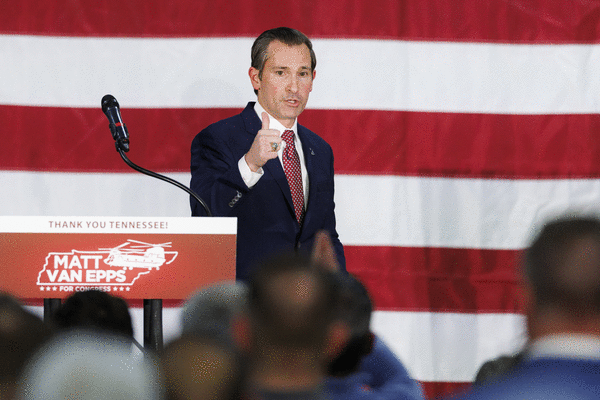
Democrats may not have pulled off the political upset of the 21st century in the recent special election in Tennessee, but Republican Matt Van Epps’ single-digit margin of victory in a much-watched Seventh District congressional race should give his party pause.
The GOP candidate should have won by at least twice as much, given the district’s distinctly conservative leanings. But 34-year-old progressive Democrat Aftyn Behn, a state lawmaker, struck a nerve with a campaign that focused on affordability and frustration with Washington.
Following strong Democratic showings in New Jersey and Virginia gubernatorial races last month, should Republicans be sweating next year’s midterms and the possibility of losing their slim House majority?
Absolutely. But don’t just listen to Nashville area voters to hear that message. Economic concerns show up in all sorts of voter polls. It’s clear that average folks, including MAGA enthusiasts, are worried about making ends meet.
How can the president change voters’ negative perceptions of the economy and boost his popularity numbers in a short period of time?
Lowering tariffs would probably help. But there’s one other possibility that some have floated, which he could pursue immediately without necessarily having much impact at all on those living in the Northeast or West Coast who traditionally vote for Democrats.
How? By raising the federal minimum wage to account for inflation.
It’s an idea that runs counter to GOP impulses to moderate wage growth. For starters, there is the belief that raising the minimum wage reduces jobs, incentivizes automation and stifles economic growth — many argue that paying people more makes the aggregate minimum wage workforce make less. There’s some truth to that.
In 2023, California stunned the nation, with Gov. Gavin Newsom signing into law a $20 minimum wage for fast food workers. Within a year, nearly 10,000 employees lost their jobs, and fast-food prices increased, in some places by nearly 10%.
As a first-time candidate for president, Trump opposed a $15 per hour minimum wage a decade ago. But the times have changed, and prices have gone up as a result of inflation. If the current federal minimum wage of $7.25 per hour instituted in 2009 were simply increased to compensate for inflation, it would be in the neighborhood of $14 to $15 today.
Of course, some states have less need of a higher minimum wage than others. The power of the dollar is different everywhere. For example, $100 in Baltimore goes 8.3% further than in New York. That’s why the Supplemental Poverty Measure was introduced in 2009 to take into consideration how far money takes you, even if you’re making less.
Over two-thirds of the states have raised their minimum wage. So, states like Maryland, where the minimum wage is already $15 an hour, would receive no benefit under a federal minimum wage increase to $15. Same with Massachusetts, the District of Columbia, Illinois, California, New Jersey, New York, Rhode Island, Washington and some others. Not so in Rep. Marjorie Taylor Greene country: Georgia follows the federal minimum wage as do states like Alabama, Idaho, Indiana, Iowa, Kansas, Kentucky, Louisiana, Mississippi and on.
A $7.25 minimum wage certainly cannot last forever. Think of what a meal or a gallon of gas would cost in the 1970s versus today. Over just the past decade, the purchasing power of the dollar has decreased by 35%.
We can acknowledge how unsustainable an unwavering minimum wage is while also acknowledging that not every state needs the higher $20, even $30-an-hour minimum wage that advocates in states like California have called for.
However, we may be at a point where Republicans can advocate for a sensible minimum wage and show you can be pro-worker and pro-business and perhaps even look like the grown-up non-socialist in the room.
____
Baltimore Sun editorial writers offer opinions and analysis on news and issues relevant to readers. They operate separately from the newsroom.
___
©2025 The Baltimore Sun. Visit at baltimoresun.com. Distributed by Tribune Content Agency, LLC.



















































Comments