Brutal cold puts US power grids on edge in wake of storm
Published in Weather News
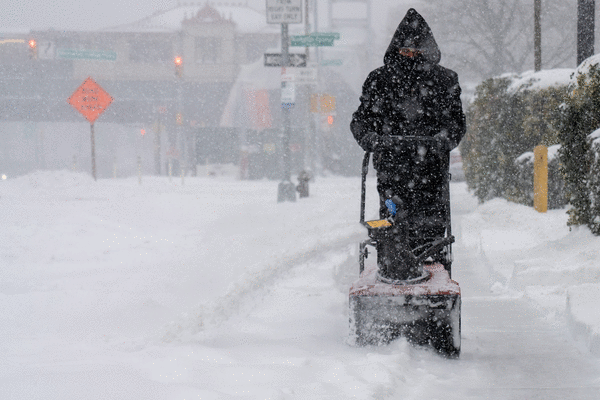
U.S. power grids are under mounting pressure following a winter storm that unleashed deep cold and heavy snow and ice from Texas to Maine, driving up heating demand and raising the risk of blackouts.
The storm affected millions of people across the eastern two-thirds of the United States, with 813,000 homes and businesses without electricity as of 11 a.m. New York time as snow and ice ravaged local distribution lines, according to PowerOutage.us. More than half of the outages were reported in three states: Tennessee, Mississippi and Louisiana.
So far, power grids have avoided large system-level cuts, but subzero temperatures and dangerous wind chills are set to linger all week, testing seasonal power demand records from Texas to New England. Some areas have reported extensive damage to trees and power lines and blocked roads, which could slow electricity restoration, said Nicole Joniak, a meteorologist at AccuWeather Inc.
“Power may take days to be restored across the hardest hit areas,” she said. “This will be especially dangerous, as temperatures will be well below historical averages across much of the eastern and central United States this week.”
PJM Interconnection — the operator of the largest U.S. grid, which stretches from New Jersey to Illinois — declared a Level 1 emergency for Tuesday, which means every power plant that serves the region is required to be ready to run full-tilt.
More than an inch of ice blanketed the Southern Plains and Southeast, including parts of Oklahoma, Louisiana, Mississippi and South Carolina, Joniak said. The northeast had the heaviest snow, with more than 23 inches in New Bethlehem, Pennsylvania. In New York City, 11.4 inches fell in Central Park, according to AccuWeather.
Airlines have warned about widespread and long-lasting travel disruptions in the wake of the storm. Around 4,700 flights were canceled Monday as of 10:20 a.m. New York time, according to FlightAware. That’s down from roughly 11,600 cancellations when disruptions peaked on Sunday.
While the cleanup and repair work begin in earnest, forecasters are already wary of another potential system that may develop along the East Coast next weekend, said Allison Santorelli, a forecaster with the U.S. Weather Prediction Center.
“It is too early to say exactly where, but with all this cold air in place it could bring snow to a lot of places in the east,” she said.
Wholesale power prices for the broader PJM grid hit $160 a megawatt-hour at 10:51 a.m. New York time. Meanwhile Virginia, which is home to the highest concentration of data centers in the world, was at a premium of about $228. Chicago, however, was at minus $115, signaling that some suppliers may have to pay others to take their megawatts because of excess electricity locally.
U.S. officials and grid operators have gone to extraordinary lengths to shore up the electricity network amid fears of a power supply crunch.
PJM warned it was facing seven straight days of unprecedented demand and pushed power plants to secure natural gas supplies through the week.
In Texas, the state grid operator is forecasting demand for electricity will rise to nearly 75 gigawatts on Monday. That’s unusually high for winter but lower than what the grid operator, the Electric Reliability Council of Texas, had said it was expecting previously. The state has ample power on hand to meet demand, according to ERCOT’s website. The grid operator had previously forecast Monday’s demand to hit 86 gigawatts, which would have broken a record set in August 2023.
Other grid operators have been obtaining waivers from some pollution limits so they can boost generation from dirtier power-plants such as diesel and coal. U.S. energy officials also asked grid operators to make backup power available from facilities including data centers.
Temperatures in many of the hardest-hit regions may only reach the teens and low-20s on Monday. The U.S. National Weather Service has warned that frigid temperatures could last into February across the eastern half of the country.
_____
(With assistance from Rachel Lavin, Priscila Azevedo Rocha, Brian Eckhouse, Julian Hast, Sing Yee Ong, Lauren Rosenthal, Mary Hui and Cedric Sam.)
©2026 Bloomberg L.P. Visit bloomberg.com. Distributed by Tribune Content Agency, LLC.






Comments