EPA chief vows federal support for Tijuana River crisis, voices confidence in Mexico
Published in Science & Technology News
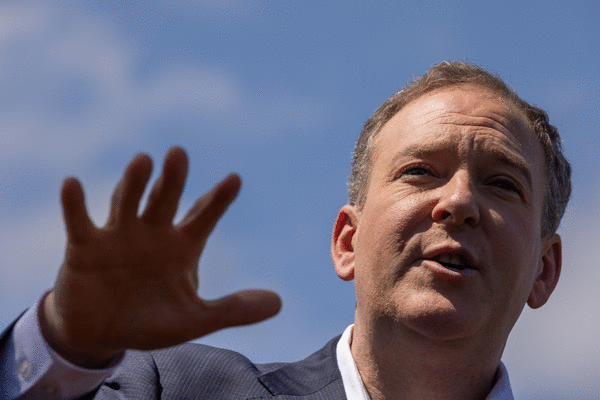
SAN DIEGO — Federal officials met in San Diego on Thursday to discuss the government’s response to the decades-long Tijuana River sewage crisis, with EPA Administrator Lee Zeldin expressing confidence in Mexico’s commitment to completing infrastructure projects aimed at ending years of cross-border pollution.
Speaking to reporters and local leaders in Coronado, Zeldin addressed the crisis that has resulted in billions of gallons of pollution being dumped into the ocean, causing beach closures and health issues for residents in South Bay communities.
“I have smelled the most awful of smells. I’ve seen contaminated land. I’ve seen contaminated water,” Zeldin said. “I look forward to going back to D.C., sitting down and assessing today’s visit, today’s asks, and finding out any other possible way that we can help.”
Millions of gallons of untreated wastewater flow daily from Mexico’s Tijuana River across the border into the United States, contaminating beaches near Imperial Beach and exposing nearby communities to toxic gases including hydrogen sulfide.
Zeldin said President Trump has taken a personal interest in the issue, particularly after seeing interviews about Navy SEALs training in contaminated water at Coronado. The administrator confirmed Mexico has met every target under the recently signed Minute 333 agreement between the two countries.
When pressed by reporters about his confidence in Mexico’s commitment, Zeldin said Mexico would hold up its end of the agreement.
“The smart thing for me to do here is to be as cautious as possible and to hedge and to leave myself all sorts of outs and not answer your question as candidly as I truly want to,” Zeldin said. “But I believe that Mexico is going to continue to meet these targets that they committed to.”
Zeldin emphasized the importance of identifying sustainable solutions rather than temporary fixes that waste taxpayer money. He noted that since his confirmation, the EPA’s primary focus has been stopping sewage from crossing the border.
He pointed out that Congress recently completed an appropriations bill that included additional border infrastructure funding, and future bills will likely include more requests for federal support.
“It’s very helpful to identify which projects … can result in sustained help and what type of an ask might be a bandaid,” Zeldin said. “The next time there’s infrastructure that breaks in Tijuana, next time that there’s a big wet weather event, all of a sudden those taxpayer dollars are just instantly washed away.”
Rep. Mike Levin, who attended the meeting, said Zeldin told officials he has been holding meetings twice a week on the issue since becoming administrator.
“On this issue, I applaud Administrator Zeldin, and we haven’t agreed on many things, but on this issue, I applaud his commitment and I applaud his dedication,” Levin said during an interview following the event.
The overall problem involves approximately 100 million gallons per day of sewage. The U.S. side is expanding the South Bay treatment plant from 25 million to 50 million gallons per day capacity by 2027, while Mexico has committed to handling the other 50 million gallons through projects outlined in Minute 333.
Levin said Congress has secured $653 million for the crisis since 2020, including $300 million through the USMCA trade agreement and an additional $353 million in subsequent years.
However, Levin emphasized a critical lesson from the 1990s when the South Bay plant was originally built with construction funding but inadequate maintenance budgets.
“It’s not just enough to build out the capacity of the plant and solve the problem for one period of time, but to ensure that every year we have that ongoing maintenance,” Levin said.
The visit drew some criticism from local advocates who argued federal officials should engage directly with affected residents rather than with the press and local officials. San Diego County Supervisor Paloma Aguirre sent a letter to Zeldin inviting him to meet with South San Diego communities.
“The crisis will not be solved in a conference room in Coronado,” Aguirre wrote. “It will be solved by engaging with the people who are on the ground studying the pollution, the physicians witnessing the health repercussions, and most importantly, the residents who are living with the consequences in our communities.”
The Tijuana River Coalition, representing more than 60 organizations, echoed that sentiment while acknowledging the federal attention. A hydrogen sulfide air quality alert was issued the day of the federal visit.
Levin expressed optimism that the EPA and federal government would maintain bipartisan cooperation to solve the crisis.
“Of course this is the Trump administration, anything is possible. But as I sat around that table, I felt very confident that this would continue to be a top priority for the EPA and for the Trump Administration,” Levin said. “And that is a good thing for all of San Diego.”
Zeldin was realistic about potential setbacks, noting infrastructure breaks and weather events could cause pollution before all projects are completed by 2028. However, he committed to quarterly public updates on progress.
“Whatever I can legally do to assist, I will,” Zeldin said. “I personally feel very invested in this effort.”
©2026 The San Diego Union-Tribune. Visit sandiegouniontribune.com. Distributed by Tribune Content Agency, LLC.






Comments