NASA Langley makes final preparations for Artemis II mission to launch around the moon
Published in Science & Technology News
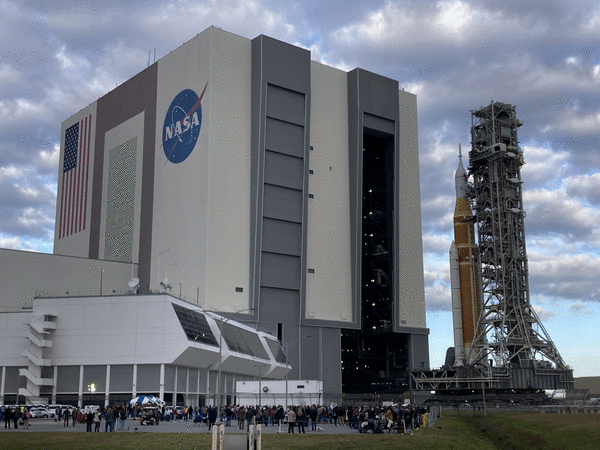
When Apollo 17 astronauts returned from the moon in 1972, they visited NASA Langley Research Center in Hampton, Virginia, to thank staff for their contributions to the mission, saying “we stood on the shoulders of giants as we shot for the stars.”
More than 50 years later, NASA Langley researchers are making final preparations to do it again as Artemis II prepares to launch a crewed flight around the moon in a few weeks.
The mission was originally scheduled to launch as soon as Sunday. But a hydrogen leak and issues fueling the rocket during a dress rehearsal on Monday, coupled with a limited launch window per month, is pushing the final launch back, according to David Piatak, who helps lead Langley’s Aeroelasticity Branch.
As he stood on a model of the moon’s surface, Piatak explained how Langley’s contributions will be most visible during Artemis’ initial launch. He said Langley led aeroscience testing for Artemis’ launch system to make sure the rocket gets off the ground, and its wind tunnels helped calculate how the rocket and other cargo remain stable and structurally sound upon entering orbit.
“Space is hard, and even though we’ve been doing this since Sputnik in ’57 and throughout the Apollo and shuttle years, to this day in 2026, the amount of energy that needs to be expended to get to orbit is enormous,” Piatak said. “All of that has to be engineered with such precision such that we don’t blow the whole thing up.”
Piatak had only recently begun his career at NASA when space shuttle Colombia killed its seven-member crew when it disintegrated upon reentry in 2003. His work has been focused on maximizing crew safety ever since. He was present during Monday’s faulty dress rehearsal at Kennedy Space Center in Florida, and said the test was still a success in giving NASA data to ensure opening night goes off without a hitch.
Much like how the aviation industry made traveling the world feasible in the 1920’s, Piatak said the the goal of Artemis II and future missions is to collaborate with the federal government and industry partners like SpaceX to create a space economy that pushes deeper into space and makes traveling the stars a feasible reality rather than science fiction fantasy.
“It’s us striving for excellence. It’s trying to push the boundaries and explore,” Piatak said. “It’s what humans are really good at.”
Meanwhile, research aerospace engineer Julia Cline pointed to a model of structures and rovers on the surface of Mars, and said lunar missions like Artemis II are a stepping stone to eventually get humans to the Red Planet.
Her group focuses on advanced future technologies like moon farm operations in an effort to create the infrastructure necessary to sustain a long-term presence on the moon and Mars. She pointed toward the surface models and said missions like Artemis I and II open the door for future missions to deliver cargo to the lunar surface to begin those projects.
“I would compare it to a similar setup to a city,” Cline said. “We need all the basic infrastructure: power, communication, data, a transportation system. So, we’re really thinking about how to build actual structures on the surface.”
When the agency began discussing building infrastructure on the moon more than four decades ago, the idea was to have astronauts build it themselves, according to Cline. Now, she said the advent of robotics allows the agency to pursue projects without putting astronauts in harm’s way from things like radiation, extreme temperatures or micro-meteors.
“There’s challenges associated with putting humans in certain areas of the solar system. We’re not designed to necessarily operate in a space environment,” Cline said. “It’s very harsh on a human body, and so we can send robots to areas where we cannot go.”
That infrastructure building, particularly in the realm of robotics, is where NASA Langley will contribute most to these future missions, according to Cline.
Ideally, robots will be responsible for assembling systems in orbit and completing other repetitive tasks so those structures will be in place before astronauts step foot on the surface, according to Cline. Langley is expected to shift its focus more toward figuring out how to support future deep space missions like Artemis, but it’s unclear how that will impact Langley’s science research.
“There’s a lot of interest from our stakeholders in having those systems assembled in orbit,” Cline said. “I think the thing that Langley contributes is we’ve got novel ideas on how to solve the challenges that will enable us to make it happen.”
NASA’s International Space Station has helped foster a low Earth orbit economy through commercial and research partnerships with companies like Blue Origin for roughly 20 years. Now, Cline said NASA, including Langley, will work to broaden that approach to the moon and beyond.
“The moon is the next step, and then on to Mars after that,” Cline said. “That’s really an interesting and worthwhile challenge to be able to move in that direction.”
_____
©2026 The Virginian-Pilot. Visit pilotonline.com. Distributed by Tribune Content Agency, LLC.






Comments