For injured sea turtles like 'Porkchop,' Southern California's Aquarium of the Pacific has doubled its care space
Published in Science & Technology News


LONG BEACH, Calif. — A hunk of romaine was easy pickings for Porkchop and her three flippers.
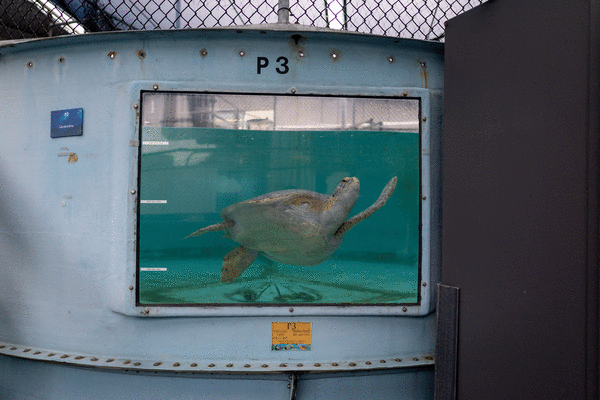
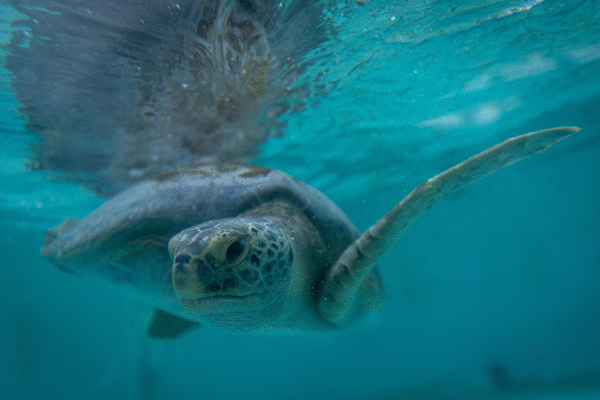
On a rainy day last week, the green sea turtle pumped her limbs and stretched her beak up to chomp a lettuce leaf floating on the surface of a tank at the Aquarium of the Pacific in Long Beach. That’s where she’s been on the mend since early March, when she arrived with a hook lodged in her throat and a flipper that was mostly dead from fishing line that had choked off circulation.
The 85-pound turtle earned her nickname from aquarium staffers when she quickly began eating after having her flipper amputated, and her enthusiasm for grub hasn’t waned.
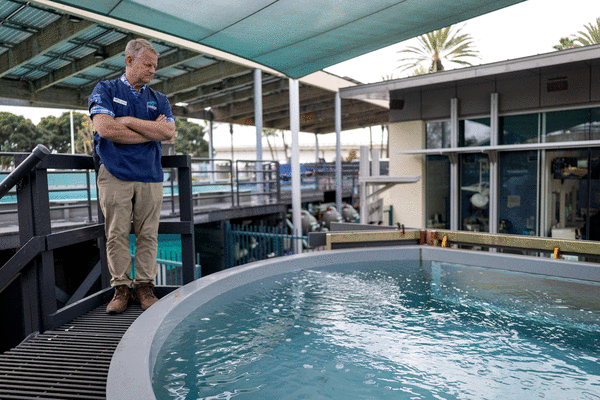
“She looks really good for what I can see through the window,” said Dr. Lance Adams, director of veterinary services for the aquarium, observing her through a viewing portal. “She’s maybe a little less graceful, but not substantially so.”
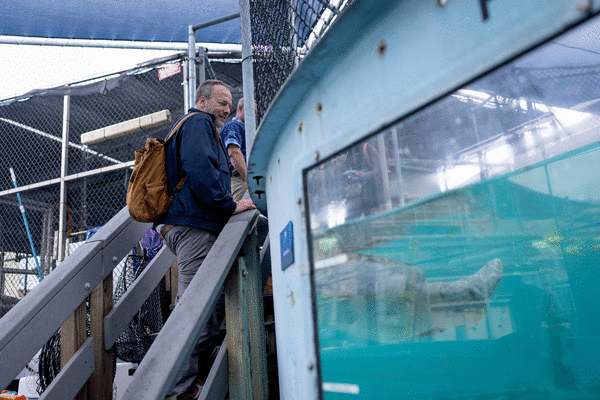
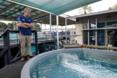
Starting Wednesday, aquarium visitors will be able to see Porkchop — and other sea turtles — be rehabilitated with the opening of a new area that includes a roughly 4,000-gallon pool.
The aquarium has been caring for ailing sea turtles for more than a quarter of a century, but this is the first time the public will be able to see the work in action. Staffers often help turtles that have swallowed plastic, been struck by boats, gotten stuck in areas they can’t get out of, or, like Porkchop, become entangled in fishing gear.
“The aquarium has a stellar reputation for being a community center [and a place] to bring children for education and learning,” aquarium President and Chief Executive Jeffrey Flocken said. “But one of the things I’d love to have people understand more is the great conservation work that we’re doing behind the scenes.”
Porkchop will spend only a short time in the spotlight. Soon, she’ll be released back into the San Gabriel River, where she was found and where a population of her kind resides — in a stretch where salt and fresh water comingle. (Yes, sea turtles live in L.A. County.)
“Turtles are very hardy healers,” Adams said. “They just take a while.”
That’s right, slow and steady wins the race. But there’s a biological reason: Sea turtles are cold-blooded, and don’t heal as fast as creatures with warm blood pumping through their veins.
The downside is that they can occupy space in a care facility for some time. If a turtle is in trouble and the aquarium is full, it has to go elsewhere. In Southern California, the aquarium is one of two places with dedicated space for turtle rehab (the other is SeaWorld San Diego).
With the new rehabilitation area, the aquarium is going from being able to treat one or two turtles at a time to up to four. That keeps pace with an increase in calls to help turtles after 2016, the year of a marine heat wave, dubbed “The Blob,” according to Flocken.
Part of the reason for the increase also might be a bump in awareness. In 2012, volunteers began monitoring Eastern Pacific green sea turtles that live near the mouth of the San Gabriel River, in the Long Beach-Seal Beach area, keeping tabs on the green behemoths that can grow up to 500 pounds and live more than 80 years. More than 100 turtles have been recorded there, and their numbers are on the rise. They forage in Southern California but nest and mate on the sandy beaches of central Mexico.
“It’s really neat that we have this local species that you wouldn’t think of here in Southern California,” said Cassandra Davis, director of volunteer services for the Aquarium of the Pacific.
It was a volunteer who spotted Porkchop, formally known as CM2502. Fishing line was wound around her right flipper and ran into her mouth. She was also attached to a medley of debris — clothes, algae, plastic.
When she came up for air, aquarium staffer Aaron Hovis jumped in and grabbed her. Once freed from the garbage, she was loaded onto a stretcher and brought to the aquarium.
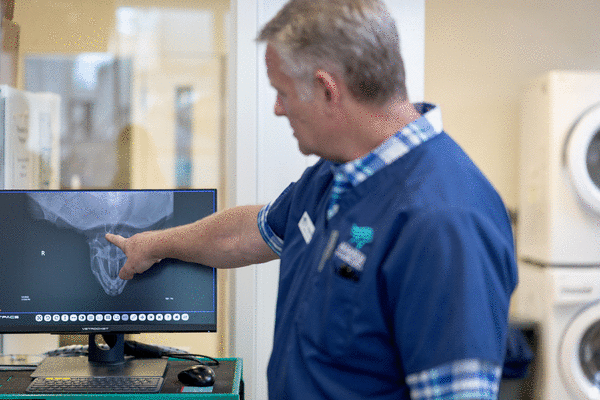
Ninety-percent of her flipper was necrotic, and veterinary staff promptly removed the dead tissue. An X-ray confirmed there was a hook in her mouth.
Not long after, she went through more procedures: one to amputate her damaged limb and another to cut through her neck to retrieve a fishing hook that had migrated to tissue outside the esophagus. Due to all the stress, she shed a lot of the outer scales of her shell, revealing soft ones underneath.
Porkchop has persevered through her travails. The roughly 15- to 20-year-old turtle’s blood work, appetite, behavior, weight and X-rays have all been “normal,” according to Adams.
Even down a flipper, she’s expected to be able to manage in the wild. Speed isn’t turtles’ forte and it’s not what keeps them safe; it’s their tough exterior.
She could go home in as little as two weeks.
“It’ll be really exciting to see her get back out into the wild but of course I’ll worry about her forever — getting tangled up again, or something else,” Adams said. “I hope she decides to swim back down to Mexico and stay where there’s less people.”
©2026 Los Angeles Times. Visit at latimes.com. Distributed by Tribune Content Agency, LLC.






Comments