Wolves and other predators present 'a crisis,' California's environment chief says
Published in Science & Technology News



SACRAMENTO, Calif. — California lawmakers on Tuesday took initial steps toward addressing the public safety concerns posed by the state’s growing populations of wolves, mountain lions and other predators — issues the state’s top environmental official called a crisis.
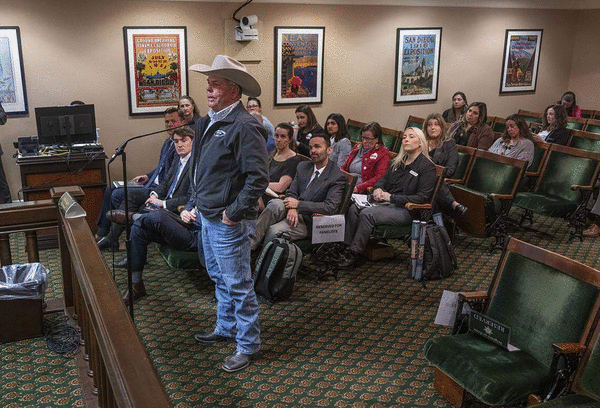
A packed hearing before the Assembly Committee on Water, Parks and Wildlife drew lawmakers from throughout the state and nearly 100 members of the public. They were there to begin discussions on how to protect both wildlife and people after a bloody spring and summer during which a single wolf pack killed 92 calves in Sierra Valley, stressing law enforcement resources and terrifying residents and local ranchers.
The hearing took place on the same day that a mountain lion was captured and tranquilized in an urban part of San Francisco and just weeks after a wolf killed an aging horse who was a family pet in Lassen County.
“This is a full-blown crisis in many of our rural communities,” Wade Crowfoot, California’s Natural Resources Secretary, told the lawmakers.
As California has succeeded in helping wolves, mountain lions, bear and other predators build or stabilize their populations with environmental protections, so-called human-wildlife conflicts have increased.
In 2024, a man in El Dorado County was killed by a mountain lion, and last year a mountain lion was euthanized after it killed four goats near a daycare center in Yuba County. In 2023 a Downieville woman was “eaten alive” by a black bear, Sierra County Sheriff Mike Fisher said.
Predator species are crucial to the state’s ecological systems, keeping populations of prey animals like deer and elk from growing too large and boosting biodiversity.
‘Human-wildlife conflict is not inevitable’
But California, with its dense population of 40 million people, is a particularly complicated place to manage the aspects of predator behavior that affect humans and livestock. About a third of Californians live in what’s called the wildland-urban-interface, where human settlements overlap with wildlife habitat like forests, mountain foothills or desert open space, Crowfoot said.
“Some level of wildlife sightings and interactions, given this overlap and proximity is inevitable,” he said. But “human-wildlife conflict is not inevitable.”
But finding solutions could be difficult — and expensive.
The state spent more than $2 million last summer trying to use nonlethal methods to chase wolves away from Sierra Valley. In the end, those methods failed, leading officials to kill four members of the Beyem Seo pack — one accidentally.
Human-wildlife conflict “is happening more and more frequently,” said Assembly member Diane Papan, D–San Mateo, who called for Tuesday’s hearing as chair of the Water, Parks and Wildlife committee.
Last year, Papan worked with ranchers to pass a bill allowing them to compost the carcasses of cattle killed by wolves so that the remains don’t simply stay on their properties and attract more predators and scavengers.
Although increasing funding for such programs may be difficult in today’s tight budget environment, Papan said resources clearly were needed to bolster the state’s efforts to help property owners repel predators. Increased use of technology to track wolves and coordinate communication could help ease tensions without costing too much, she said.
State programs aimed at helping communities pay for protections against predators such as installing improved fencing or training in nonlethal methods of controlling them have only been funded sporadically.
Stress for ranchers and community members
On Tuesday, most participants agreed in concept that the goal is to create an environment in which humans can live alongside wildlife, and where so-called nonlethal methods are used to keep predators away from homes, schools and livestock. Environmentalists argued that these methods, which include better fencing for farm animals and the use of rubber bullets, bean bags and pyrotechnics to frighten predators away, should be enough. But many rural residents say they also need to be able to kill the animals under certain circumstances.
Fisher, the Sierra County Sheriff whose jurisdiction was hardest-hit by wolf predations last year, is among those seeking law enforcement authority to euthanize some protected predators such as wolves and mountain lions when they pose a threat to humans and livestock.
The proximity of the Beyem Seo wolf pack to local ranching communities and their highly unusual focus on killing and eating livestock quickly became a public safety issue, Fisher told the committee, leading to high levels of stress among ranchers and community members and straining his small department’s resources.
“In rural California, wildlife conflict is not theoretical,” Fisher said. “It is not just about livestock. It involved repeated predator conflict near homes, predators losing fear of humans, and communities living under constant disruption and chronic stress.”
Nonlethal methods do not always work, as the difficulty with the Beyem Seo pack showed, he said. Fernando Najera, director of the California Carnivores Program at UC Davis, said that recent experience showed that mountain lions can learn not to be afraid of technology that once worked to frighten them away from people and livestock.
He showed a video of a mountain lion approaching a goat pen. As the feline approached, it triggered a device that emitted loud noises and flashing lights. The lion ran away. But on subsequent nights, the video showed, it did not run. The animal, Najera said, had learned that the flashing lights and loud noises were not actually dangerous.
To fund efforts to coexist
Still, representatives of environmental groups begged lawmakers not to make it easier to kill wolves, which are protected under both the state and federal endangered species acts, or the other predators. They urged them, instead, to better fund efforts to manage the animals by helping ranchers and others keep them at bay.
Anjali Ranadivé, daughter of Sacramento Kings owner Vivek Ranadivé, was one of several environmentalists who urged lawmakers to restore and increase funding for a program to support coexistence with wolves.
“Protecting wildlife protects what it means to be human,” she said. Several members of her organization, Women for Wolves, said they opposed the use of lethal methods to limit or respond to wolf attacks on livestock.
Rick Roberti, a Sierra Valley rancher who is president of the California Cattleman’s association, said the talk of coexistence without the option of taking assertive action to control wolves and other predators was difficult to hear after living through the strains and frustrations of the Valley’s summer of wolves.
“I‘m highly offended at some of the things I’ve heard, because not one out of these people lived through what we lived through this year,” he said.
Papan, the committee chair, said in an interview that she thought the legislature was unlikely to condone increased killing of predators, particularly protected species like wolves.
But Assembly member Heather Hadwick, R-Alturas, urged the state to take the concerns of her constituents seriously. Any successful effort at controlling wolves or other predators, she said, would depend on gaining the trust of all the people affected.
“The fear in our communities is not abstract,” she said. “These are places where people have been killed by bears and mountain lions, where families carry permanent loss.”
____
©2026 The Sacramento Bee. Visit at sacbee.com. Distributed by Tribune Content Agency, LLC.






Comments