Chicago's Brookfield Zoo leads effort to protect polar bears as Trump opens Arctic refuge to oil drilling
Published in Science & Technology News
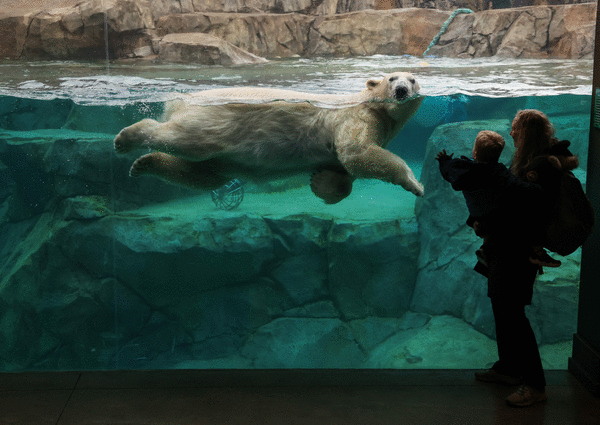
CHICAGO — Shortly after her arrival last fall, Amelia Gray met Hudson, and the pair hit it off immediately. They touched their noses together in greeting and chuffed — a soft, breathy, snorting sound that signals affection or reassurance. Amelia Gray rolled on her back, gently pawing at her counterpart. Later that same day, they played in the pool together.
The connection has fueled hopes at the Brookfield Zoo Chicago that the two polar bears will soon breed, offering scientists a glimpse into how mothers care for newborns inside their maternal dens — and, in the Arctic wilderness, where climate change already threatens their survival.
The usual challenges to studying polar bears in their natural habitat — a harsh climate, a vast, isolated territory and the dangers the massive predators pose to humans — have been further complicated after President Donald Trump in October announced plans to open 1.6 million pristine acres of the Arctic National Wildlife Refuge coastal plain in northeastern Alaska to leasing for oil and gas drilling.
The Trump administration’s move has rekindled a sense of urgency among conservationists, eliciting legal challenges from activists and advocates, as well as prompting a coalition of institutions, including Brookfield Zoo, to accelerate research efforts, especially because so much about the species’ reproduction remains unknown.
“That’s where zoos really have such a unique opportunity to really understand what takes place within that neonatal period with the cub,” said Mike Adkesson, president and CEO of the suburban zoo, “to understand what the bears need in terms of ideal terrain for the construction of that den, to understand breeding interactions and how a natural range space may be impacted by changes to wild landscapes.”
Climate change from fossil fuel extraction and burning has already significantly affected polar bears in the wild; their populations have rapidly declined as rising global temperatures melt polar caps and reduce the sea ice they need to hunt seals. Photos of bedraggled, emaciated polar bears floating on slabs of ice have become emblematic of the far-reaching impacts of climate change on wildlife. Since 2006, the species has been classified as vulnerable by the International Union for the Conservation of Nature.
But experts worry that drilling in the species’ natural habitat would accelerate their decline even more by further downsizing where they can roam and den, adding physiological stress on the mammals and altering their behavior. Currently, polar bears from the Arctic Ocean’s Beaufort Sea den at high densities in the stretch of coastal plain that is being opened to drilling.
“The frightening part is, they are a species that we’re seeing such dramatic declines in,” Adkesson said, “and it’s a species that we could conceivably lose from the face of the Earth in the next 100 years.”
Rita Stacey Vondra, who leads Brookfield Zoo’s animal care and community engagement teams, added, “And I’ll throw in there: Extinction is forever, and we’ll never get this species back if we don’t do something.”
‘Hope is now’
Spanning roughly 19 million acres in the northeastern corner of Alaska, the Arctic National Wildlife Refuge is one of the world’s last intact ecosystems. Located on the traditional homelands of the Iñupiat and Gwich’in peoples, the refuge is critical habitat for many migratory birds, caribou and polar bears.
The U.S. Geological Survey has estimated that its coastal plain contains between 4.3 billion and 11.8 billion barrels of recoverable oil. The low end of the estimate is less than the total crude oil production in 2024 in the United States, which was 4.6 billion barrels.
Institutions from the newly formed Polar Bear Population Alliance hope their collaborative efforts — to understand the repercussions of habitat disturbances on wild populations from drilling before they occur — can be used to inform policy around timing and siting for drilling, Adkesson said. How would the polar bears’ diets and their metabolism change in a smaller range? Would that, in turn, affect their reproductive success if they don’t have enough fat reserves to nurse their cubs?
The goal is to offer science-backed guidelines for rules and regulations, including time periods related to breeding and reproduction during which disturbances should be kept at a minimum, as well as areas where it is critical that drilling be avoided. Whether or not the government and fossil fuel companies would heed the advice is hard to predict.
“That would be the hope,” Adkesson said.
Collecting samples from even just a few bears in wild, remote areas, however, can be a painstaking, yearslong process. Research with captive polar bears can fill in that gap, supplying additional samples, Adkesson said.
At Brookfield Zoo, the polar bears — with some enticement — voluntarily take part in the research, offering their paws for blood draws and opening their massive jaws up for a mouth swab. They are trained multiple times a day to practice participating in their own care and medical evaluations. Specifically, researchers at the zoo are focused on the animal’s welfare and reproduction, such as figuring out smart pairings for breeding, as well as understanding what den designs best support successful births.
On a chilly January morning, senior animal care specialist Erin Hennessy stood in front of a grate door looking into Hudson‘s habitat. The male bear, having been summoned with a bell, approached at a lumbering pace.
“Paw,” Hennessy said, putting her hand against the metal. Hudson raised a large, furry front paw to meet her hand, earning a tasty spoonful of smooth peanut butter that he happily licked across the grating.
“That’s currently his favorite,” said Brianna Pohl, lead animal care specialist. “They need a reason to want to participate.”
Since 1948, the zoo has cared for generations of polar bears, with many born on-site like Hudson, 19 years ago. Besides him, the zoo’s polar bear population currently includes his potential mate, 9-year-old Amelia Gray, the female newcomer from the Oregon Zoo in Portland, and Hope, a 10-year-old female who made her local debut in 2021. The latter mated with Hudson last year, but despite spending October through December in a cozy den, no embryo implanted.
“She did sleep an awful lot, but unfortunately, she did not have any cubs born this year,” Vondra said. It prompted the search for another adult female to create a breeding group and let Hudson choose his mate.
Scientists at the zoo have also been studying polar bears that were at Brookfield years ago but have since left. In a recently published study, researchers carefully examined seven video recordings spanning almost four hours of mother Arki and her male cub, Kinapak, during the first month after he was born in December 2000, to understand denning behavior. Arki had mated with Aussie, who at one point was the oldest male polar bear in an accredited North American zoo, until he was euthanized at 32 in 2017. Two European zoos also provided more recent video footage used in the study.
“In the wild, this is the one time in a polar bear’s life that you can’t study and document their behavior,” said Lance Miller, one of the study authors and Brookfield Zoo’s vice president of animal welfare science. “This is impossible. And so the ability to have these amazing dens with the cameras right there, and be able to document and evaluate it — it’s pretty phenomenal.”
During the first three months of their lives, a critical period for development, polar bear cubs are entirely dependent on their mothers for thermal regulation and nursing, which happens inside the den. A frame grab from video footage out of Zoo Hannover in Germany shows a tiny newborn cub nuzzled against its mother’s neck as they slept.
“It’s just amazing to think about these 1,000-pound animals in the harshest climate you can imagine,” Adkesson said, “giving birth to a baby that, I always joke, is like the size of two sticks of butter —”
“I call it a Twinkie,” Vondra chimed in.
“— that it survives, that they have such intent maternal care that they’re able to nurse this helpless little life,” Adkesson said.
Scientists don’t know how climate change could shift denning locations and habitats, if at all, though declining sea ice may have adverse effects on females reaching traditionally preferred areas for the species. And, as winters shorten, female polar bears could be coming out of their dens earlier during their cubs’ development period, possibly affecting the offspring’s potential for survival, Miller said.
It’s important to understand how climate change affects polar bears, he added, to understand how it affects an entire ecosystem. As top predators in the food web, their removal would have “detrimental, ripple effects” on the biodiversity and health of their environments, Vondra said. And threats to polar bears, such as human encroachment and loss of sea ice, also threaten other species along the way.
“By the time you’re impacting that top tier, you’ve also had huge impacts and disturbances on everything else that falls into that ecosystem,” Adkesson said.
“And we don’t want to get to the point where there’s no hope,” Vondra added. “So, hope is now.”
Emotional connections
The average person in Chicago won’t ever get to see a polar bear in their natural habitat, Adkesson said.
“So we, as an organization, play such a key role in making that connection,” he added, “and helping people to see and appreciate and understand an animal that’s thousands of miles away and the conservation threats that are facing it.”
Joanne Moore, a zoo member and animal lover who houses old dogs, cats and horses in her DeKalb County farmhouse, visits every week and walks around the grounds for hours as a form of therapy.
Even though she has seen the polar bears plenty of times before, that cold January morning Moore witnessed something new. From a distance, she watched in awe as animal care staffers trained Hudson.
“This is very special, to see this,” she said. “You don’t often have the opportunity.”
Inside the other enclosure, Amelia Gray swam loops in the water, her fur rippling in gentle and mesmerizing movements. A mother and her young child approached the glass as the massive bear treaded water on the other side. The little boy put his hand up and offered a quiet “Hi.”
Miller recalled a study he did at Brookfield Zoo in 2019 to evaluate the emotional experience of visitors during a polar bear training. There were three groups: one that saw the session in person, another that saw it on video and a third that listened only to an audio recording from the training.
“What we found is that being able to see a polar bear up close and in person … you have that positive emotional experience, you actually retain information better,” Miller said. “You have more empathy toward wild polar bears, and you’re also more excited about getting involved in conservation.”
Adkesson said those connections are at the core of the zoo’s mission: “To help (people) appreciate the majesty of nature, to help them appreciate these incredible species that we share this world with.”
____
©2026 Chicago Tribune. Visit at chicagotribune.com. Distributed by Tribune Content Agency, LLC.






Comments