After switch from ULA, SpaceX set for speedy national security launch
Published in Science & Technology News
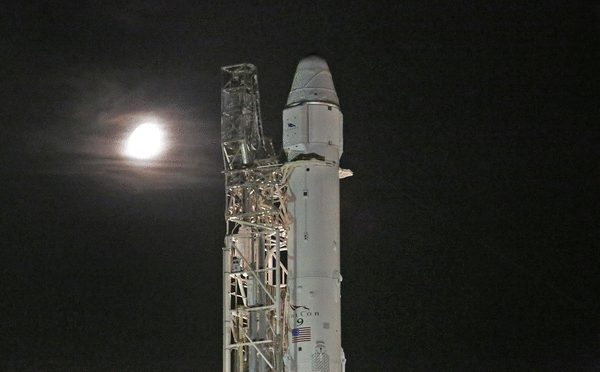
SpaceX is set to launch its latest national security mission, yet another GPS satellite that was originally to have been launched by United Launch Alliance.
A Falcon 9 that was delayed from Monday because of weather is now set to lift off Tuesday night on the GPS III-9 mission to bring the satellite to medium-Earth orbit from Cape Canaveral Space Force Station’s Space Launch Complex 40, targeting a 15-minute warning that opens at 11:38 p.m. A backup option falls to Wednesday night at 11:34 p.m.
Space Launch Delta 45’s weather squadron forecasts a 95% chance for good conditions Tuesday.
This will be the fifth trip to space for the first-stage booster, which will aim for a recovery landing downrange on the droneship A Shortfall of Gravitas, stationed in the Atlantic.
It’s the second national security mission of the year for SpaceX, which flew the NROL-105 mission from California earlier this month.
ULA had originally been awarded the GPS III-9 task order as part of the National Security Space Launch Phase 2 contract back in 2023, but as ULA’s new Vulcan rocket faced delays in certification, the Space Force beginning in 2024 began trading out assigned Vulcan missions.
ULA will in exchange take over the launch of another Phase 2 GPS mission that had been given to SpaceX and originally targeted to ride on a Falcon Heavy.
It’s the third GPS satellite that was taken from an original Vulcan assignment and switched to SpaceX following the Rapid Response Trailblazer launch in December 2024 and the GPS III-7 mission in May 2025.
This particular satellite, the Space Vehicle 09, is named in honor of NASA astronaut Col. Ellison Onizuka, who died aboard Space Shuttle Challenger on Jan. 28, 1986.
It’s the ninth of 10 satellites constructed by Lockheed Martin to add to the U.S.’s GPS capability in space. It’s also part of an accelerated mission timeline laid out by the Space Force for national security missions in which payloads get to space in under three months from the decision to go, compared to the normal turnaround that can take up to 24 months.
“For this launch, we traded a GPS III mission from a Vulcan to a Falcon 9, then exchanged a later GPS IIIF mission from a Falcon Heavy to a Vulcan,” said USSF Col. Ryan Hiserote, SYD 80 Commander and NSSL program manager. “Our commitment to keeping things flexible – programmatically and contractually – means that we can pivot when necessary to changing circumstances. We have a proven ability to adapt the launch manifest to complex and dynamic factors and are continuing to shorten our timelines for delivering critical capabilities to warfighters.”
This GPS satellite has been in Florida since July, but is on target to launch within six months of arrival.
“This mission represents an outstanding collaboration across multiple teams and agencies,” said U.S. Space Force Col. Stephen Hobbs, MD 31 commander. “It foot stomps our ability to rapidly deploy a high-value space asset, in this case, an additional M-Code-capable satellite that brings significant, immediate value to the Joint Force.”
ULA and SpaceX have shifted roles since the NSSL Phase 2 contracts were originally announced. The five years’ worth of task orders announced from fiscal 2020-2024 were to give ULA 60% of the assignments. All of those were supposed to fly on Vulcan, with its first launches to be completed by summer 2022.
To date, ULA has only managed to fly two of those 26 missions. The first had to shift to an Atlas V rocket in summer 2024 as Vulcan wasn’t certified until spring 2025.
ULA, which is a joint venture of Boeing and Lockheed Martin that formed in 2006, had originally been targeting mid-2020 for Vulcan’s debut. But it faced hurdles from COVID, acquisition of engines from supplier Blue Origin, delays from customer payloads and even a fiery test-stand incident that all contributed to a nearly four-year slide.
It flew for the first time in January 2024, but not again until that October, both as part of ULA’s efforts to get national security certification. An issue with a solid rocket booster motor detaching during launch on the second flight, though, delayed that certification until March 2025.
ULA did manage its first national security launch on a Vulcan last August and has its second, USSF-87, slated to fly as early as Feb. 12.
In the meantime, the NSSL Phase 3 task orders have mostly gone to SpaceX, with launches now being split into two lanes. All of the lane 1 missions, which feature less stringent requirements and are designed to allow for up-and-coming rocket companies to compete, have gone to SpaceX.
The more demanding lane 2 missions can only be flown by SpaceX, ULA and newcomer Blue Origin, although Blue Origin’s New Glenn has to complete four missions before its certification and as such has yet to be awarded any task orders.
The full five years’ worth of lane 2 missions is worth $13.7 billion for task orders assigned from 2025-2029. The expectation missions will be flown two to three years after assignment. The Space Force said the initial breakdown would dole out than $5.9 billion to SpaceX, more than $5.3 billion to ULA and nearly $2.4 billion to Blue Origin.
SpaceX would receive 28 of 54 planned missions, or 52%. Meanwhile, ULA’s take is only 19 missions, or 35%, while newcomer Blue Origin would get seven, or 13%.
_____
©2026 Orlando Sentinel. Visit orlandosentinel.com. Distributed by Tribune Content Agency, LLC.






Comments