California Coastal Commission approves land deal to extend last nuclear plant through 2030
Published in Science & Technology News
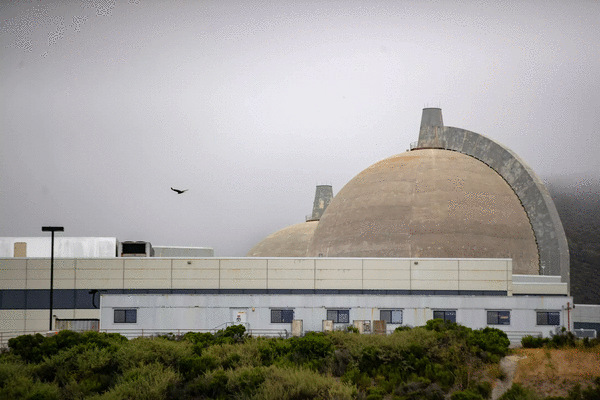
California environmental regulators on Thursday struck a landmark deal with Pacific Gas & Electric to extend the life of the state’s last remaining nuclear power plant in exchange for thousands of acres of new land conservation in San Luis Obispo County.
PG&E’s agreement with the California Coastal Commission is a key hurdle for the Diablo Canyon nuclear plant to remain online until at least 2030. The plant was slated to close this year, largely because of concerns over seismic safety, but state officials pushed to delay it — saying the plant remains essential for the reliable operation of California’s electrical grid. Diablo Canyon provides nearly 9% of the electricity generated in the state, making it the state’s single largest source.
The Coastal Commission voted 9-3 to approve the plan, settling the fate of 12,000 acres that surround the power plant as a means of compensation for environmental harm caused by its continued operation.
Nuclear power does not emit greenhouse gases. But Diablo Canyon uses an estimated 2.5 billion gallons of ocean water each day to absorb heat in a process known as “once-through cooling,” which kills an estimated 2 billion or more marine organisms each year.
Some stakeholders in the region celebrated the conservation deal, while others were disappointed by the decision to trade land for marine impacts — including a Native tribe that had hoped the land would be returned to them. Diablo Canyon sits along one of the most rugged and ecologically rich stretches of the California coast.
Under the agreement, PG&E will immediately transfer a 4,500-acre parcel on the north side of the property known as the “North Ranch” into a conservation easement and pursue transfer of its ownership to a public agency such as the California Department of Parks and Recreation, a nonprofit land conservation organization or tribe. A purchase by State Parks would result in a more than 50% expansion of the existing Montaña de Oro State Park.
PG&E will also offer a 2,200-acre parcel on the southern part of the property known as “Wild Cherry Canyon” for purchase by a government agency, nonprofit land conservation organization or tribe. In addition, the utility will provide $10 million to plan and manage roughly 25 miles of new public access trails across the entire property.
“It’s going to be something that changes lives on the Central Coast in perpetuity,” Commissioner Christopher Lopez said at the meeting. “This matters to generations that have yet to exist on this planet ... this is going to be a place that so many people mark in their minds as a place that transforms their lives as they visit and recreate and love it in a way most of us can’t even imagine today.”
The deal decides the fate of the rugged coastal landscape that surrounds the nuclear facility.
A map of California's coast near San Luis Obispo showing land proposed for transfer to state parks under a deal to keep Diablo Canyon Power Plant open. Highlighted areas are North Ranch at 4,500 acres, South Ranch at 2,500 acres, and Wild Cherry Canyon at 2,400 acres near Montaña de Oro State Park.
Critically, the plan could see Diablo Canyon remain operational much longer than the five years dictated by Thursday’s agreement. While the state Legislature only authorized the plant to operate through 2030, PG&E’s federal license renewal would cover 20 years of operations, potentially keeping it online until 2045.
Should that happen, the utility would need to make additional land concessions, including expanding an existing conservation area on the southern part of the property known as the “South Ranch” to 2,500 acres. The plan also includes rights of first refusal for a government agency or a land conservation group to purchase the entirety of the South Ranch, 5,000 acres, along with Wild Cherry Canyon — after 2030.
Many stakeholders were frustrated by the carve-out for the South Ranch, but still saw the agreement as an overall victory for Californians.
“It is a once in a lifetime opportunity,” Sen. John Laird, a Democrat, said in a phone call ahead of Thursday’s vote. “I have not been out there where it has not been breathtakingly beautiful, where it is not this incredible, unique location, where you’re not seeing, for much of it, a human structure anywhere. It is just one of those last unique opportunities to protect very special land near the California coast.”
Others, however, described the deal as disappointing and inadequate.
That includes many of the region’s Native Americans who said they felt sidelined by the agreement. The deal does not preclude tribal groups from purchasing the land in the future, but it doesn’t guarantee that or give them priority.
The yak titʸu titʸu yak tiłhini Northern Chumash Tribe of San Luis Obispo County and Region, which met with the Coastal Commission several times in the lead-up to Thursday’s vote, had hoped to see the land returned to them.
Scott Lanthrop is a member of the tribe’s board and has worked on the issue for several years.
“The sad part is our group is not being recognized as the ultimate conservationist,” he told the Los Angeles Times. “Any normal person, if you ask the question, would you rather have a tribal group that is totally connected to earth and wind and water, or would you like to have some state agency or gigantic NGO manage this land, I think the answer would be, ‘Hey, you probably should give it back to the tribe.’”
Tribe chair Mona Tucker said she fears that free public access to the land could end up harming it instead of helping it, as the Coastal Commission intends.
“In my mind, I’m not understanding how taking the land ... is mitigation for marine life,” Tucker said. “It doesn’t change anything as far as impacts to the water. It changes a lot as far as impacts to the land.”
The deal has been complicated by jurisdictional questions, including who can determine what happens to the land. While PG&E owns the North Ranch parcel that could be transferred to State Parks, the South Ranch and Wild Cherry Canyon are owned by its subsidiary, Eureka Energy Company.
What’s more, the California Public Utilities Commission, which regulates utilities such as PG&E, has a Tribal Land Transfer Policy that calls for investor-owned power companies to transfer land they no longer want to Native American tribes.
In the case of Diablo Canyon, the Coastal Commission became the decision maker because it has the job of compensating for environmental harm from the facility’s continued operation. Since the commission determined Diablo’s use of ocean water can’t be avoided, it looked at land conservation as the next best method.
This “out-of-kind” trade-off is a rare, but not unheard of way of making up for the loss of marine life. It’s an approach that is “feasible and more likely to succeed” than several other methods considered, according to the commission’s staff report.
“This plan supports the continued operation of a major source of reliable electricity for California, and is in alignment with our state’s clean energy goals and focus on coastal protection,” Paula Gerfen, Diablo Canyon’s senior vice president and chief nuclear officer, said in a statement.
But Assemblymember Dawn Addis, a Democrat, said the deal was “not the best we can do” — particularly because the fate of the South Ranch now depends on the plant staying in operation beyond 2030.
“I believe the time really is now for the immediate full conservation of the 12,000 (acres), and to bring accountability and trust back for the voters of San Luis Obispo County,” Addis said during the meeting.
There are also concerns about the safety of continuing to operate a nuclear plant in California, with its radioactive waste stored in concrete casks on the site. Diablo Canyon is subject to ground shaking and earthquake hazards, including from the nearby Hosgri Fault and the Shorline Fault, about 2.5 miles and 1 mile from the facility, respectively.
PG&E says the plant has been built to withstand hazards. It completed a seismic hazard assessment in 2024, and determined Diablo Canyon is safe to continue operation through 2030. The Coastal Commission, however, found if the plant operates longer, it would warrant further seismic study.
A key development for continuing Diablo Canyon’s operation came in 2022 with Senate Bill 846, which delayed closure by up to five additional years. At the time, California was plagued by rolling blackouts driven extreme heat waves, and state officials were growing wary about taking such a major source of power offline.
But California has made great gains in the last several years — including massive investments in solar energy and battery storage — and some questioned whether the facility is still needed at all.
Others said conserving thousands of acres of land still won’t make up for the harms to the ocean.
“It is unmitigatable,” said David Weisman, executive director of the nonprofit Alliance for Nuclear Responsibility. He noted that the Coastal Commission’s staff report says it would take about 99 years to balance the loss of marine life with the benefits provided by 4,500 acres of land conservation. Twenty more years of operation would take about 305 years to strike that same balance.
But some pointed out that neither the commission nor fisheries data find Diablo’s operations cause declines in marine life. Ocean harm may be overestimated, said Seaver Wang, an oceanographer and the climate and energy director at the Breakthrough Institute, a Berkeley-based research center.
In California’s push to transition to clean energy, every option comes with downsides, Wang said. In the case of nuclear power — which produces no greenhouse gas emissions — it’s all part of the trade off, he said.
“There’s no such thing as impacts-free energy,” he said.
The Coastal Commission’s vote is one of the last remaining obstacles to keeping the plant online. PG&E will also need a final nod from the Regional Water Quality Control Board, which decides on a pollution discharge permit in February.
The federal Nuclear Regulatory Commission will also have to sign off on Diablo’s extension.
©2025 Los Angeles Times. Visit at latimes.com. Distributed by Tribune Content Agency, LLC.






Comments