The Secret Lives of Indoor Cats
Published in Cats & Dogs News
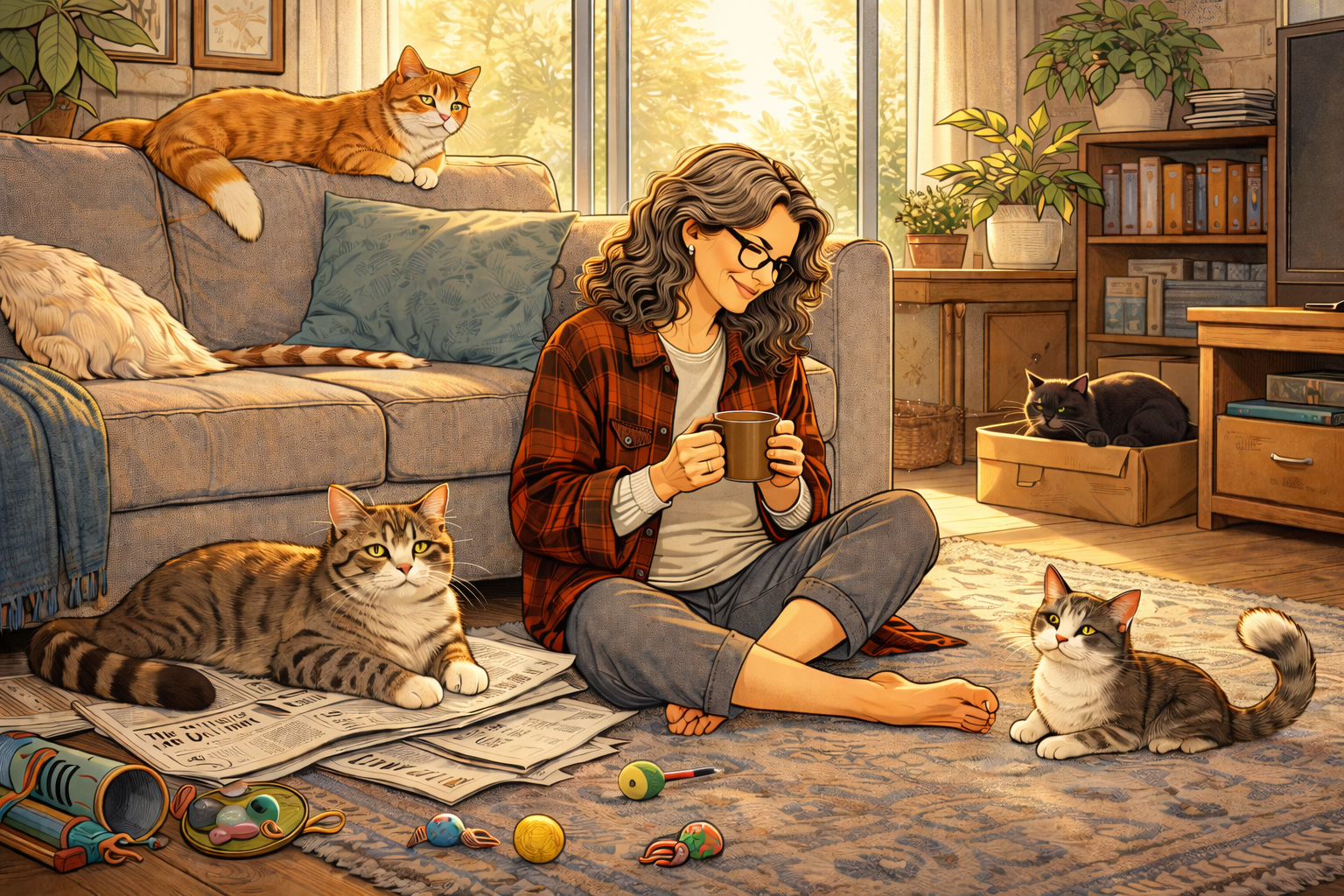
The cat does not pace. It does not wait. It does not wonder what comes next. It occupies, with quiet certainty, the exact place it has chosen—and in doing so, reveals a world most humans move through without ever truly seeing.
Indoor cats, often dismissed as idle or sheltered, live within a complex geography of habit, instinct and subtle control. Their lives unfold not in broad gestures, but in precise, repeated acts that transform ordinary homes into layered territories of meaning.
THE MAP YOU CANNOT SEE
To the human eye, a living room is a single space. To an indoor cat, it is a network of zones, each with purpose and hierarchy.
The back of the couch is not simply furniture; it is a raised observation platform. The patch of sunlight that appears at 2:17 p.m. is not incidental; it is a scheduled event. The corner of a desk, cleared for work, becomes a contested border the moment a laptop opens.
Cats move through these spaces with intention. They revisit locations at predictable intervals, reinforcing invisible boundaries. A chair is not “sat on”—it is claimed. A windowsill is not decorative—it is a surveillance post, tracking birds, wind, and distant motion.
Over time, these choices accumulate into a map that only the cat fully understands. Humans, though they believe themselves to be in charge, are merely tolerated inhabitants moving through a system already in place.
THE SCIENCE OF INCONVENIENCE
Among the most studied—and least understood—behaviors of indoor cats is their tendency to occupy precisely the space a human intends to use.
A sheet of paper placed on an otherwise empty desk becomes immediately desirable. A keyboard in use attracts a cat with uncanny speed. The moment a human settles into a chair, a cat appears, either to displace or to annex.
Experts suggest several explanations: warmth, attention-seeking, or curiosity. But observation suggests something more refined.
Cats are drawn not just to objects, but to *focus*. Wherever human attention gathers, the cat follows—not to share in the activity, but to redirect it. The act is less interruption than recalibration.
The message is simple: what you are doing matters less than where you are doing it. And where you are doing it, the cat has already decided.
THE NOCTURNAL COUNCIL
If daytime reveals the cat’s geography, nighttime reveals its society.
Owners frequently report sudden bursts of activity in the early morning hours: running, leaping, vocalizing, and unexplained collisions with unseen forces. These episodes, often dismissed as random energy, follow patterns that suggest coordination rather than chaos.
Multiple-cat households exhibit synchronized movement, as if responding to cues inaudible to humans. Even solitary cats engage in repeated circuits, tracing routes that echo daytime patrols but with heightened urgency.
The theory, half in jest and half in earnest, is that these hours constitute a kind of meeting—a nightly reaffirmation of territory, hierarchy, and purpose. Whether chasing shadows or each other, the cats are not merely playing. They are participating in a system that does not require human understanding.
THE HUMAN, AS ASSESSED
Within this system, the human occupies a clearly defined role.
Food provider, door operator, source of warmth—these functions are essential, but they do not confer authority. Instead, they place the human within the cat’s structure as a managed resource.
The cat’s expectations are precise. Meals must arrive on time, regardless of clocks or schedules. Doors must open when requested, even if the request is immediately withdrawn. Laps must be available, but not presumptively offered.
Failure in any category results not in anger, but in correction. A stare held too long. A paw extended with measured insistence. A vocalization calibrated to escalate only as needed.
It is not punishment. It is feedback.
THE OBJECTS THAT MATTER
In a home filled with toys, beds, and carefully chosen comforts, the indoor cat often selects something else entirely.
A crumpled receipt. A twist tie. A cardboard box that once held something far more valuable than itself. These objects, overlooked by humans, become the center of intense, if temporary, devotion.
The pattern is familiar. Weeks of indifference are followed by sudden fixation. The object is chased, carried, defended, then—just as abruptly—abandoned.
What defines these choices remains unclear. Texture, scent, unpredictability—all play a role. But there is also an element of discovery. The object is not valuable because it was given. It is valuable because it was *found*.
In this way, the indoor cat recreates a version of the hunt within the confines of domestic life.
AGE AND AUTHORITY
Not all cats occupy their world in the same way. Age introduces a visible shift, from kinetic exploration to settled command.
Young cats move as if testing the limits of space itself. They leap, sprint, and collide with a disregard for consequence that borders on exuberance. Every object is new. Every surface is negotiable.
Older cats, by contrast, move less—but mean more. Their routes are shorter, their choices more deliberate. They do not need to explore; they already know.
Where a young cat claims space through motion, an older cat claims it through presence. A single, well-chosen resting place can hold more authority than a dozen frantic circuits.
The household adjusts accordingly. Energy yields to gravity. Chaos yields to certainty.
THE QUIET NEGOTIATION
For all their independence, indoor cats do not exist apart from their humans. Their lives are intertwined in a continuous, largely unspoken negotiation.
A human shifts position to avoid disturbing a sleeping cat. A cat adjusts its weight to remain balanced on a moving lap. These small accommodations accumulate into a shared rhythm.
It is not ownership, and it is not submission. It is coexistence, shaped by repetition and mutual adaptation.
The cat does not learn the human’s world. The human learns the cat’s.
And in that learning, something subtle changes. The house feels different. Time feels different. Attention narrows, sharpens, becomes more deliberate.
The cat, having altered nothing outwardly, has altered everything.
========
Leland R. Kettering is a features writer focused on everyday systems, domestic behavior, and the unnoticed structures of daily life. He lives in a quiet coastal town where the furniture is not entirely his. This article was written, in part, utilizing AI tools.








Comments