Here's why Ford, GM are approaching autonomous vehicles differently
Published in Automotive News
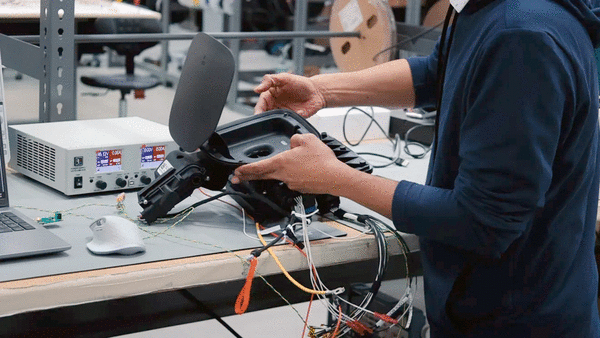


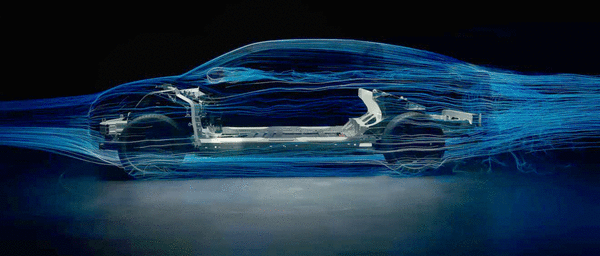




Detroit automakers say increasingly autonomous and software-defined vehicles will arrive in showrooms in the next couple of years, but how they're achieving that status and rolling out the technology follows two different approaches.
Both Ford Motor Co. and General Motors Co. have pegged 2028 for the launch of Level 3 automated driving systems, which allow drivers to take their eyes off the road. Ford will debut the technology on its new Universal Electric Vehicle platform that starts with an affordable midsize pickup, but GM will launch its system on the electric version of its flagship Cadillac Escalade SUV. The electrical architectures behind each of their systems also differ, underscoring priorities around costs, manufacturing and quality processes and commercial vehicles.
Car buyers are demanding affordability, but also features that improve convenience, safety and personalization. The pressure is high for global automakers as they strive to offer innovative, reliable technologies at accessible costs. The result is varying approaches in product development and the price points at which they launch the technology.
"If you think about Ford's ethos, it's making things accessible and affordable and still fun," said Jae Park, Ford's vice president of digital product design for EV digital design. "Efficiency is our job so that affordability and access is available."
Ford had highlighted the launch of its Level 3 automated driving system on its Universal Electric Vehicle Platform — which makes it debut next year under the midsize truck set to start at $30,000 — as a step toward "democratizing" AV technology. The UEV electrical architecture supporting the driving system is one of three Ford has in development as it balances costs, various powertrains and unique needs of consumers from the retail side to commercial.
Meanwhile at GM, the Cadillac Escalade IQ EV that first will get access to Level 3 automated driving starts at nearly $130,000. The company, however, said it plans to expand the availability of that central computing platform and the driving system beyond that and to various powertrains.
The rollout of software-defined vehicles and autonomy has its challenges. Many consumers remain skeptical of increasingly automated driving functions, while expecting personalized features that make accomplishing tasks in the car easier and more enjoyable. The company that follows through on its strategy has the potential to unlock higher demand, pocket fatter margins and lower costs.
"It's not about whether GM’s decision is right and Ford’s decision is wrong," said Stephanie Brinley, principal automotive analyst covering North and South America for the Auto Intelligence service at S&P Global Mobility. "It's: How do you execute on the decision you’ve taken?"
Feature or luxury?
Ford hasn't said at what price point Level 3 autonomy will be available in 2028. But executives have said they are seeking to "democratize" it like how Henry Ford's invention of the moving assembly line brought vehicle ownership to the masses.
"Fundamentally the question becomes: What are you selling?" said Paul Costa, Ford's executive director of electronics platforms. "Is L3 a luxury, or is it a feature? Because if it's a luxury, you put it on an expensive vehicle. You just count on the fact that those customers don't really care about how much high-end features cost, and they'll just buy it. But if you're going to put it on a vehicle like UEV, it's not a luxury, it's a feature. We have to treat it as such and not turn the vehicle into a luxury vehicle, just because we want to support this feature."
Sammy Omari, Ford's executive director of advanced driver assistance systems and in-vehicle infotainment, emphasizes that the ability to engineer eyes-free technology at an accessible price point allows it to launch on a greater number of vehicles sooner. That means more data on the system's performance from which developers can learn.
"We're very excited about that flywheel," Omari said, "because the more customers that use it, the more we understand how our customers are using it, and then, we can go improve it."
Starting with the all-electric Escalade, GM will launch Level 3 on a flagship product similar to what it did with the launch of its Level 2 hands-free Super Cruise system. The proliferation of that technology took some time, but eventually expanded across the automaker's portfolio.
For Level 3, GM already has a base from Super Cruise and the Level 4 robotaxi system from its now-defunct Cruise LLC self-driving car unit. GM expects adoption to follow an S curve with steady growth as the company understands the best way to integrate it and then a more aggressive adoption across its product line.
"The design of the Escalade IQ has given us a strong foundation to add the hardware without increasing the cost of the vehicle substantially," GM spokesperson Kellie Van Maele said in an email. "Ultimately, we’re optimizing tech for every vehicle, price point, and use case."
Electrified vehicles first came to market as smaller, commuter vehicles with fuel economy benefits. Sales struggled. But when Tesla Inc. launched EVs as tech-savvy, premium models, they became status symbols and increasingly desirable.
Ford's Omari said improvements to BlueCruise, the Blue Oval's Level 2 hands-free driving system available on a number of vehicles in its lineup, have pushed its usage rate beyond 30%, showcasing the importance of the improvement flywheel. He also noted that once consumers buy an EV, they often stick with EVs. Autonomy is similar.
"If you look at our customer data, what we see is: It's this first moment of letting go of the steering wheel," Omari said. "That is a moment that can be relatively emotional, like, 'Hey, can I let go the steering wheel?' And now the car drives itself."
Once customers get over that initial hurdle, he said, they understand better the value of the technology: "By getting this into many hands, and giving those people the opportunity to experience it, we see that once they do have a good experience, then usually things are sticky."
Zonal vs. centralized computing
Deciding to launch the technology accessibly is one thing. Developing the product that makes that possible is another. Ford executives declined to provide details on the hardware specifics on the Level 3 autonomous system, but Ford follows other automakers likes Tesla, EV startup Rivian Automotive Inc. and a few Chinese brands in adopting a zonal electrical architecture for the UEV.
The in-house-developed architecture features five main computers, or electronic control units, located throughout the vehicle in different zones to control the various electrical functions from tailgate lights in the back to windshield wipers in the front. This represents a decrease in the number of often supplier-provided modules in existing vehicles, requiring less wiring and allowing for speedier, less complicated over-the-air updates that keep a vehicle functioning properly.
GM's central computing platform takes the zonal architecture one step further by integrating all of the functions under one single main "brain." It takes computing across dozens of modules in current vehicles to a few high-performance compute units. The Detroit automaker plans to use the platform across internal combustion engine and EV vehicles to limit complexity and boost scale for lower costs and faster rollouts.
"This unlocks faster decision-making, simpler updates, and richer features without the latency or fragmentation that comes from spreading compute across multiple zones," Van Maele said about GM's centralized vehicle computing platform. "It’s built for scale and futureproofed for AI-heavy workloads."
That commonization of the advanced electrical architectures will offer GM benefits in bringing products to market, said Sam Abuelsamid, vice president of market research at automotive communications firm Telemetry Agency: "We're not seeing it come to the rest of the Ford lineup as quickly as what GM is going to do it."
At the January CES consumers electronics trade show in Las Vegas, Ford introduced its new vehicle compute center, the brain behind the UEV platform. The single, powerful module centralizes control of infotainment, advanced driver assistance systems, audio and networking. That can be brought to vehicles of various powertrains, Costa said.
Not having zonal modules supporting one central computer, however, comes with challenges, he said: "If you were to take that to its logical extreme and just have one central computer that did everything, you would create a wiring nightmare for the vehicle, because every light, every switch, everything would have to go all to the center of the vehicle. It'd be a very difficult vehicle to build. It'd be expensive wiring. Exactly the kind of things that we don't want for UEV. We want an easy-to-assemble, simple, elegant architecture."
The zonal architecture strikes the balance between hardware and software simplicity, he added.
Domain-based vs. zonal
The zonal electrical architecture, however, isn't the only one Ford is developing, Ford CEO Jim Farley said at the Detroit Auto Show. In addition to the UEV architecture, Ford is developing two other advanced electrical architectures.
"Taking an advanced electric architecture to an F-150, that's some work that's never really been done in our industry before," he said, noting the focus has been on all-electric EVs. "Our plans are very aggressive, where we have three new electric architectures across our company. One will be with the UEV, which will be purely zonal. We have also an electric architecture for the next generation of our multi-energy vehicles, including the F-150, plus EREVs and hybrids across our lineup. And then, we have one other."
EREVs (e-revs) are extended-range electric vehicles. Unlike hybrids, they operate fully off a battery, but they have a gas engine onboard to recharge the battery. The next-generation F-150 Lightning truck will launch as an EREV.
The complexity for the full-size F-Series trucks with a zonal architecture is the amount of customization needed for those products, Costa said. A more traditional domain-based architecture for now remains the best solution, he said.
Engineers identify modules in a zonal architecture by their location in a vehicle like front right or left rear. For a domain-based architecture, modules are characterized by their function such as controllers for doors, the tailgate, or lighting.
Zonal is great if features from vehicle to vehicle are similar like Ford intends for the smaller EVs built off the UEV Platform, Costa said. But for vehicles highly customized like Ford's trucks, a domain-based architecture offers configurability benefits.
Upfitters are third-party manufacturers that take a vehicle and add other equipment to it often for commercial applications like for plumbers, contractors, ambulances and cranes. They are a big growth area for Ford Pro, Ford's profit margin-beast commercial division supplying businesses, governments and car rental companies.
"We're not seeing advantages in the near-term with today's zonal architectures on our larger trucks," Costa said. "Having a module that is specific to a tailgate actually has advantages. When you're going to be making dump trucks or something like that, that's not going to have a tailgate. You want that electronics to come out easily."
On the software side, it also adds complexity in a zonal architecture, which has limited customization options on vehicles available today with that platform.
"They can't build a Super Duty on that architecture today," Costa said. "Maybe someday in the future we'll be able to, but currently, domain-based architectures are serving Super Duty really well."
©2026 www.detroitnews.com. Visit at detroitnews.com. Distributed by Tribune Content Agency, LLC.







Comments