Appreciation: Catherine O'Hara was an onscreen benediction
Published in Entertainment News
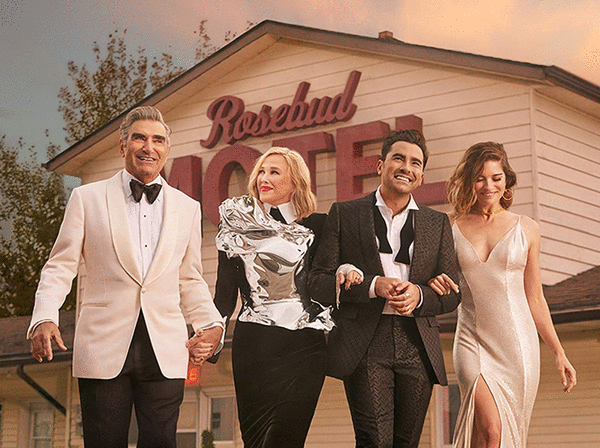
It is painful to have to write about Catherine O'Hara, so alive and lively a presence, in the past tense. O'Hara has lived inside my head — is it too corny to say my heart? — from "SCTV" to "Schitt's Creek" to "The Studio," on whose second season she was scheduled to start work, when she died, Friday at 71.
Any appearance constituted a recommendation for — a benediction upon — whatever she was appearing in; you felt she would only say yes to things that used her well, that sounded fun or interesting, and that her casting reflected well on the project and people who cast her. I think of her not as a careerist, but a Canadian. Of joining "Schitt's Creek," she said when I interviewed her in 2015, "it took me a few moments to commit, (but) I already trusted (co-creator, co-sta) Eugene (Levy) as a writer and an actor, and as a good man who I could stand to spend time with."
This is how it began for her, in Toronto, where her brother Marcus was dating Gilda Radner, who was in "Godspell" with Levy and Martin Short. "And it was really watching Gilda when I realized, 'cause I'd always liked acting in school, that it was actually a local possibility. And then she got into Second City theater, and I was a waitress there — it's like I stalked her — and then she did the show for a while and then took on a job for the National Lampoon. So I got to understudy or take her place — I got to join the cast, and Eugene was in it. It was really just the luck of having a professional actor suddenly in my life."
As an "SCTV" early adopter, O'Hara was first attractive to me because she was funny, but she was also beautiful — a beauty she could subvert by a subtle or broad rearrangement of her features. Although fundamentally a comic actress, her characters could feel pained or tragic beneath the surface — even Lola Heatherton, one of her signature "SCTV" characters, an over-exuberant spangled entertainer ("I love you! I want to have your babies!" was a catch phrase) is built on desperation. Among many, many other parts, she played a teenaged Brooke Shields singing Devo's "Whip It!" Katherine Hepburn, a depressed Ingmar Bergman character, and, most memorably, chirpy teenage quiz show contestant Margaret Meehan, buzzing in with answers before the questions are asked, and growing tearfully undone as the host (Levy) becomes increasingly angry.
Elsewhere, she played a forgetful suburban mom in "Home Alone," the work for which she's arguably best known, given its ongoing mainstream popularity; an ice cream truck driver messing with Griffin Dunne in Martin Scorsese's "After Hours"; and a tasteless art snob and indifferent mother in "Beetlejuice," where she met her future husband, production designer Bo Welch.
She shone in three Christopher Guest movies, paired with Fred Willard in "Waiting for Guffman" as community stars; opposite Levy in "Best in Show," as a dog handler with a lot of ex-boyfriends; with Levy again in "A Mighty Wind," as a reuniting '60s folk duo; and in "For Your Consideration" as an aging actress dreaming of an Oscar. In the great Netflix miniseries "A Series of Unfortunate Events" (also designed by Welch), she played an evil optometrist, the sometime girlfriend of Neil Patrick Harris' Count Olaf, dark, cold, sexy.
Last year, she picked up a supporting actress Emmy nomination as a dethroned but not knocked down executive in "The Studio"; she's fierce and funny. And, though she was fundamentally a comic actress, she could play straight, as in the second season of "The Last of Us," penetrating opposite Pedro Pascal as his therapist, and the widow of a man he killed.
Lived in across six, ever-richer seasons of "Schitt's Creek," Moira Rose is certainly her crowning achievement, a completely original, Emmy-winning creation whose quirks and complexities were embraced by a wide audience; going forth, she'll be a reference to describe other characters — a "Moira Rose type" — with no explanation needed.
With her original, breathy way of speaking, stressing odd syllables and stretching random vowels to the breaking point, her mad fashions and family of wigs, Moira is a sketch character with depth. Of all the Roses, she's the one most resistant to adapting to their motel world, to coming down off the mountain, but she is as needy as she is condescending, and underlying her fantastic, tightly structured carapace is a fear that's terribly moving when it shows through the cracks.
"I like to think she's really threatened by this small-town life — because she's been there, you know?" O'Hara said back when the series began. "That just makes it more threatening in my mind. And I like to think of her as more vulnerable than just snobby or superior. I think it's way more insecure."
Her tentative acceptance of her circumstance, as well as the show's overarching arc, finds expression in the series finale, where, all white and gold, in flowing robes with long blonde locks cascading from beneath a bishop's hat, she tearfully conducts the marriage of her son, David (co-creator Dan Levy). Speaking of a sort of wind of fate, she says, "All we can wish for our families, for those we love, is that that wind will eventually place us on solid ground. and I believe it's done just that for my family in this little town, in the middle of nowhere." You might cry, too.
I had the luck to speak with O'Hara several times over the run of the series. The last was in Canada, a day or two before the last day of filming. We sat on the apron of the Rosebud Motel, looking across the muddy parking lot to where fans were gathered on the road above.
"They're there as much for each other as for us. It's almost that we don't have to be there, but we brought them together somehow." That's what actors and the stories they tell, give us — the joy, and sometimes the pain: A world of strangers, united in this awful moment, out of love for Catherine O'Hara.
©2026 Los Angeles Times. Visit latimes.com. Distributed by Tribune Content Agency, LLC.









Comments