'The Forest Service can't be that dumb' -- former Baltimore director decries closure plans
Published in News & Features
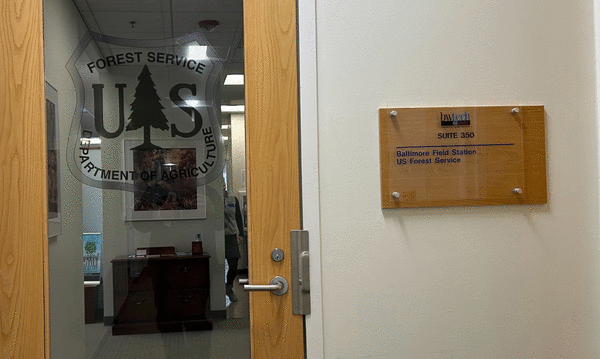
BALTIMORE — Baltimore’s Forest Service Urban Field Office will close sometime this year, according to a March 31 U.S. Department of Agriculture announcement. Employees at the Catonsville office say they still do not know when or how that will take place, or what will happen to them.
“Reorganization? More like disorganization,” one employee told The Baltimore Sun on Thursday. “We all got a letter about it, but it was filled with ambiguity. It’s been a challenge — fear, doubt, confusion, misinformation.”
He asked that his name not be used for fear of retribution.
“I was completely dumbfounded,” retired Baltimore field office director Morgan Grove told The Sun. “I thought, ‘The Forest Service can’t be that dumb.’ Of course, I feel terrible for the staff there who have dedicated their professional lives to the USDA Forest Service and to doing research for the American People. They believe their job is to produce research and data that is going to make the world a better place.”
The USDA announced the closures of at least 31 local offices at the end of March as part of a plan to “strengthen local leadership, streamline operations, and improve mission delivery.” Changes include moving headquarters to Salt Lake City, Utah, consolidating research activities at Fort Collins, Colorado, transitioning to a state-based leadership model and building a network of Operations Service Centers.
“The transition will occur in phases to ensure continuity of operations and to give employees time and clarity as decisions are made,” the statement reads
The USDA Forest Service declined to answer questions from The Sun, including how many employees are affected and when a detailed timeline would be released. Officials responded by emailing quotes included in their March 31 news release.
Agency plans include appointing 15 state directors to oversee local operations, the statement said. “This approach is intended to simplify the chain of command, strengthen local partnerships and give field leaders greater ability to respond to conditions on the ground.”
Grove said closing the Baltimore field office wastes a global model of how integrated, local forest research benefits surrounding communities. Work conducted here provided the world with new ways to measure urban trees, parks and forests, using NASA orbital assets that can distinguish trees from buildings and other hard surfaces. That research revealed how historic discrimination against Black neighborhoods shows up in their lack of trees, as well as trees’ connection to crime and public health, including how many people die during heat waves.
At 30 years old, the Baltimore office is one of the Forest Service’s original urban field offices, he said, responsible for the world’s longest-running urban watershed monitoring program — tracking the health of Gwynns Falls. Baltimore researchers partnered with the Baltimore City Division of Forests and Department of Public Works, pioneering programs to recover and reuse wood from trees downed by storms and demolitions of abandoned buildings and homes.
Grove said the agency’s justifications for consolidating offices in Salt Lake City, Utah, don’t make sense.
“The Forest Service said they need to relocate people to where the forests are. How many forests are in Utah?” he said. “The most heavily forested part of the United States is the Mid-Atlantic region and the Northeast, and they know that.”
Utah’s forests cover one-third of the state, according to a state forestry division publication. Maryland is 39% wooded, while forests cover half of the mid-Atlantic region — from Maryland to lower New York State — and 58% to 89% of states in the Northeast. America’s forested lands are concentrated in the South, Northeast, Lake States, Rocky Mountains and Pacific Coast, according to the Environmental Systems Research Institute, developer of the mapping tool ArcGIS.
An employee at the Baltimore office told The Sun they have not received any clear communications about when their office will close, or whether they will have to relocated to Utah or Colorado.
“This administration does not have a lot of respect for civil servants, or science, or research,” said one employee who asked to remain anonymous as she is not authorized to speak with the media. “We’ve heard that pretty loud and clear from the political leaders. They have treated us like trash.”
-----------
©2026 The Baltimore Sun. Visit at baltimoresun.com. Distributed by Tribune Content Agency, LLC.






Comments