Judge gives federal government 3 weeks to turn over evidence from Renee Good's killing
Published in News & Features
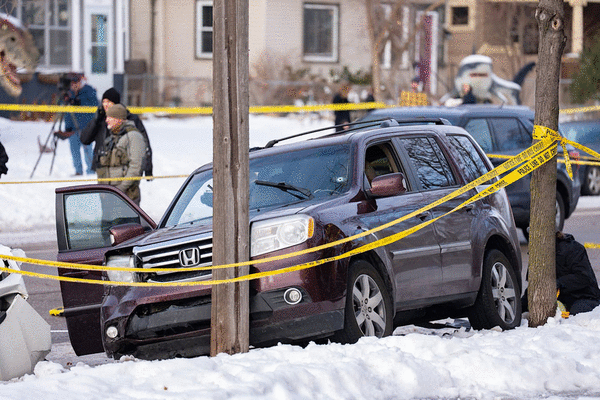
MINNEAPOLIS — A U.S. District Court judge in Minnesota ruled Thursday that multiple federal agencies have three weeks to produce troves of unredacted evidence related to the killing of Renee Good by federal immigration agent Jonathan Ross.
The evidence is similar to what the state of Minnesota is demanding from Good’s killing in an unprecedented lawsuit against the Trump administration filed last month in U.S. District Court for the District of Columbia. But the order releasing the evidence stems from the prosecution of Roberto Carlos Muñoz-Guatemala, who was convicted of assaulting Ross last year in a violent traffic incident in Bloomington.
Eric Newmark, the attorney for Muñoz-Guatemala, successfully argued that Good’s killing could produce new evidence related to Ross’ tactics that affects sentencing or the possibility of requesting a new trial.
Judge Jeffrey Bryan ordered the U.S. Attorney’s Office for Minnesota, the Justice Department, the Department of Homeland Security and Immigration and Customs Enforcement (ICE) to turn over the following evidence to the court so that a magistrate judge can review it for relevancy:
Muñoz-Guatemala was convicted of assaulting Ross after dragging him several hundred feet with his car on June 17, 2025. Ross was attempting to execute an immigration arrest in Bloomington and his arm was inside the rear window when Muñoz-Guatemala accelerated and attempted to flee. Ross required 20 stitches for a deep cut in his right arm and another 13 stitches in his left hand.
The Minnesota Star Tribune reported that Ross was the federal agent who shot Good on Portland Avenue on Jan. 7. In February, Muñoz-Guatemala asked for the disclosure of personnel and training information for Ross along with “the full investigative file” related to the fatal shooting of Good.
While the federal government objected to the disclosure of the evidence, Bryan ruled that Muñoz-Guatemala’s right to due process included the disclosure of any relevant evidence through the sentencing phase of his trial.
Federal guidelines also require the court to consider if any wrongful conduct by Ross contributed significantly to Muñoz-Guatemala’s decision to flee the scene. If it is determined that Ross’ conduct did play a role in Muñoz-Guatemala’s crime, “the court may reduce the sentence below the guideline range.”
“We’re really grateful for the order,” Newmark said. “We think this information is relevant to new trial motions or potential sentencing. A full accounting of Jonathan Ross’ behavior in this matter directly relates to this case.”
Messages seeking comment were left with the U.S. Attorney’s Office for Minnesota.
The order states that if any evidence is not available, the federal government needs to explain each missing item “and a brief description of the efforts undertaken to look for such evidence.”
Once the evidence is turned over, it will be reviewed by a magistrate judge to determine if it is relevant to Muñoz-Guatemala’s sentencing. If it is, the judge will “determine the most appropriate method and timing for any required disclosures.”
The federal government could move to vacate Muñoz-Guatemala’s conviction and dismiss the charges, but the presiding judge and defense would have to agree to it.
Legal efforts to recover information from Good’s killing have been ongoing since the federal government removed the Minnesota Bureau of Criminal Apprehension from a joint investigation into the shooting.
Both Ross and ICE initially agreed to a use-of-force investigation, according to a person familiar with the decision.
A high-ranking White House official overruled them.
The state of Minnesota, through Attorney General Keith Ellison, Hennepin County Attorney Mary Moriarty and Bureau of Criminal Apprehension Superintendent Drew Evans, sued the Trump administration on March 24 over the actions of federal agents during Operation Metro Surge.
The suit accused the top law enforcement agencies in the United States of withholding evidence from the killings of Good and Alex Pretti and the shooting of Julio Sosa-Celis to protect agents from potential criminal charges.
The Department of Homeland Security, responding to the lawsuit, said all three shootings remain under investigation, including the killing of Good, which Trump administration officials had previously said was not under investigation.
©2026 The Minnesota Star Tribune. Visit at startribune.com. Distributed by Tribune Content Agency, LLC.



Comments