COVID in Florida 6 years later: Another new variant, milder infections, fewer deaths and vaccines
Published in News & Features
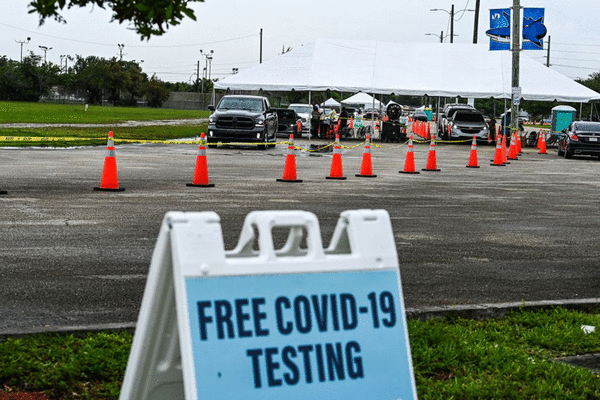
FORT LAUDERDALE, Fla. — Six years ago this month, Florida schools and beaches closed, cruise ships reported their first COVID outbreaks, and shoppers scrambled to get whatever toilet paper remained on the shelves.
Almost overnight, the COVID lockdown went into effect, triggering isolation of the elderly, drive-through testing sites and social distancing in public places.
A lot has changed since then.
Florida hospital emergency departments are no longer jammed with COVID patients, and the virus is no longer as deadly.
As of early 2026, COVID-19 has fallen out of the top 10 causes of death in the state.
Yet, a new variant has just surfaced in the U.S., known as BA.3.2, appearing in wastewater samples from 25 states including Florida, according to the Centers for Disease Control and Prevention.
It carries 70 to 75 mutations and may evade existing immunity. However, scientists say there is no evidence that BA.3.2 causes a different kind of illness. Like other recent variants, it appears to cause mostly mild, cold-like symptoms. Overall, COVID now looks more like the flu or a cold; people with mild cases experience sore throat, sinus congestion and runny nose, and those with more severe cases experience cough, fatigue, muscle aches, and shortness of breath. In the early days of COVID, people complained of losing their sense of taste or smell. That’s not happening as much anymore.
COVID infections are now milder, but some people are still being hospitalized from the virus — about 200 statewide as of March 21, according to the CDC.
Infectious disease doctors say those most at risk for severe disease remain the same. Adults over 65 and infants under 1 year old continue to be the most likely to be hospitalized. And risk increases with the number of a person’s chronic conditions.
What happened to those big COVID waves?
Across the country, COVID-19 activity is decreasing, and in Florida, it’s currently at a “very low” level, according to the CDC’s Respiratory Illnesses Data Channel updated on March 20.
Those big waves, spurred by new variants and subvariants that ripped through the state from 2020 to 2022, are no longer as concerning. From 2020 to today, each successive wave has been lower than the last, a pattern reflected in almost every metric, including hospitalizations, notes epidemiologist Katelyn Jetelina, author of Your Local Epidemiologist Newsletter. “We now reliably see two waves each year: one in winter, one in summer. But nationally over the past two years, the summer wave has been larger than the winter wave. We don’t know why.”
Tests have improved, but fewer people use them
Remember those long lines at Hard Rock Stadium and Florida parks to get tested for COVID?
They are long gone.
Instead, at-home COVID test kits are available at almost every pharmacy.
Tests are most accurate a few days into symptoms, not at the first sign of illness.
However, most people have stopped testing themselves unless they are sick enough to see a doctor, said Dr. William Schaffner, an infectious disease specialist and professor at the Vanderbilt University School of Medicine.
“If you are sick and go to a medical practitioner, you will be tested,” Shaffner said. “Patients themselves on their own are not doing testing, in part because the virus now is less severe. If you have a mild illness, you don’t want to get a test that requires you to stay home and miss school or work.”
Because of the immunity most people now have, the amount of time someone is contagious with COVID-19 still can vary. However, for the most part, “you’re contagious for the day before you get sick and then most contagious for the next two to three days,” Schaffner says. “It tapers off after that, but it’s not like a light switch.”
Still no perfect treatment for COVID
On a hot Florida day in the summer of 2021, Gov. Ron DeSantis announced he was opening yet another state-run monoclonal antibody clinic to treat COVID-19 patients.
That touted COVID therapy no longer works for more current variants. Instead, treatment focus has shifted primarily to antivirals like Paxlovid.
“Six years ago, we didn’t have that possibility,” said Dr. Aileen Marty, an infectious disease expert and professor at FIU Herbert Wertheim College of Medicine. “If you test and take that drug right away, then you’ve vastly reduced your risk of ending up severely ill.”
While Paxlovid remains effective at reducing the risk of severe disease, particularly for people over 65 and those with underlying conditions, be prepared to pay a sizeable sum for it. The government no longer subsidizes the medication.
Researchers are studying other COVID treatments, recognizing that Paxlovid has drawbacks and potential drug interactions. “Antivirals against COVID are good but not perfect,” Shaffner notes. “Paxlovid clearly has a role, and if you’re over 65, you would want to take Paxlovid because it keeps you out of the hospital. But there are people working in laboratories to find a better antiviral.”
Vaccines protect, but public trust has eroded
One of the best benefits of the pandemic is innovation in vaccines. One of the worst is skepticism.
In Florida, innovative mRNA COVID vaccines helped curb the death rate that had been climbing in late 2020, particularly among the elderly.
The vaccines have been updated over time, with the most recent in the fall of 2025. While they don’t prevent COVID, the vaccines continue to provide protection — about 50% against emergency room visits and hospitalization, according to Jetelina. Experts acknowledge that vaccine protection still wanes over time, dropping to roughly 18% at roughly four months. After much debate, the CDC recommends COVID-19 vaccines for people ages 6 months and older, with discussion of the benefits of vaccination with a health care provider. However, public trust in health leaders is at an all-time low, according to the Pew Research Center.
In Florida, like many other states, COVID vaccination rates are declining. Florida no longer publishes information on vaccine uptake, and Florida’s Surgeon General Joseph Ladapo publicly has questioned vaccine safety. The CDC estimates that only about 17% of adults have received the 2025-26 COVID-19 vaccine.
“There is absolutely a tremendous amount of herd immunity now,” Marty said. Still, she notes, vaccination should be considered, especially for those most at risk of severe disease, including young children who often don’t yet have immunity from COVID.
“If you are 65 or older, it is currently recommended that you get vaccinated twice a year,” she said.
Long COVID and after-effects
Long COVID is a chronic condition that develops within three months after an infection. It can include symptoms such as fatigue, confusion, sleep problems, and other health issues, including shortness of breath and fluctuating blood pressure.
“Long COVID is very real and very debilitating,” said Dr. Nancy Klimas, Nova Southeastern University director of the Institute for Neuro Immune Medicine and professor with the Department of Clinical Immunology. “It continues to not only exist, but grow in numbers because every time you get COVID, you’re at risk of having a post-COVID consequence.”
Klimas said about 8% of people on average get Long COVID, adding that the more times someone gets COVID, the more at risk they become, and vaccination does help in preventing it.
“Right now, there are no approved treatments at all,” Klimas said. “But there is a lot of clinical trial work.”
Klimas operates a Long COVID clinic at NSU and is conducting research on South Florida healthcare workers with symptoms. She also is studying potential treatments.
CURE ID is a government-run treatment registry where patients, researchers, and doctors share what works for Long COVID and what doesn’t.
Our habits are forever changed
Have you seen the passenger who wipes down every nook and cranny around an airplane seat? Or how about the teacher who posts on Instagram about how she has stepped up her handwashing and encourages her students to do so, too?
For many people, the pandemic brought hygiene to the forefront, shaping behaviors so that using hand sanitizer and covering coughs are habits.
And while mask-wearing isn’t the requirement it once was, some people still wear them.
“I still go to crowded areas and spot individuals wearing masks, which I applaud,” Marty said. “They’re either wearing them because they know they’re susceptible and so they’re protecting themselves. Or they’re wearing it because they know they’d have something and they don’t want to share it with the rest of us.
“So, when I see somebody with a mask, I’m like, ‘Yay, good for them,'” she said.
With a new variant emerging and already detected in 23 countries, Marty said Florida will likely see an increase in COVID cases in the next few months. “With our immunity, it is less likely to cause any major illness, but you know, each new variant comes with its little surprises.”
----------
©2026 South Florida Sun Sentinel. Visit at sun-sentinel.com. Distributed by Tribune Content Agency, LLC.






Comments