Sheriff's Office transfers of non-citizen local jail inmates to ICE is up nearly threefold
Published in News & Features
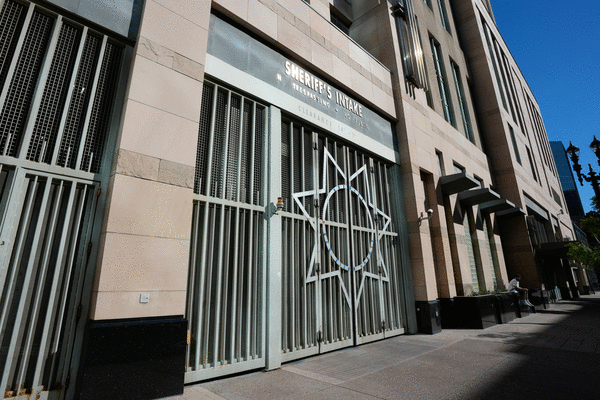
The number of noncitizens who were transferred from San Diego County jails into the custody of federal immigration agents last year nearly tripled, largely because federal authorities ramped up their use of judicial warrants in the face of the state’s stringent laws limiting cooperation on immigration enforcement.
Last year, 83 people were transferred from local county jails to Immigration and Customs Enforcement agents. In 2024, the total number of people transferred was 30.
Last year brought the highest number of judicial warrants submitted by ICE since the California Values Act — commonly referred to as Senate Bill 54, SB 54 or the “sanctuary state law” — went into effect in 2018. The law limits the involvement of local law enforcement with federal immigration authorities.
Sheriff Kelly Martinez shared her department’s 2025 ICE contacts with the county’s Board of Supervisors on Tuesday evening as part of an annual forum under the state’s TRUTH Act, which requires sheriff’s departments to provide data about cooperation with ICE requests to transfer incarcerated people into federal custody.
Communities locally and across the country have expressed fear over immigration crackdowns over the last year by the Trump administration, and on Tuesday several speakers decried any cooperation with ICE.
Supervisor Paloma Aguirre acknowledged “terror” in communities. “What we are grappling with here tonight is not just what is legal, but what is the true impact of what we’re experiencing,” Aguirre said.
Of the 83 people transferred to ICE custody last year, 53 were sent as the result of federal judicial warrants. That’s a jump from 2024, when the department reported it was presented with 17 federal warrants.
Asked about the local increase in use of federal judicial warrants, the San Diego-area U.S. Attorney’s Office said Wednesday it is “prioritizing prosecutions of previously-deported criminal aliens.”
“The increase in judicial warrants coincides with additional federal prosecutions of criminal aliens who (1) have been previously deported and (2) are now located in state custody,” the office said in a statement.
As for the other 30 of the 83 people transferred from jails to ICE, Martinez said they had convictions for “qualifying offenses” under the law — offenses such as assault, child molestation or robbery.
Many speakers implored the sheriff to comply with county policy in place since 2024 barring any deputies from cooperating with ICE when it comes to the transfer of noncitizen inmates. The sheriff stood firm on her decision to continue the limited cooperation with immigration authorities permissible under state law.
“As sheriff, I set the policy of our detention facilities,” she told the board Tuesday. “It has always been my belief that it is safer to conduct legal immigration transfers within state statutes to avoid disruption and ripple effects, and having bystanders taken in as collateral as part of federal immigration enforcement.”
The transfers occur in the jails. Martinez said she believes it is safer for the community if ICE agents — who already know a person’s release date — take people into custody at the jail rather than go looking for them on the streets. “If they (ICE) are going to go into the community, there will be collateral damage, and that’s my bigger concern,” Martinez said.
“Individuals who have been transferred to ICE are not one-time criminals,” she said. “They have been convicted of crimes on multiple occasions, and if they weren’t transferred due to a legal federal judicial warrant, then they are transferred due to serious qualifying convictions.”
At least one person transferred to ICE had no recent jail bookings, according to the sheriff’s department, and at least one person had 19 priors.
Five of the 83 people transferred to ICE self-reported that they had been born in the U.S. She said her department does not verify a person’s citizenship.
Last year, ICE agents asked the Sheriff’s Office to provide the release-from-custody date for 1,082 people in county jail. After vetting, the Sheriff’s Office rejected 894 of the requests. They agreed to provide that information for 188 people because they had a prior qualifying conviction.
Aguirre asked several pointed questions about the process, including the financial cost of staff time to handle work such as screening people and facilitating ICE transfers. Martinez said that time is not specifically tracked, but that the same staffers who do that work “have a million other duties. We would have those staff employed whether they were doing this function or not.”
Shortly before the roughly two-hour hearing ended, Board Chair Terra Lawson-Remer pointed out a story that the nonprofit news organization CalMatters published Tuesday alleging that the Sheriff’s Office had failed to investigate reports of rape at an Otay Mesa immigration detention facility run by private company CoreCivic. The story alleged there had been at least seven reported sexual assaults at the facility last year.
According to the news report, there is a signed agreement known as a memorandum of understanding, or MOU, between the Sheriff’s Office and the detention center that allows the facility to investigate such allegations on its own.
Martinez told Lawson-Remer that her department does investigate, and said that in 2024 it investigated a case that led to the prosecution of a staffer accused of sexually assaulting someone in custody. The sheriff also said the warden had reached out regarding an allegation of an incident under the Prison Rape Elimination Act, but then did not call the department back to further investigate.
“There’s something about the structure of an MOU that says, ‘Hey, CoreCivic, you guys get the first cut at deciding whether this is serious enough to call the sheriff,’” Lawson-Remer said later in the exchange. “I’d rather have you guys out there investigating.”
“Everyone wants the sheriff to do the investigation of every facility in the county, including the prisons and juvenile facilities,” Martinez said. “It’s logistically very difficult.”
Lawson Remer soon started to ask, “Could you have an MOU that you’ll come investigate anything that’s reported instead of them…”
Martinez jumped in. “I don’t know if we have the staff capacity for that. Perhaps you could give me a bunch more positions, and we could create an investigative unit,” she said.
The sheriff said that she understands the concern, and later said, “For me to have the capacity to investigate every crime or every sexual assault that potentially or is alleged in another facility in this county is a difficult ask.”
_________
(Staff writer Alex Riggins contributed to this report.)
©2026 The San Diego Union-Tribune. Visit sandiegouniontribune.com. Distributed by Tribune Content Agency, LLC.






Comments