White House to pause quarter-billion in Minnesota Medicaid dollars as part of fraud crackdown
Published in News & Features
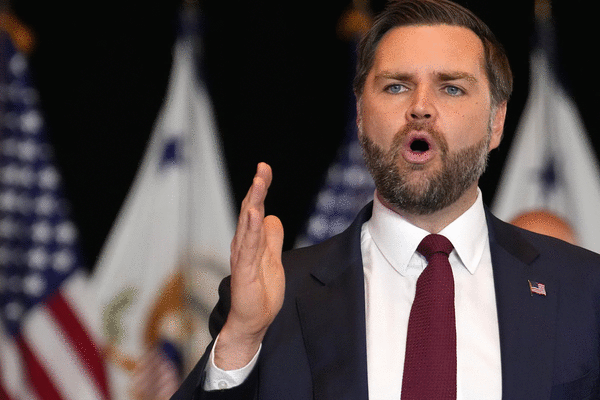
The Trump administration announced Wednesday it plans to halt $259 million in Medicaid payments to Minnesota over concerns about fraud in the state’s social services programs, the latest chapter in the federal government’s crackdown on the state.
The announcement comes one day after President Donald Trump’s State of the Union address, where he zoomed in on fraud in Minnesota and announced Vice President JD Vance would be leading efforts to combat the issue. It also follows the wind-down of Operation Metro Surge, a immigration crackdown in the state initially prompted by allegations of fraud.
“A quarter billion dollars is not going to be paid this month to Minnesota for its Medicaid claims,” Centers for Medicare & Medicaid Services Administrator Dr. Mehmet Oz said alongside Vance in a Washington, D.C., news conference.
The administration said it would withhold the funds until the Walz administration puts together a “comprehensive corrective action plan to stop the problem.”
Vance argued that the administration’s actions were meant for Minnesota to take “its obligation seriously to be good stewards of the American people’s tax money.”
“All we need the governor and the administration of Minnesota to do is something quite simple, which is to show that before you give Medicaid funds to somebody, you’re taking seriously whether they provided the services that they say that they’re providing,” Vance said.
In a post on X, Walz said he thinks the administration’s latest action “has nothing to do with fraud,” saying federal agents who were sent to Minnesota to crack down on fraud detained children and violently clashed with protesters.
“His (U.S. Department of Justice) is gutting the U.S. Attorney’s Office and crippling their ability to prosecute fraud. And every week Trump pardons another fraudster,” Walz said.
The announcement comes after federal officials warned the state in January that it would withhold up to $515 million in quarterly Medicaid funding over fraud concerns.
The state responded to the threat by saying it would appeal the federal government’s announcement, arguing it was “legally baseless” and politically motivated.
The state has pushed back against past comments from Oz that it is not adequately addressing fraud, highlighting numerous steps they are taking – from a detailed prepayment review to an effort to visit and revalidate 5,800 Medicaid providers.
“Today’s announcement is part of a broad and sustained attack by the federal government on Medicaid in Minnesota,” Human Services Commissioner Shireen Gandhi said in a statement. “Deferring $259 million will significantly harm the state’s health care infrastructure and the 1.2 million Minnesotans who depend on Medicaid. The federal government chose to ignore more than a year of serious and intensive work to fight fraud in our state.”
Oz said that Minnesota has already paid for the services but characterized the administration’s actions as simply not reimbursing the state. He also claimed the state’s rainy day fund could handle any potential lapse in payments, “so we are very confident that people will not be hurt in Minnesota.”
“Any delay in the services should be laid at the seat of Gov. Walz,” Oz said, adding that Minnesota would likely not be the only state the administration would target. “I believe he will take this seriously.”
Oz said they’ve notified the governor’s office and allowed 60 days to respond to a letter addressing their concerns and lay out a “comprehensive corrective action plan to solve the problem.”
“If Minnesota fails to clean up the systems, the state will rack up a billion dollars of deferred payments this year,” Oz went on to warn. “Governor Walz has ... 60 days to respond to our letter.”
The Medicaid funding freeze is one of several the administration has threatened amid fraud concerns in Minnesota, triggering legal battles.
Asked about the legality of the federal government’s pause in legally obligated funds, Vance said he was confident in the administration’s legal authority to do so.
“Congress appropriates it. We’re the ones who actually make sure this goes to the people it ought to go to and inherent in that is making sure that it only goes to the people that Congress says that it should go to,” Vance said.
Back in Minnesota, the administration’s announcement sparked concern from many at the “Disability Rights on Hold” event in Minneapolis, where experts, advocates and providers discussed how fraud allegations and funding freezes are affecting the disability community.
Several people worried the deferred funding was poorly thought out and will hurt people who need services.
“His actions are harming the people of Minnesota, especially those most vulnerable,” Naveh Eldar, CEO of disability advocacy organization The Arc Minnesota, said of Oz.
The announcement follows Medicaid cuts in Trump’s “Big Beautiful Bill” and could put further pressure on state resources that may potentially destabilize programs for people with disabilities, said Sumukha Terakanambi, a disability advocate who has Duchenne muscular dystrophy.
“These decisions are being made with very little thought for people with disabilities who frankly cannot afford these kinds of cuts or clawbacks to happen,” Terakanambi said.
There was also confusion about how the deferred funding announcement fits with past federal threats to withhold Medicaid dollars — and questions about how the state will weather potential funding losses.
“It adds more concern to an already stressed industry,” said Sue Schettle, who leads the Association of Residential Resources in Minnesota. “What does all this mean? How is it going to impact people who need services? What’s next?”
_____
©2026 The Minnesota Star Tribune. Visit startribune.com. Distributed by Tribune Content Agency, LLC




Comments