Florida House approves citizenship verification, new ID rules for voting
Published in News & Features
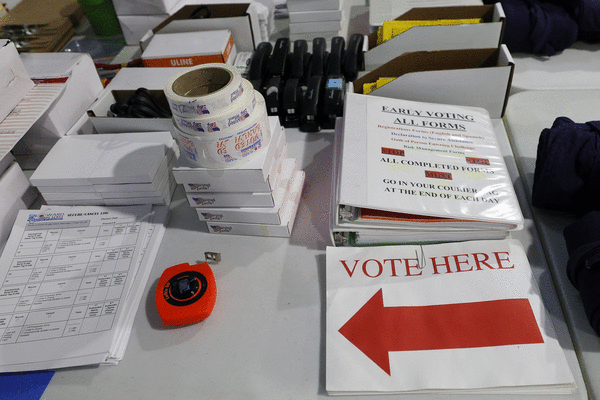
A day after President Donald Trump demanded Congress impose new rules governing elections, Republicans in the Florida House of Representatives passed a state-level measure Wednesday that mirrors much of what Trump wants on the national level.
The legislation would make multiple changes in Florida election law. The provisions with the biggest potential impact on voters would require citizenship verification of registered voters and eliminate some forms of identification that have long been accepted for voting in Florida.
Supporters said House Bill 991 would keep Florida at the forefront of well-run, honest elections. Opponents said the new rules, if they become law, would prevent some citizens from voting in future elections with the greatest impact on students, seniors and women.
Jessica Lowe-Minor, president of League of Women Voters of Florida, said in a statement that the House-passed bill “will make it harder for eligible Americans to vote. By tying the right to vote to possession of costly documents that many citizens don’t have easy access to, it undermines Floridians’ freedom to vote and moves us away from the concept of a free and fair democracy.”
In her final pitch for passage, state Rep. Jenna Persons-Mulicka, the Fort Myers Republican who sponsored the bill, invoked Trump’s comments from his State of the Union address. “You heard our president last night,” she said, adding that, “Floridians want election integrity.”
State Rep. Dana Trabulsy, R-Fort Pierce, the chief co-sponsor, rejected opponents’ warnings about the impact.
“This bill is not voter suppression. This bill is not driving us to a dictatorship,” she said. “I hear you saying, ‘We have had and do have the safest elections in the United States,’ and maybe we do. Our governor said we do and I believe we do. But that doesn’t mean we always will … We have to keep ahead of the people who want to game our system.”
Over the course of a two-hour debate on the legislation, Democrats argued against it and sought to scale back some of its provisions. Vastly outnumbered, the Democrats’ efforts failed. The bill passed 83-31.
All Broward and Palm Beach county state representatives voted on party lines, with Republicans voting “yes” and Democrats voting “no.”
Several Democrats delivered emotional pleas to their Republican colleagues not to pass the bill.
State Rep. Ashley Gantt, a Miami-Dade County Democrat, expounded on what she’s previously said about one of her aunts, who was born in South Carolina in the Jim Crow era in the 1950s to a mother who wasn’t allowed in a whites-only hospital because she was Black.
Consequently Gantt’s aunt has no birth certificate. Her aunt is a retired federal worker who has been voting for years but has been unable to get a driver’s license renewed because she can’t satisfy the requirements for REAL ID without a birth certificate. The main way the legislation calls for checking voters’ citizenship is by cross-referencing with driver’s license agency citizenship records, something that could snag Gantt’s aunt.
“Our policy has serious consequences. And to be the descendant of people who built this country, and not be able to do something as fundamental as vote because she can’t get her ID, I don’t think y’all understand how much rage that makes me feel for my aunt,” Gantt said.
And, Gantt said, after previous news media coverage of her aunt’s story, she said she’s been contacted by many voters in the same situation.
“We are debating access and equity and who gets to participate in the democracy that we cherish,” said state Rep. RaShon Young, D-Orlando. “Security and access are not opposing values. When we elevate one while eroding the other, we are not advancing democracy … This is fear mongering and disenfranchisement and voter suppression dressed up as security.”
Senate Bill 1334 covers many of the same subjects but differs from the House bill in some ways. In order to go to Gov. Ron DeSantis for his signature, the two bills would need to be synched before the scheduled March 13 adjournment of the annual legislative session.
Citizenship
Citizenship is already required to vote in Florida. And in legislative committees and in debate on Wednesday, sponsors of the new requirement didn’t cite evidence of more than scattered cases in which non-citizens may have voted.
At a House committee hearing, Persons-Mulicka pointed to what a state report about 2025 election investigations described as 198 “likely noncitizens who illegally registered and/or voted in Florida.” That works out to less than 1 possible noncitizen for every 70,000 registered voters.
Sponsors said the citizenship verification, long sought by Trump who claims droves of non-citizens are voting, would keep it that way.
“This shouldn’t be a problem if you are an American citizen,” Trabulsy said.
Voting rights advocates said verification could cause problems for some voters.
The Brennan Center for Justice has reported that 9% of American citizens — like Gantt’s aunt — don’t have immediate access to the type of documents the legislation would require to prove citizenship. The League of Women Voters said that could translate to more than 1 million Florida voters “who could get caught in this bureaucratic web to prove their citizenship to vote.”
Voting advocates said women would run into compliance problems far more than men, because women are more likely to change their names when they get married and divorced.
Persons-Mulicka said there wouldn’t be problems. “If you are on the voter rolls and you are a U.S. citizen … you should not have any fear that you will be removed,” Persons-Mulicka said. “We want to make sure we know who you are.”
Pressed by opponents about the implementation, which would require coordination between election officials and the state driver’s license agency, Persons-Mulicka said she has “not spoken with anybody” at the Department of Highway Safety and Motor Vehicles about her bill.
Voter ID
The ID issue isn’t about whether voters should have to show identification to vote.
That question is controversial in many states, but Florida has long required people to show identification to vote. Most people use their driver’s licenses, with others using state-issued ID cards.
For people without those forms of ID, state law has permitted multiple other forms of identification.
Under the legislation, student IDs, even issued by state colleges and universities, debit or credit cards and retirement center, neighborhood association or public assistance identification would no longer be accepted.
State Rep. Marie Woodson, D-Hollywood, told her colleagues that many of the college students they represent don’t drive. And the new restrictions would prevent some from voting.
Other provisions
House Bill 991 has several other provisions, including changing the system of election recounts in close elections and instituting audits of all elections.
Democrats offered multiple amendments in an attempt to alter the legislation before its final passage. Republicans rejected them all.
One amendment, sponsored by state Rep. Christine Hunschofsky, D-Parkland, would have banned people from carrying firearms inside polling places, within the 150-foot no politicking zone around polling places, and at drop-off locations for mail ballots.
“I don’t think somebody should be able to go to a polling place with an AR-15 because I think that will make other people afraid to go there and exercise their American constitutional duty of voting. Why would we want that?” Hunschofsky said.
State Rep. Robin Bartleman, D-Weston, urged her colleagues to support Hunschofsky’s amendment. “We all been to the polls,” she said. “We see how hot it gets. We have an opportunity to prevent something from happening.
________
©2026 South Florida Sun Sentinel. Visit at sun-sentinel.com. Distributed by Tribune Content Agency, LLC.



Comments