In race with SpaceX, Blue Origin refocuses efforts on Artemis moon lander
Published in News & Features

SpaceX’s stranglehold as NASA’s choice for the historic moon landing planned for the Artemis III mission later this decade was loosened last year to allow competitor Blue Origin back into the conversation. Jeff Bezos’ company is now laser-focused on the opportunity.
On Friday, the company announced it would cease launches of its space tourism New Shepard rocket for at least the next two years as it tries to get its Blue Moon lander program in shape to perhaps swoop in and steal Elon Musk’s thunder.
New Shepard has flown 98 humans into space for short, suborbital missions since 2021, including Bezos, William Shatner, Katy Perry and Michael Strahan. Three of its customers have been from Central Florida: Winter Park power couple Marc and Sharon Hagle, who flew up twice, and Brevard County millionaire Steve Young.
“The decision reflects Blue Origin’s commitment to the nation’s goal of returning to the moon and establishing a permanent, sustained lunar presence,” the company said in a statement.
That mission awaits the successful completion of Artemis II, which could launch as early as Sunday with four crew on a lunar flyby mission. NASA has to run through the results of a wet-dress rehearsal performed Monday before declaring a launch date, which could also target launch in early March or April.
That would then set up what NASA aims to be the first return to the lunar surface since the Apollo 17 mission in 1972.
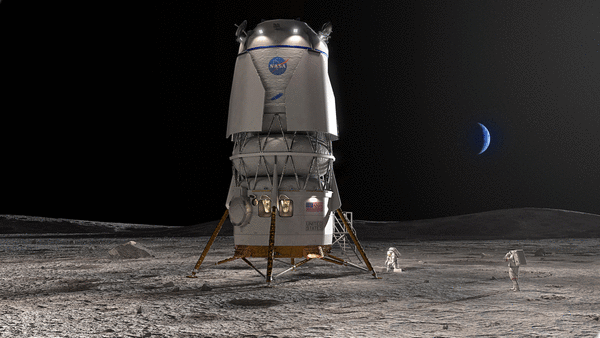
SpaceX had been awarded the contracts to be the human landing system for both Artemis III and IV with its in-development Starship spacecraft while Blue Origin was on tap to become the lander for Artemis V with a lander called Blue Moon.
Delays in Musk’s Starship efforts, though, pushed NASA to reopen the Artemis III contract so it will go to whichever company has a working lander available. Already, those delays have shifted plans so NASA is no longer trying to launch the moon landing mission by summer 2027, which had been the latest moving target at the end of the Biden administration.
Under Trump’s first term, NASA had been pushing for boots on the moon by as early as 2024. That date has kept sliding further into the decade amid delays to the uncrewed Artemis I mission that finally launched in late 2022, and then a longer series of delays that pushed the Artemis II mission into 2025.
The latest target by the Trump administration is to get the lander on the moon by the end of 2028, before the end of the president’s last term in office.
Both Blue Origin and SpaceX have worked with NASA to come up with more streamlined plans to get their landers ready, according to new NASA Administrator Jared Isaacman.
“I did meet with both Blue Origin and SpaceX on their acceleration plans. These are both very good plans. I would say they both reduce technical risk from where we were before,” he said during an Artemis II briefing last month.
Both companies, though, will need to figure out how to get their landers to its destination with a system of propellant depots parked in the space between the Earth and the moon. This would mean propellant transfer in space, which for SpaceX would mean at least 10 or more such pit stops in place.
And both companies have to demonstrate they can stick the landing on a test run before NASA will let astronauts on board.
“That becomes a pretty critical milestone in the development of the capability, and one that we’re very much looking forward to with both providers,” said Thomas Percy with NASA’s Human Landing System Program Office during a panel discussion last week during SpaceCom at the Orange County Convention Center. “It does give us a unique opportunity to bring out the vehicle to understand how they’re going to work and learn from that before we send crew to the surface.”
For Blue Origin’s part, it’s looking to get its first taste of lunar soil later this year with a smaller, uncrewed lander called the Blue Moon Mark 1, or MK1.
“For Mark 1, this is our No. 1 pathfinder named Endurance. It’s headed to near Shackleton Crater,” said Blue Origin’s director of civil space Eddie Seyffert during the panel. He said it’s designed to land “anywhere on the lunar surface, landing day or night. So this is a capability that we’ve invested in, in partnership with NASA, so that we can demonstrate the foundational technologies that will be needed for the Mark 2 crew and the Mark 2 cargo lander.”
The company shipped the lander, which was manufactured in Cape Canaveral, over to Houston, where it arrived Monday. It’s headed to to the thermal vacuum chamber at NASA’s Johnson Space Center.
“We’ll be performing both thermal balance and full mission testing at the hot and cold plateaus,” said Blue Origin CEO Dave Limp in a post on X. “This will prove that MK1 can maintain thermal equilibrium and perform its mission in space. MK1 joins the legacy of historic missions like Apollo and James Webb Space Telescope tested in this same chamber.”
The company will then bring it back to the Space Coast with plans to launch it atop one of their heavy-lift New Glenn rockets later this year.
Its destination is the lunar south pole, where at 26 feet tall, it would become the largest lander to ever touch down on the moon if successful.
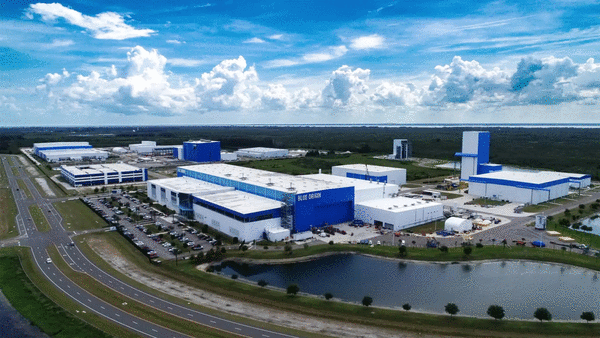
The larger Blue Moon Mark 2 lander, which will be about 50 feet tall, will be manufactured at a second lunar plant building that was recently opened on the company’s massive campus in Merritt Island.
SpaceX’s Starship plans are still working toward satisfying NASA’s lunar lander needs. It completed a successful 11th test flight from its Texas launch site in October, setting up what would be a new generation of the Starship spacecraft lined up for launches this year.
The Super Heavy booster it plans to use on its next launch was rolled out over the weekend to begin prelaunch testing. Meanwhile, construction continues at Kennedy Space Center’s Launch Pad 39-A on what would be SpaceX’s first operational Starship launch site.
“After Artemis II is successful, we are going to shift all of our focus over to Artemis III, and we’re going to be the ones on the clock,” Percy said. “We are very much looking forward to working with both Blue Origin and SpaceX to find ways to secure that 2028 landing.”
_____
©2026 Orlando Sentinel. Visit orlandosentinel.com. Distributed by Tribune Content Agency, LLC.





Comments