Cuba offers security cooperation to US amid its harassment of American diplomats
Published in News & Features
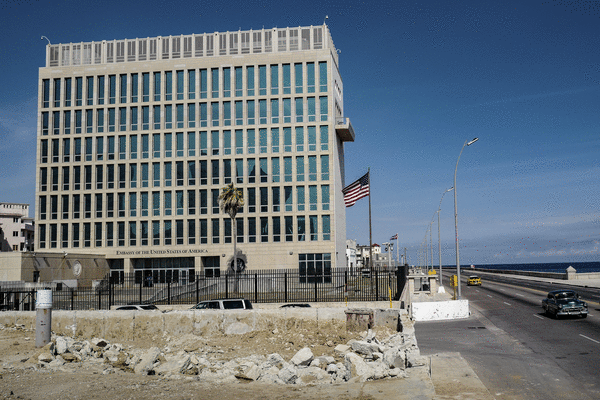
The Cuban government has exchanged its fierce rhetoric and vows to resist President Donald Trump’s “threats” for a more conciliatory offer to renew cooperation on security matters and maintain a “respectful dialogue” amid increasing diplomatic tensions and several incidents of harassment of U.S. diplomats on the island.
“Cuba is prepared to reactivate and expand bilateral cooperation with the United States to address shared transnational threats, without ever relinquishing its sovereignty and independence,” the island’s foreign affairs ministry said in a statement late Sunday, noting that the two countries would benefit from “constructive engagement.”
“Cuba reaffirms its willingness to maintain a respectful and reciprocal dialogue, oriented toward tangible results, with the United States government, based on mutual interest and international law,” the statement added.
The Cuban government, which the U.S. includes in its list of states sponsoring terrorism, denied it support or harbors terrorist organizations. It said it could cooperate with the U.S. in areas including “the fight against terrorism, the prevention of money laundering, drug trafficking, cybersecurity, human trafficking, and financial crimes, and continuing to strengthen its legal framework to support these efforts, recognizing that when there has been a will on both sides, progress has been made in these areas.”
Cuba started cooperating with the United States on these issues under the Obama administration but Trump scrapped those talks in his first term.
It is unclear what exactly prompt the new offer. Just Friday, the country’s leader was blasting the U.S. government after Trump signed an executive order Thursday to impose tariffs on countries supplying oil to Cuba. Cuban leader Miguel Díaz-Canel said the measure demonstrates “the fascist, criminal, and genocidal nature of a clique that has hijacked the interests of the American people for purely personal gain.”
But as the country’s oil reserves dry and blackouts and long lines to buy gas spread around the country, the change in tone suggests the Cuban government has started grappling with the severity of the situation, after Trump moved to cut oil supplies to the island from Venezuela and Mexico.
Cuba’s offer is far from the economic and political reforms that U.S. officials and experts have pointed out are more relevant in potential talks, but it might provide an opportunity to bring those issues to the table. It comes after Pope Leo XIV called for dialogue between the two countries and Cuban bishops offered to mediate. Cubans on the island and abroad have also been openly calling for urgent changes as the country’s economy nears total collapse.
Some Cuban Americans quickly noted the offer avoids dealing with the more pressing issues at hand.
“There’s nothing new in Havana’s ‘security’ overture to Washington,” said Ric Herrero, executive director of the Washington-based Cuban Study Group. “Reasonable on its face, yet unresponsive to reality. As always, it dodges the core drivers of bilateral tension: the demands of three generations of Cuban diaspora; the island’s disastrous, centrally planned economy, and its cozy ties” to U.S. adversaries.
On Sunday, Trump reiterated his administration has reached out to Cuban officials for talks.
“Cuba is a failing nation — it has been for a long time, but now it doesn’t have Venezuela to prop it up, so we are talking to the people in Cuba, their highest people in Cuba,” he said speaking from Mar-a-Lago on Sunday. “I think we’re going to make a deal with Cuba. It’s in bad shape. Cuba has a humanitarian problem.”
“I want the people that came here and were horribly treated to be taken care of, to be able to go back,” he added.
Previously, he said on Air Force One that his administration was “starting to talk to Cuba. They need help, on a humanitarian basis.”
Trump also confirmed he asked Mexican President Claudia Sheinbaum to stop oil shipments to Cuba. Sheinbaum said in a statement Sunday that her government was sending other basic supplies to the island as humanitarian relief, while engaging in diplomatic efforts to try to continue sending oil as a humanitarian gesture “without confrontation.”
But even if the two governments are talking — which Cuba’s handpicked president has denied — Cuban authorities have resorted so far to their habitual defiant messaging against “imperialism” and risking further confrontation, and have ramped up harassment of U.S. diplomats on the island.
Since the capture of Venezuelan strongman Nicolás Maduro and Trump’s warning to Cuba to “make a deal before it’s too late,” Cuban leaders have been sending the message they are preparing for war, not for dialogue, appearing on television in military fatigues overseeing military exercises and training of the population.
Just hours before Sunday’s statement, Cuba’s leader blasted Trump’s measures as the actions of an “irrational empire.”
“We are prepared to face any additional blockade measures and any military threat or aggression with the same courage and determination as the 32 Cuban fighters who fell heroically on January 3 in Venezuela,” he said Saturday, in reference to the Cuban bodyguards who died trying to protect Maduro, who was apprehended by U.S. special forces during a military raid in Caracas.
During the weekend, members of Cuba’s communist organizations and government supporters gathered at several locations in Trinidad and Camaguey — outside a church, a hotel and restaurants — to heckle the chargé d’affaires at the U.S. Embassy in Havana, Mike Hammer, in what’s known as “acts of repudiation,” typically organized by the government and its state security agency. The videos show Cubans calling Hammer “murderer” and shouting, “You are not welcome in Cuba.”
Cuban police also stopped Hammer’s convoy on the road and briefly took his passport before they could continue to Camaguey.
U.S. diplomats in Cuba are under close surveillance and have been harassed in the past by state security agents. But at this delicate moment, the concern is that “someone wants to become the ‘hero’ of the revolution and does something stupid, or someone gets hurt,” a U.S. official said.
“The illegitimate Cuban regime must immediately stop its repressive acts of sending individuals to interfere with the diplomatic work of CDA Hammer and members of the @USembcuba team,” the State Department’s Western Hemisphere Affairs bureau said Sunday. “Our diplomats will continue to meet with the Cuban people despite the regime’s failed intimidation tactics.”
_____
©2026 Miami Herald. Visit miamiherald.com. Distributed by Tribune Content Agency, LLC.


Comments