'Capitalism is supposed to be faster than communism': Space roadblocks frustrate congressman
Published in News & Features
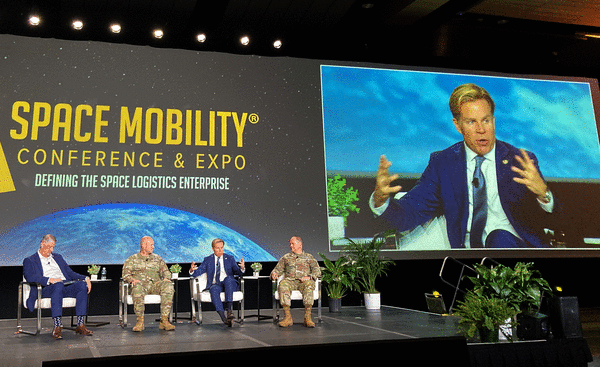
ORLANDO, Fla. — Sitting between a pair of Space Force colonels in room full of military and commercial aerospace representatives, U.S. Rep. Mike Haridopolos spoke his mind about some of the hurdles that have slowed launch endeavors in the U.S.
“What frustrates me as an American is capitalism is supposed to be faster than communism, and yet you have run into (times) — (for) many companies in this very room — when it’s the government that’s hampering your success. I won’t name acronyms, but we know them all,” he said.
Haridopolos, who represents Florida's Space Coast in Congress and leads the U.S. House Space and Aeronautics Subcommittee, was speaking Wednesday on a panel at the Space Mobility Conference, a one-day gathering put on by the Space Force that’s part of four days of Commercial Space Week events at the Orange County Convention Center.
He did call out the Environmental Protection Agency, which he said would at times not approve things “because of that bureaucratic inertia.” Another common target from many attendees of the conference has been the paperwork required by the Federal Aviation Administration.
“The Chinese, in some of these cases, are doing it faster. So we have to win. We need to prove that capitalism is a more effective means of transportation and success,” he said. “In some ways, we’ve become so big, it’s hampered that success. So we’re always going to be looking for ways to reduce, to eliminate the proverbial red tape and find that success. And so that’s my focus.”
He was joined on the panel by Col. Brian Chatman, commander of Space Launch Delta 45 based at Patrick Space Force Base in Brevard County, and Col. James Horne, commander of Space Launch Delta 30 based at Vandenburg Space Force Base in California, and led by moderator Rob Long, who leads Space Florida, the state’s aerospace finance and development authority.
Both colonels detailed the stresses of increased launches in the last five years with the Eastern Range seeing 109 and Western Range 71 launches in 2025, and projections that combined they could hit 500 launches by 2030.
Col. Chapman said logistics and efficiency have become the main bottleneck, such as when the boosters from SpaceX and Blue Origin flights land downrange and come back to Port Canaveral, but then need to make their way back for refurbishment.
“Today, I’ve got one main artery to drive on and off of Cape Canaveral Space Force station. I need a booster transport lane,” he said. “I need the ability to deconflict how men and women get to work day to day, from how we transport launch related hardware, those stages, boosters back over to the processing facilities.”
Col. Horne echoed the the need for infrastructure investments.
“So check this out. I’m not going to name names, because you know who you are, but there is a provider that the way they get into our harbor is they hire a surfer. He stands on the edge of the barge. He waits for the tides to optimize, and he says, ‘Ready? ready? Go!’ And the boat harbor guy, he guns it, and they ride the wave into the harbor. That’s not how you should be doing that,” he said. “So we’re going to fix that.”
It’s one example of how increased use is taxing the existing space for the two busiest spaceports in the world.
“We have to invest in our hardware in a way that makes it like any other normal course, and opens up capacity to as many days a year as possible,” he said. “We have to optimize our spaces to be able to accommodate the surge that’s coming.”
Getting investment from commercial companies, though, is an existing headache, one the Col. Horne said Congress could help with.
“I think we’re at this interesting inflection point in our industry. You look back at the airline industry in the 1920s and 30s, as they started to pick up, there was this transition from the government doing it to commercial doing it in this hybrid approach that morphed over the years,” he said. “I think we’re at the cusp of that now, and we’re writing the doctrine, the policy of the law, structures to enable us to operate more freely, to share resources, to partner together on things.”
He said the need is there to increase public-private partnership.
“We have legislative authorities, but they’re hard to execute right now because it requires that the private investment be appropriated. No private company is going to lock up private capital for two years in the appropriation cycle,” he said.
Haridopolos said he hears the needs of both colonels.
“I’m going to try to put more of an emphasis on making sure that our main launch facilities have the infrastructure in place, not just for today, but anticipating the future, because it’s a heck of a lot more expensive to do it the other way around. I think that’s vital,” he said.
Haridopolos also proffered his take on keeping the commercial sector on track, decrying the changes that political upheaval can bring every four years.
“What happens too often in government is that you have a Democratic administration than a Republican administration, and businesses have great difficulty navigating those changing philosophies,” he said. “We can’t allow that to happen in space, because this is not a short-term, one-term, or one-year endeavor, or even one-presidential-term endeavor. This is a multitude of years made to come together to put this infrastructure in place.”
His goal he said is to find common partners on both side of the political aisle to ensure that happens, and make clear directives so the private sector feels confident to invest.
“As we take on this emerging marketplace of space technology and what it might mean in the future, Congress needs to be that bedrock that offers the commercial sector, and of course our partners in the military and government world, that certainty and stability, that if you make this investment, it’s a long-term thing.”
Haridopolos, while praising Trump’s space-related goals, did highlight how Congress was able to ignore Trump’s proposed NASA budget proposal that would have cut its funding from nearly $25 billion down to less than $19 billion in 2026.
“Congress is absolutely committed to making sure we stay number one in space,” he said.
A big part of that drive, and one that brings in both sides of the political spectrum, is making sure America’s goals are not usurped by the Chinese.
“We know that China doesn’t necessarily play by the rules, and they’re doing all types of nefarious things we’ve seen over the last couple of decades in space,” he said. “And so it’s integral to protect not just our military needs but our commercial needs from some of these activities, whether it be privacy concerns or even more dramatic in the potential conflict.”
So while he may be a Republican and in his first term in Congress, he feels when it comes to space, everyone can be on the same page.
“What gives me so much confidence is when I go into the room with military leaders and civilian leaders in these different companies, they have one mission. And sometimes you see these bureaucratic battles happen. I’ve seen just the opposite,” he said. “People want to play as good teammates on every level.”
_____
©2026 Orlando Sentinel. Visit at orlandosentinel.com. Distributed by Tribune Content Agency, LLC.






Comments