US imposes sanctions on more members of Haiti's presidential council
Published in News & Features
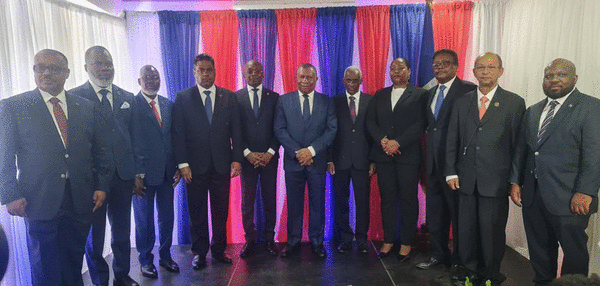
Two members of Haiti’s transitional presidential council and a cabinet minister have had their U.S. visas revoked in the latest round of sanctions announced by the State Department on Wednesday.
The visa restrictions come just three days after two other members of the council were similarly barred from entering the United States by the Trump administration. As in previous cases — including the visa revocation of another council member in November — the State Department did not identify the individuals involved, citing privacy concerns.
However, with the latest action, a total of five of the council’s seven voting members are now under U.S. sanctions. The measures also extend to immediate family members who currently hold valid U.S. visas. For officials with family ties in the United States, the sanctions carry significant personal and professional consequences.
State Department spokesman Thomas “Tommy” Pigott said the individuals’ actions “have enabled Haitian gangs, some of which are designated as Foreign Terrorist Organizations, to destabilize the country. The Trump administration will continue taking steps to impose these measures against anyone who contributes to the destabilization of Haiti and our hemisphere.”
On Wednesday, while testifying in Congress about Venezuela, Secretary of State Marco Rubio told lawmakers that gangs in Haiti have fueled “systematic collapse.
“These criminal gangs that basically control territory and threaten the ability to even form a government there,” he said.
Last week, five members of the council voted to oust Prime Minister Alix Didier Fils-Aimé ahead of the end of the council’s mandate on Feb. 7. U.S. officials, including Rubio and the chargé d’affaires at the U.S. Embassy in Port-au-Prince, Henry Wooster— have warned that the move is illegal.
Speaking at a graduation ceremony Friday for nearly 900 new police officers in Port-au-Prince, Wooster said maintaining Fils-Aimé as head of the Haitian government “remains essential to advancing efforts to combat terrorist gangs and stabilize the country.”
Despite those warnings, council members have reportedly pushed ahead. In recent days, council chairmanr Laurent Saint-Cyr has refused to sign a resolution backed by the five seeking Fils-Aimé’s removal.
Following his refusal, some council members reportedly attempted to remove Saint-Cyr from his position. The sanctions reflect U.S. concerns and frustration that despite stern warnings and clear messages, some members of Haiti’s transitional leadership continue to fuel instability and create a political crisis ahead of their departure.
_____
©2026 Miami Herald. Visit miamiherald.com. Distributed by Tribune Content Agency, LLC.



Comments