Machado backs US transition plan, rejects power-sharing with criminal networks
Published in News & Features
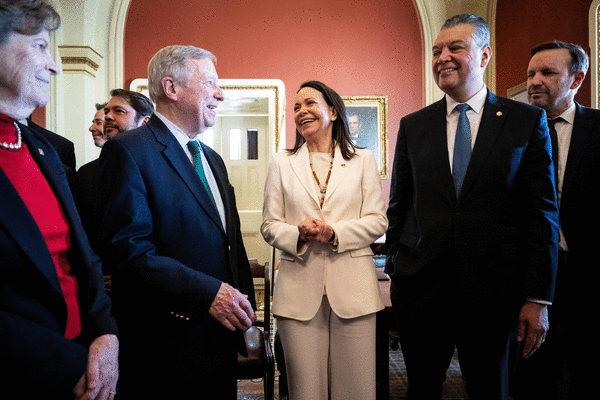
Venezuelan opposition leader María Corina Machado said on Wednesday that the country’s democratic forces are willing to participate in a “real transition” of power, but will not accept any arrangement that keeps what she described as criminal structures linked to the current authorities in place.
Speaking to reporters after a meeting with U.S. Secretary of State Marco Rubio in Washington, Machado said the opposition would support a transition process only if it restores democratic institutions and dismantles networks she accused interim authorities led by interim President Delcy Rodríguez of using to retain power.
“We are willing to facilitate a genuine transition,” Machado said. “But not a Russian-style transition where mafias remain in control. Venezuela does not need stability for criminals — it needs justice, truth and freedom.”
Machado, who last year was awarded the Nobel Peace Prize for her “tireless work promoting democratic rights for the people of Venezuela,” described Rodríguez as a central figure in what she called a system of “narcoterrorism and repression,” accusing her and other senior officials of responsibility for extrajudicial killings, mass political imprisonment and the forced migration of millions of Venezuelans.
She said no one in the democratic opposition trusts Rodríguez, but acknowledged that international efforts are focused on creating incentives that weaken the repressive apparatus.
Her comments came as Venezuela experiences a limited but notable release of political prisoners following U.S.-backed pressure on Caracas after the removal of former president Nicolás Maduro earlier this month.
Machado said that of more than 700 political prisoners documented by human rights groups, 301 have been released since early January. However, she noted that none of the 171 detained military personnel have been freed.
“Not a single soldier has been released,” she said. “Civilians and military prisoners are equally our priority.”
She also said that in January alone, 36 Venezuelans were “kidnapped” by security forces, with 14 still in detention. Among those still imprisoned, she highlighted three former metropolitan police officers — Luis Enrique Molina, Héctor Robain and Erasmo Bolívar — who she said have been jailed for 23 years.
Machado credited the releases and growing public protests to sustained international pressure, particularly from Washington. She thanked U.S. President Donald Trump and the U.S. government for what she described as unprecedented support for Venezuela’s democratic cause.
“For the first time, people feel they are not alone,” she said.
She pointed to student demonstrations at 20 universities across Venezuela demanding the freedom of political prisoners, calling the protests “unthinkable just days ago.” She also highlighted public prayer vigils led by churches and families protesting outside detention centers.
Machado said she plans to return to Venezuela soon but declined to provide a specific date, saying she is completing “important meetings and agreements” abroad. She stressed that her return must be accompanied by security guarantees not only for herself, but for hundreds of political leaders in hiding or exile and millions of Venezuelans living abroad.
“This is not about one person,” she said. “It’s about millions who want to come home and rebuild their lives.”
On the economy, Machado said Venezuela has more than $1.3 trillion in potential investment opportunities in energy, infrastructure, agriculture and technology, but warned they will not materialize without a credible legal framework.
She sharply criticized Venezuela’s judicial system, citing international assessments that rank the country near the bottom globally for the rule of law. She dismissed suggestions by Colombian President Gustavo Petro that Maduro should be tried in Venezuelan courts, saying judges who rule against the regime face imprisonment themselves.
“Not a single ruling has ever favored a citizen against the regime,” she said.
Machado also questioned the legitimacy of Venezuela’s electoral institutions, describing the July 2024 presidential election as fundamentally unfair and saying nearly 40% of eligible voters were unable to vote. She said at least 9 million Venezuelans need updates to the electoral registry, including millions living abroad.
She called for a transitional government that legitimizes all branches of power, including a new National Assembly, arguing that the current legislature was elected in a vote she described as fraudulent and marked by minimal turnout.
Machado said oil revenues — long a source of corruption — must be redirected to social investment. She accused previous governments of diverting billions of dollars to political allies abroad, including Cuba, while Venezuelans faced hunger and collapse of public services.
Despite the fragility of institutions, she said mechanisms are being discussed to ensure oil income benefits education, healthcare and nutrition.
Machado ended by describing Venezuela’s struggle as part of a broader hemispheric effort against authoritarianism and organized crime.
“Venezuela will be free,” she said. “And when that happens, freedom, security and stability will spread across the Americas — including to Cuba and Nicaragua.”
_____
©2026 Miami Herald. Visit miamiherald.com. Distributed by Tribune Content Agency, LLC.




Comments