Trump's Greenland threats reopen tariff wounds in Europe
Published in News & Features
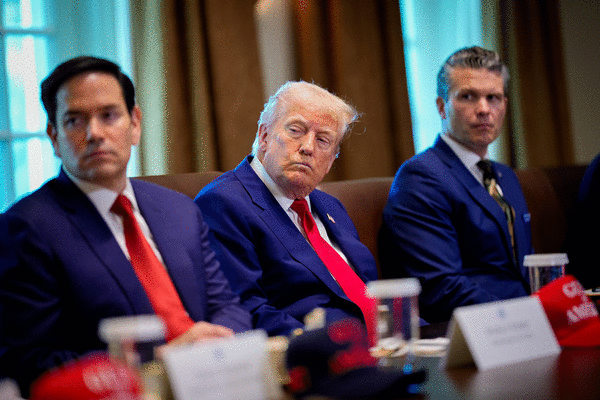
President Donald Trump’s fixation on Greenland offers an ice-cold reminder to leaders in Europe and abroad: No deal is ever final.
Trump announced a 10% tariff, rising to 25% in June, on eight European nations, including Denmark, for saying they would undertake token NATO military exercises in Greenland in response to U.S. saber-rattling.
While the tariffs aren’t certain to take effect, the threat was a brazen escalation and insult to close U.S. allies, trampling over the U.S.-EU trade deal reached only six months earlier at Trump’s Turnberry resort in Scotland.
Trump’s targets in Europe pushed back quickly. UK Prime Minister Keir Starmer blasted his tariff threat as “completely wrong,” France’s Emmanuel Macron called it “unacceptable” and Swedish Prime Minister Ulf Kristersson said his country wouldn’t be “blackmailed.”
A senior European lawmaker called for a halt to a U.S.-EU trade truce sealed with Trump in July, and EU national ambassadors will meet Sunday to discuss the bloc’s next steps, according to a person familiar with the matter. Macron would be seeking to activate the EU’s anti-coercion instrument — the bloc’s most powerful retaliatory tool — against Trump’s tariff threat, a person close to the French president said Sunday.
The tariff missive also underscored several emerging lessons of the second Trump administration: Nothing is out of reach of negotiations, alliances are met with suspicion, and power and leverage are king.
“Those who thought the second year was going to be a year of tariff stability should recognize this is looking a lot like the first year,” said Josh Lipsky, chair of international economics at the Atlantic Council. “There will be united pushback. One, because of how unified Europe is on the Greenland issue, and two, because of how much of a political price Europe already paid for the Turnberry agreement.”
Trump’s tariffs will apply to Denmark, Norway, Sweden, France, Germany, the UK, the Netherlands and Finland. It came as protests were held across Denmark staunchly opposing any U.S. control of Greenland.
Remarkably, Trump made his tariff pronouncement after those countries — some of the U.S.’s longest-standing allies and all NATO members — said they were sending only a few dozen troops to Greenland to participate in a joint exercise.
The eight countries issued a joint statement Sunday reiterating that the exercise was a response to the necessity of strengthening Arctic security and that the tariff threats “risk a dangerous downward spiral.” Danish Prime Minister Mette Frederiksen said separately her government was in “intensive dialogue” with allies and that it was even more important for Europe to “stand firm.”
“This isn’t Iran we’re talking about, it’s Denmark,” Scott Lincicome, a trade analyst at the libertarian Cato Institute, said, adding that the move will anger “a lot of folks.”
Republican Senator Thom Tillis and Democrat Jeanne Shaheen issued a joint statement urging the Trump administration to “turn off the threats and turn on diplomacy.”
The co-chairs of a Senate NATO group wrote, “Continuing down this path is bad for America, bad for American businesses and bad for America’s allies.”
‘Dangerous’ times
Whether Trump would ever seriously weigh invading Greenland is not clear, though he has consistently left open the possibility. Speaking to the BBC in an interview that aired Sunday, House Speaker Mike Johnson said he didn’t foresee military intervention given the small population of the island and that diplomacy would be “the way to go.”
“Greenland has strategic importance to us because of its geography, its placement, but not just to the U.S. but to all freedom-loving people everywhere,” Johnson said. “We live in a dangerous time and a dangerous world.”
But one of Trump’s top officials, speaking Friday evening on Fox News, accused Europe of freeloading off the U.S. and said Greenland’s fate should reflect who has the power to protect it — even though, as part of Denmark, any attack on it by an adversary could trigger the alliance’s mutual defense clause, known as Article 5, and a potential U.S. response.
“Denmark is a tiny country with a tiny economy and a tiny military. They cannot defend Greenland,” Deputy Chief of Staff Stephen Miller told the network. “To control a territory you have to be able to defend a territory, improve a territory, inhabit a territory. Denmark has failed at every single one of these tests.”
Because it’s part of Denmark, it also “in principle is covered by the mutual solidarity clause in Article 42.7 of the Treaty on European Union,” European Commission spokeswoman Anita Hipper said this week.
Instead, NATO members are now facing economic pressure by a member of their bloc to support the forceful seizure, an extraordinary development even by the standards of Trump’s avowed transactionalism.
Changing calculations
Up to now, European leaders have largely tried to placate Trump by cutting deals and not confronting him, particularly as they work to maintain U.S. military and intelligence support for Ukraine to fend off Russian aggression.
But a move on Greenland might change the EU’s calculations. Italian Prime Minister Giorgia Meloni, who has engaged in a lengthy balancing act with Trump, labeled the threat of tariffs on countries choosing to contribute to Greenland’s security “a mistake.” Speaking to reporters in Seoul on Sunday, Meloni said that she had spoken to the U.S. president in recent hours and called for a resumption in dialogue.
Ireland regarded Trump’s announcement as “completely unacceptable and deeply regrettable,” Foreign Minister Helen McEntee said in a statement, adding that “respect for sovereignty and territorial integrity of States is “non-negotiable.”
Allies had earlier concluded “it was better to placate Trump and move on than it was to escalate, and if you did that, you could give your companies and investors some certainty,” Lincicome said. “It’s just clearly the case that that’s just wrong. The only government so far that has seemed to have gotten Trump to back down is China and they did that via rather aggressive retaliatory actions.”
The Greenland-related tariffs may not take effect — Trump may seek to impose them under a law that the Supreme Court could soon rule on, potentially curtailing authorities Trump has used so far to quickly enact levies on friends and foes alike.
Both Lipsky and Lincicome said that they think it’s unlikely, with the Supreme Court case and other factors, that the tariffs actually kick in Feb. 1.
“Not impossible, but low probability,” Lipsky said. But it also isn’t clear what Europe might bargain away to win a delay, as has been the case in other tariff negotiations. “This is different than a traditional threat.”
Trump’s threat drew criticism from retiring Republican Representative Don Bacon, who said Congress should claw back tariff powers that Trump has consolidated and predicted Trump’s impeachment were he to invade.
“I feel like it’s incumbent on folks like me to speak up and say that these threats and bullying of an ally are wrong,” Bacon told CNN. “And just on the weird chance that he’s serious about invading Greenland, I want to let him know that it would probably be the end of his presidency. Most Republicans know this is a moral wrong and we would stand up against it.”
Ron Wyden, the top Democrat on the Senate Finance Committee, called Trump’s latest threat a “pointless imperial fantasy” and called on other lawmakers to disavow it. Senate Minority Leader Chuck Schumer said Democrats will introduce legislation aimed at blocking Trump from imposing the levies.
_____
(With assistance from Alice Gledhill, Tiago Ramos Alfaro, Jennifer Duggan, Ania Nussbaum and Christian Wienberg.)
_____
©2026 Bloomberg L.P. Visit bloomberg.com. Distributed by Tribune Content Agency, LLC.





Comments