Allegations of racial profiling of US citizens on the rise as ICE surge expands in Minnesota
Published in News & Features
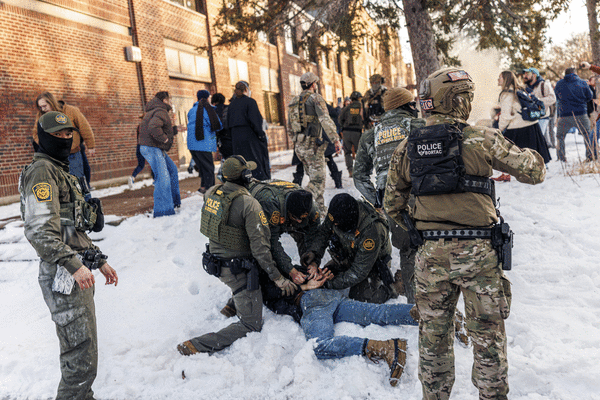
Luis Escoto panicked when he looked out the window of his family’s West St. Paul restaurant this month and saw armed and masked ICE agents surrounding his 69-year-old wife as she parked her car.
His wife is, like him, a U.S. citizen, and Escoto ran out with her passport to prove it. When he asked agents why they were questioning her, he said, they told him it was because she is Mexican.
“She’s brown. I look white,” Escoto said when recounting the exchange. “My, God, is this America?”
The Jan. 11 incident is one of multiple documented instances in recent weeks of Department of Homeland Security agents confronting people of color — at bus stops, on sidewalks, in parking lots — and demanding proof of citizenship. Many of the interactions have been filmed by the individuals themselves or other observers and showcased on social media platforms as examples of alleged racial profiling by ICE agents.
Media outlets, including the Minnesota Star Tribune, also have documented instances of Somali, Latino and Native Americans being detained when they were unable to immediately prove their citizenship.
Federal officials have repeatedly said that they are following the law during its immigration enforcement. They deny that they are targeting people based on race and ethnicity.
“These allegations are disgusting, reckless and categorically FALSE,” Tricia McLaughlin, assistant secretary for the Department of Homeland Security (DHS), said in a written statement. ”What makes someone a target for immigration enforcement is if they are illegally in the U.S.— NOT their skin color, race, or ethnicity."
But elected officials, lawmakers and civil liberties organizations say the Trump administration has been emboldened by a recent Supreme Court opinion allowing federal agents to make immigration stops based on race and ethnicity.
The ACLU of Minnesota filed a class action lawsuit on Thursday, Jan. 15, accusing federal immigration agents of racially profiling Somali and Latino Minnesotans through unlawful stops, arrests and use of force during Operation Metro Surge.
The lawsuit alleges agents routinely detain people without warrants or probable cause, ignore proof of citizenship or lawful status, and target individuals based on race or perceived ethnicity in violation of the Fourth and Fifth Amendments.
“This is quintessential racial profiling,” the ACLU complaint said.
Last July, a federal judge barred agents from using race, ethnicity, language and work location as a factor in stopping people during immigration enforcement in Los Angeles. The case, Noem v. Vasquez Perdomo, was upheld on appeal. But on Sept. 8, the U.S. Supreme Court’s conservative majority agreed to temporarily lift the restrictions and allowed agents to use a range of factors as reasonable grounds to continue the stops.
The so-called “Kavanaugh stops” are named after Supreme Court Justice Brett Kavanaugh, who wrote a stout defense of the practice allowing agents to consider someone’s apparent race or ethnicity; whether they speak another language or accented English; their presence at possible day-labor locations, and whether they work in immigrant-related jobs like construction or car washing.
Kavanaugh also said ethnicity can be a “relevant factor” when considering why agents make an immigration stop.
“As for stops of those individuals who are legally in the country, the questioning in those circumstances is typically brief, and those individuals may promptly go free after making clear to the immigration officers that they are U. S. citizens or otherwise legally in the United States,“ Kavanaugh wrote in a concurrent opinion.
But critics say the stops mark a sharp expansion of federal enforcement into everyday public life, where citizenship itself no longer guarantees protection from questioning, force or detention, according to attorneys and lawmakers.
“The Trump administration has been crystal clear about their intention to target Somali and Latino people, specifically surrounding Operation Metro Surge,” Catherine Ahlin-Halverson, a staff attorney with the ACLU of Minnesota, said at a Jan. 15 news conference.
Attorneys point to instances like the one that played out in a Robbinsdale grocery store parking lot as an example where agents are detaining citizens.
The encounter, which was livestreamed by a relative as it unfolded, showed ICE agents detaining Jose Roberto Ramirez, 20, at a Hy-Vee in Robbinsdale on Jan. 8.
Ramirez was born in Minneapolis, according to a birth certificate provided to the Star Tribune by his family. His mother, Raelyn Duffy, a member of the Red Lake Nation, said agents refused to let her son show identification and told him he “wasn’t from here.”
Ramirez later said he pulled into the parking lot intentionally, hoping to stop somewhere public.
“I wanted to stop somewhere people could see,” he said.
His aunt arrived as agents surrounded his vehicle. Video shows agents drawing guns before pulling Ramirez from the car. He was handcuffed, placed in an ICE vehicle and taken to the Whipple Federal Building near Fort Snelling, where his mother said she was initially turned away despite bringing his passport and birth certificate.
Ramirez was held for several hours before being released without charges. He said agents made comments suggesting he would see family members in detention and tightened his handcuffs when he asked for relief.
ICE officials did not respond to questions about the encounters uncovered by the Star Tribune but Homeland Security Secretary Kristi Noem said on Sept. 15 that everyone, including U.S. citizens, should be prepared to present proof of citizenship if they’re questioned by ICE.
“If we are on a target, there may be individuals surrounding that criminal that we may be asking who they are and why they’re there and having them validate their identity,” Noem said.
But in some instances, citizens say they were never given an opportunity to present identification.
On Monday, Jan. 12, a 40-year-old U.S. citizen, said immigration agents followed him after he made eye contact with them from an alley in south Minneapolis.
Christian Molina said agents eventually struck his car from behind, demanded papers and released chemical irritants before leaving the scene as neighbors gathered. Molina said he believes he was targeted because he appeared Hispanic.
“You cannot just stop people by their look,” he said.
_____
(Elliot Hughes and Emmy Martin of the Star Tribune contributed to this report. )
_____
©2026 The Minnesota Star Tribune. Visit startribune.com. Distributed by Tribune Content Agency, LLC





Comments