Boston Mayor Wu takes aim at Trump, outlines priorities in inauguration speech
Published in News & Features
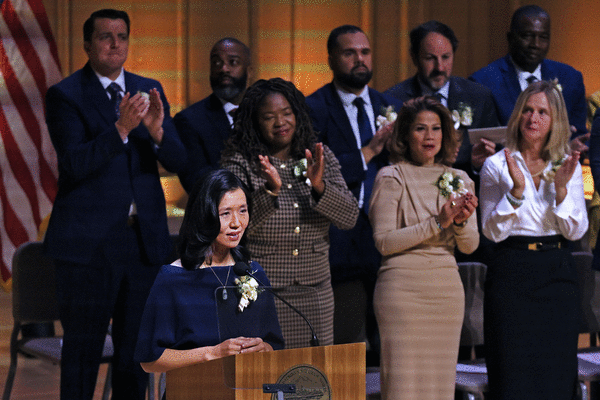
Boston Mayor Michelle Wu was officially sworn into her second term Monday, and while she used her inauguration speech to sharply criticize the Trump administration and outline her office’s priorities, she didn’t announce any new initiatives.
Wu addressed a supportive crowd at the Symphony Hall, where she drew applause for her administration’s efforts to reduce gun violence “to the lowest levels on record,” spur affordable housing production, and launch family-friendly programs like a free museum initiative for city schoolchildren.
But the mayor drew her loudest applause — a standing ovation — when she vowed to continue to take on a federal administration that she said has “plundered our economy, ravaged our reputation, torched our institutions, and destroyed the lives of our people.”
“When in the course of human events, it becomes necessary for a city to stand as the beacon for freedom and proof of what’s possible — a testament to the endurance of American ingenuity and civic success — Boston will be that beacon,” Wu said. “We will not appease or abet any threat to our city, and we will not wait for permission to build the world our families deserve.”
Wu has become a progressive face of the Democratic party since being thrust into the national spotlight for her defense of the city’s illegal immigration protections before a Republican-led Congressional oversight committee probing Boston and other sanctuary cities last March.
Her criticism of the Trump administration also played well with voters during the mayoral race, where she trounced her principal opponent Josh Kraft, a son of the billionaire New England Patriots owner Robert Kraft, by 49 points in the September preliminary election, leading him to suspend his campaign two days later.
Wu ran unopposed in the November general election, and was officially sworn into her second, four-year term on Monday. Administering the oath of office to Wu was Massachusetts Superior Court Judge Sarah G. Kim.
Wu took the oath while surrounded by her husband, Conor Pewarski, and their three children. The mayor placed her hand on a bible held by her son while being sworn in and referenced her infant daughter Mira’s first steps last month in her speech.
The mayor’s speech was split between a look-back at what she considered to be her major accomplishments during her first term and a general overview of her administration’s priorities for her second.
Wu spoke to the city’s murder rate, saying gun violence is the lowest on record, and said her administration’s approach to open-air drug use, dealing and related crime at the troubled intersection of Massachusetts Avenue and Melnea Cass Boulevard, commonly known as Mass and Cass, is working, despite complaints from residents about spillover into their nearby neighborhoods.
She mentioned that the city has ended the tent encampment at Mass and Cass.
Wu touted the controversial public-private plan her administration has championed to rebuild Franklin Park’s White Stadium for a professional women’s soccer team and Boston Public Schools student-athletes, saying that the $200 million and counting project will be completed next year.
Taxpayers are on the hook for half the costs, which are expected to exceed the $91 million figure estimated by the Wu administration in December of 2024, due to federal tariffs that the mayor says are driving up construction costs. She has said a final estimate for project costs will be released this year.
Wu said the city has created the most affordable homes in a generation, launched a first-ever citywide rezoning process, and made homeownership more affordable for residents through city funds and a quicker approval process, along with launching new programs to help more city families become first-time homeowners.
The mayor vowed to build on those efforts in her new term.
“For our city to flourish, Bostonians must be able to grow up and grow old here,” Wu said. “We will work to address the housing needs of our families and seniors, focusing on solutions they want and can afford.”
Wu also vowed to improve the city’s public school system, mentioning that plans to rebuild the Madison Park Technical Vocational High School were accepted for partial funding from the Massachusetts School Building Authority.
She said the city will further its funding efforts to protect against climate change and power the city with “cleaner, more affordable energy,” expand careers in green industries, and improve municipal services.
“Together, we will deliver the best city services to all of our residents, set the standard for public education, and build an economy that will thrive for another two-and-half centuries,” Wu said. “If we can invent America, then we can be the city that forges the path forward in this moment.”
Gregory Maynard, executive director of the Boston Policy Institute, said he was surprised that the mayor didn’t list falling office values and the fiscal crisis the post-pandemic trend has created for the city, among her priorities in her speech.
“There was no discussion of the $4.2 billion in assessed value lost by commercial properties in Boston over the last two years, the huge increases in homeowners’ property taxes that collapse in office values has brought on, or how the 2% cut to city departments that Mayor Wu said was coming in the FY27 budget will impact city employees and city services,” Maynard said in a statement.
“Since those issues were ignored, this speech shed no light on the fiscal crisis that Boston is in the midst of, or Mayor Wu’s plan to tackle it,” he added.
Wu told reporters she plans to continue to push the state Senate to approve her stalled tax shift legislation, which seeks to address the impact of declining commercial values on the city’s budget — which derives about three-quarters of its revenue from property taxes — by shifting more of the city’s tax burden from the residential to commercial sector.
The legislation is aimed at offsetting a 13% tax hike the average single-family homeowner is projected to face this year. Third-quarter tax bills hit mailboxes this month.
_____
©2026 MediaNews Group, Inc. Visit at bostonherald.com. Distributed by Tribune Content Agency, LLC.





Comments