Environmentalists sue feds to protect 'prehistoric' crabs that frequent South Carolina coast
Published in News & Features
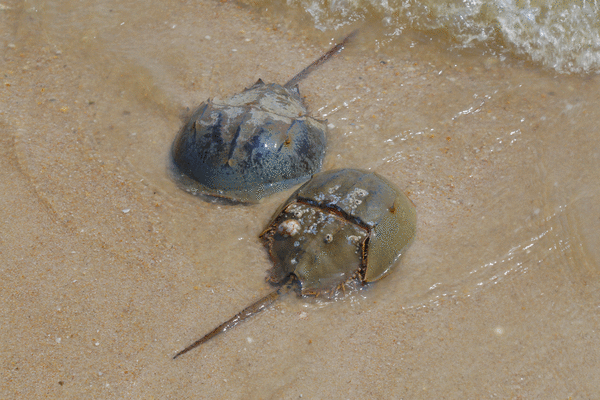
COLUMBIA, S.C. — Environmentalists are suing the federal government over what they say is a failure to protect the horseshoe crab, a prehistoric looking species that is important to the survival of shore birds in South Carolina and other coastal states.
The Center for Biological Diversity says the National Marine Fisheries Service has not met a deadline to decide whether the crabs should be protected under the federal Endangered Species Act.
The center says horseshoe crab populations have “crashed’’ as a result of climate change, habitat loss, excessive harvesting and the use of the crabs by the biomedical industry. Populations have stabilized in recent years, but are down by as much as 70% from historic levels, the center reports.
But the federal government has not made a preliminary assessment that would allow a final decision on protection of the crabs to be made, said Will Harlan, a senior scientist with the center. A deadline for the preliminary finding was in 2024, he said.
“We could lose these living fossils forever if they don’t get Endangered Species Act protections soon,’’ Harlan said in a news release after the suit was filed Monday. “It’s reckless to delay their obvious need for protection, so we’re going to court to force the government to do its job.”
In an interview with The State, Harlan said the crabs play an important role in helping other animals survive. Eleven species of shorebirds feed on horseshoe crab eggs during migration between the North and South American continents each year, according to the South Carolina Department of Natural Resources.
Those include birds such as the rufa red knot. The reddish gray coastal bird travels some 18,000 miles each year from South America to the Arctic, stopping in places like South Carolina to feed on horseshoe crab eggs. Without an adequate supply of crabs and their eggs, red knots also are in danger, he said. A single horseshoe crab can lay up to 100,000 eggs in a year, state officials say.
Red knots that feed on horseshoe crab eggs are already protected by the Endangered Species Act. In 2014, the federal government declared the red knot as a threatened species under the act. Each year, red knots travel between breeding grounds in the Canadian Arctic and Tierra Del Fuego at the southern tip of South America.
In a 2014 story in The State, a senior scientist for the Center for Biological Diversity predicted that restrictions on the harvest of horseshoe crabs would be needed as a way to help protect the red knot.
Harvesting horseshoe crabs for use by the biomedical industry has been an issue in South Carolina in recent years. Biomedical laboratories have historically captured the crabs and siphoned their blood for use in vaccines and for other purposes. The animals are then returned to the water, but critics say they don’t always survive the bleeding.
That has put a dent in horseshoe crab populations, Harlan said. But there is less need today to pull blood from horseshoe crabs than in the past because synthetic materials have been developed for biomedical purposes, critics of the use of horseshoe crabs say.
The blood, which is blue, has historically been used to test vaccines and medical devices for contamination. The State reported on the issue in an investigative series five years ago that examined the impacts of the biomedical industry on horseshoe crabs and whether blood was still needed for biomedical purposes.
Horseshoe crabs have existed for some 400 million years — and they look like it.
They have oval-shaped shells and long tails that appear menacing, like those of stingrays. But the animals are actually harmless.
They also are technically not crabs, but are more akin to giant insects, growing to as much as 2 feet long and living 25 years. Horseshoe crabs are in the family known as arachnids, animals related to spiders and scorpions, according to the South Carolina Department of Natural Resources.
The Center for Biological Diversity is a nonprofit organization active nationally. The environmental group, headquartered in Tucson, Arizona, has nearly 100,000 members nationally. The group, along with multiple other wildlife and conservation organizations, petitioned the federal government in February 2024 to protect the horseshoe crab.
_____
©2026 The State. Visit thestate.com. Distributed by Tribune Content Agency, LLC.






Comments