How fraud allegations shook up Minnesota politics
Published in News & Features
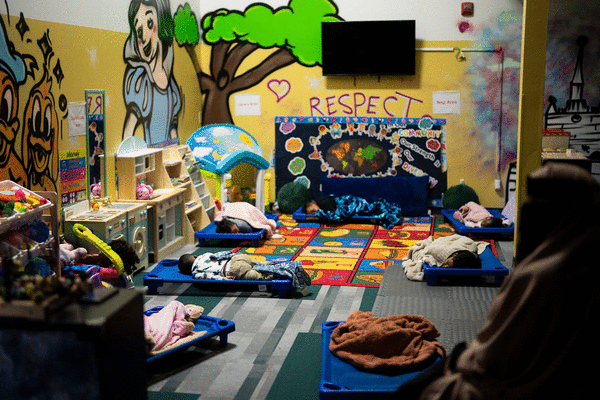
MINNEAPOLIS — Allegations of child care fraud in Minnesota aired by a conservative influencer have shaken up Minnesota politics at the highest level, with Gov. Tim Walz’s announcement on Jan. 5 that he would drop his reelection bid and focus on fighting fraud in Minnesota programs.
State regulators delved quickly last week into Minnesota’s Child Care Assistance Program after a video produced by influencer Nick Shirley went viral. On Jan. 2, the Minnesota Department of Children, Youth and Families said investigators had visited nine of the 10 sites highlighted in Shirley’s video, and found children present at all but one.
Regulators said the other center in Shirley’s video had not yet opened for business at the time of the visit. A tenth day care that was targeted in the video actually closed in 2022, regulators said.
Four of the centers featured in the video are the subject of “ongoing investigation,” according to the department, which did not release further details. In all, the department said, it is investigating 55 day care providers.
In all, more than 1,200 day care centers in Minnesota benefit from the assistance program, which helps cover the cost of day care for about 23,000 children and 12,000 families each month. In 2024, the program cost $306 million.
The nine open centers referenced in Shirley’s video received a combined $17.4 million in CCAP funding in the last fiscal year, state officials said.
Republican legislators have taken credit for providing information for the video, which fueled new questions about the integrity of multiple social service programs in Minnesota and renewed speculation about the impact of the spiraling fraud crisis on the 2026 race for governor.
To date, federal prosecutors have announced more than 90 indictments in four state social service programs funded by federal Medicaid dollars, and warned that public benefits fraud ultimately could be in the “billions.”
In announcing his decision to drop his reelection bid, Walz vowed to focus on rooting out fraud, even as he accused Republicans of trying to take advantage of the issue for political gain.
Here’s what to know about the program at the center of the story, where the allegations came from, how much money is at risk, and how the state and federal government are responding.
On Dec. 26, right-wing influencer Nick Shirley posted a 43-minute video alleging that a group of day care centers operated by Somali residents in Minneapolis has misappropriated “upwards of $100 million.”
The video shows Shirley and a man identified as “David” as they visit 10 Minneapolis child care centers that allegedly received public funding to see whether the businesses are actually taking care of children. Members of the Minnesota House Republican Caucus later said that they had provided information about fraud to the man named David who appeared in Shirley’s video.
The Minnesota Star Tribune confirmed that Shirley’s sidekick in the film is David Hoch, a former Republican who unsuccessfully ran as a third-party candidate for Minnesota governor and attorney general.
The video soon went viral on social media. It prompted a response from several Trump administration officials, including Vice President JD Vance, FBI Director Kash Patel, and Department of Homeland Security Secretary Kristi Noem.
On Dec. 29, three days after the video was first posted, Noem posted on X that ICE agents were knocking on doors in a “massive investigation on childcare and other rampant fraud.”
A day after that, Health and Human Services Deputy Secretary Jim O’Neill said in a post on X that the agency had “frozen all childcare payments to the state of Minnesota.”
O’Neill also said that payments across the U.S. made through the Administration for Children and Families will now require “justification and a receipt or photo evidence” before money is sent, and that the department has launched a fraud-reporting hotline and email address.
The Administration for Children and Families provides $185 million in child care funds annually to Minnesota, according to ACF Assistant Secretary Alex Adams.
In most cases, Shirley and his partner were either unable to get anybody to answer the door or were refused entry. A few employees or clients of the centers challenged their claims, but it’s not clear if any of those individuals were the owners.
One of the most widely shared clips focused on the Quality Learning Center, which had a misspelled sign and an apparent lack of anyone inside.
On Dec. 30, Shirley returned to Quality Learning Center, though it’s not clear why he made another visit to the site.
State regulators sent inspectors to each of the centers featured in the video to see if there were licensing issues or other problems.
At a Dec. 29 news conference, Tikki Brown, commissioner of the Minnesota Department of Children, Youth, and Families, said each of the centers has been visited in the previous six months, but none of those unannounced visits turned up evidence of fraud. She said the department has not yet found problems that warrant pausing payments to any of the centers.
Brown said two of the Minneapolis centers featured in the video shut down this year, including Quality Learning Center, which reportedly closed in mid-December. However, a department spokeswoman said later that Quality owners switched course and “decided to remain open.”
Brown declined to provide information about state reviews of Quality Learning Center, or another site featured in the video, Mako Childcare. “We generally don’t disclose information if we have a current, open investigation,” she said.
The department also has not yet answered questions about any violations or other problems that may have been found during the inspections prompted by the video.
The Minnesota Star Tribune visited all 10 facilities, and found children inside four of them when invited inside. Six other facilities were either closed or employees did not open their doors.
Ahmed Hasan, director of ABC Learning Center in south Minneapolis, invited the Star Tribune and other media outlets into the facility, where about 30 children of varying ages were visible.
State records show the facility was first licensed in 2019, with a total capacity of 40. It has had 28 violations since then, with one $200 fine for failing to do a background check on two staffers.
After Shirley’s video went viral, people began stopping by and calling as early as 5 a.m. and as late as midnight. They get calls from people from all over the country saying things like “We’re coming” and “ICE, ICE baby.”
“These people are very angry,” Hasan said, as he played some of the voicemails.
A lawyer who represents several Somali-owned day cares in the Twin Cities said his clients have received hundreds of death threats since the video went viral late in late December.
A Star Tribune review of state enforcement records and court filings shows that none of the individuals publicly identified as owners or operators of the 10 businesses have ever been charged with fraud or any other felonies. However, seven of the eight facilities with publicly available licensing records have been cited by the state for violations over the past four years, with some cited dozens of times.
Six of the 10 child care businesses featured in Shirley’s video operated as meal sites for Feeding Our Future, the nonprofit at the center of a fraud scandal that has resulted in more than 50 convictions so far. Altogether, those six businesses received $6 million from Feeding Our Future between 2018 and 2021, according to trial evidence.
Earlier this year, Feeding Our Future leader Aimee Bock was convicted of seven crimes for her role in masterminding the scheme. A federal judge granted a $5.2 million forfeiture order against Bock on Dec. 30.
Shirley, 23, is a right-wing influencer whose YouTube channel has amassed more than 1 million followers. He was one of several influencers who were invited to the White House in October to participate in an “antifa roundtable” — a discussion about left-wing groups and the anti-fascist movement — with President Trump.
He faced criticism for a video he filmed in Kyiv, Ukraine, in 2024, when he falsely implied that American tax dollars were used to buy luxury cars and install a Ferris wheel in the city. When another journalist questioned him about the video, Shirley responded that he was “making satire on the internet.”
Shirley filmed content at the Jan. 6, 2021, riot at the U.S. Capitol. He interviewed a man who participated in the riot and took a piece of mail from then-House Speaker Nancy Pelosi’s office.
Shirley’s media company is based in Utah, records show. He did not respond to requests for comment.
The state’s Child Care Assistance Program (CCAP) is aimed at helping low-income families with child care costs so that parents can work. In 2024, the program cost $306 million.
Temporary DHS Commissioner Shireen Gandhi told a panel of state lawmakers in February that Minnesota has about 1,800 licensed child care centers and about 5,800 licensed family child care providers.
She said about 3,600 providers are enrolled in the state’s Child Care Assistance Program. Every year, Gandhi said, state licensers make unannounced site visits to child care providers.
They report any violations or conditions that could be suggestive of fraud to CCAP investigators, she said.
One of the first major scandals involving fraudsters in the Somali community started in 2015, when three Minneapolis day care centers were raided by police and accused of overbilling CCAP. Investigators discovered that some day care operators billed the state for more children than were actually present.
By 2017, investigators filed charges against 10 day care operators, but the penalties were modest compared to the more recent fraud cases involving a meals program overseen by the Minnesota Department of Education.
None of the people convicted in the day care scheme were sentenced to more than five years in prison, according to a Minnesota Star Tribune review of the cases. Two of the convicted fraudsters received sentences of 30 days or less.
In half of the cases, records show, nobody was sent to jail. Prosecutors either dismissed the charges when the owners agreed to repay the stolen funds or never pursued criminal charges against individual owners after the companies pleaded guilty and were ordered to make restitution.
In response to previous questions from the Star Tribune, DHS said that it has taken numerous steps since 2019 to beef up anti-fraud efforts, including using data to flag improper billing requests, enhanced attendance requirements, increased use of video surveillance, a formal system for fraud referrals and more frequent inspections of new providers.
However, the department has not implemented one of the state Legislative Auditor’s chief recommendations: replacing handwritten sign-in sheets with an electronic attendance system.
The auditor noted that most child care fraud involved providers submitted inflated attendance records to obtain extra money, similar to what federal authorities have documented in the meals program.
In 2019, 22 states required some automated way of collecting attendance, while eight other states were developing those systems, according to the legislative auditor.
_____
(Ryan Faircloth of the Minnesota Star Tribune contributed to this story.)
_____
©2026 The Minnesota Star Tribune. Visit startribune.com. Distributed by Tribune Content Agency, LLC






Comments