Chicago aldermen forge ahead with counterproposal to Mayor Brandon Johnson's budget, push new teen curfew plan
Published in News & Features
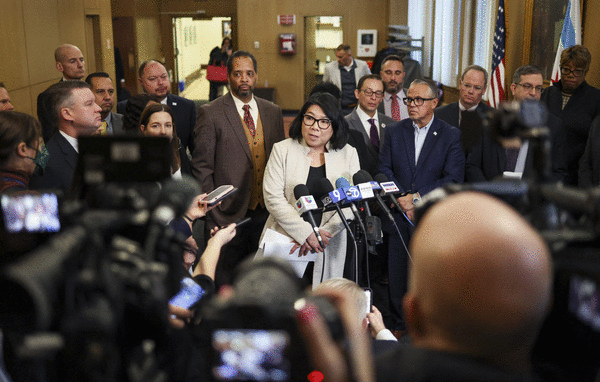
CHICAGO — Aldermen officially threw their budget cards on the table Wednesday by introducing their own 2026 package to the City Council, the clearest sign yet they believe they don’t need Mayor Brandon Johnson to solve the current impasse on next year’s spending plan.
The high-stakes game of chicken between the freshman mayor and his council antagonists — including some of his own committee leaders — now moves from the dueling news conferences of the past weeks into the actual legislative process. In the increasingly likely event they can’t reach a widely acceptable compromise, each side will try to build a proposal that can pass the council before the end of the year to avert a government shutdown.
That road remains murky, however, as cracks appeared in the aldermanic counterproposal’s support. Still, the council members opposed to Johnson’s $16.6 billion budget officially brought forward their proposals, which broadly aligned with ideas in a letter signed by 26 aldermen and sent to the mayor last week.
The aldermen’s budget does not include Johnson’s controversial head tax plan, and hikes garbage collection fees, among other changes.
But in an indication of how controversial the idea is, they lowered the proposed new trash pickup charge to $15 per household per month from the $18 fee they initially discussed. Currently, the Chicago fee is $9.50 per month for single-family homes.
The counterproposal also counts on the legalization and taxation of video gambling terminals in Chicago bars and restaurants.
Speaking to reporters after the council meeting, the mayor did not answer directly when asked whether that was a nonstarter for him, noting there’s been “some consternation and some trepidation around” the issue.
Taxes on the gambling machines would generate $48.4 million for the city, the aldermen predicted. Their projection is far higher than estimates by Johnson’s administration earlier this year.
Their proposal would also tack a 10% tax onto short-term rentals like Airbnbs, to raise an estimated $19 million.
In his afternoon news conference. Johnson said the budget “has to be” finalized by the end of this month.
“Look, I’m going to do everything that I can to avoid the chaos that, quite frankly — there are some individuals that want chaos to occur. Because those interests benefit from chaos,” Johnson told reporters. “And you know the playbook that they’re using? It’s from Donald Trump. That’s his MO.”
Johnson has dared aldermen to try to pass measure, a challenge he seemed to stand behind Wednesday as his allies allowed the measure to advance into the Finance Committee without using delay tactics. He’s also vowed to veto any budget that raises garbage fees, so aldermen would need 34 votes to withstand his opposition.
To that end, the opposition signaled they were uncowed.
“We’re going to … get that number as high as we can,” Ald. Scott Waguespack, 32nd, said when asked if aldermen would call for a vote on a budget that has a simple majority but cannot survive a veto from Johnson. “If the mayor goes for a veto, that’s on him. Then he’s going to be the one driving this city toward the fiscal cliff.”
Meanwhile, a critical swing vote came out against the aldermanic coalition’s garbage fee hike.
Far South Side Ald. Ronnie Mosley, 21st, released a statement to constituents Monday saying he would not support any budget that raises the garbage fee — or adds “unnecessary long-term debt or borrowing.” He clarified to the Tribune on Wednesday that he was talking about Johnson’s plans to scale back the advance payment to the city’s underfunded public pensions.
“I specifically asked for us to put something in this budget that signals we’re serious about our long-term debt,” Mosley said. “I haven’t seen that yet.”
Johnson said later Wednesday “there’s not a real clear pathway” on how to restore the full advance pension, but argued “that’s just one matter” that rating agencies take into consideration. S&P knocked Chicago’s credit rating down to two notches above junk status in January following the mayor’s 2025 budget and warned last month it could further downgrade the city. Such downgrades can put a damper on investor interest in city debt and make future borrowing more expensive.
Mosley, a freshman alderman who is part of the Progressive Caucus, was one of the original 26 signatories to the alternate budget. Losing his support sets back the opposition to Johnson, but the mayor appears equally stuck with how to shore up enough support for his budget plan.
And three additional City Council members meanwhile signed on in support of the updated counterproposal introduced Wednesday, giving it a theoretical 27-alderman majority on the 50-member council that so far has not been tested in a vote.
Johnson’s corporate head tax proposal, which he is now pitching as a $33-per-employee per-month fee for companies with 500 or more workers, has taken up the most oxygen in the room. But measures such as the pension payment cited by Mosley are also critical sticking points for aldermen who are concerned about a credit downgrade.
After the meeting, Ald. Jason Ervin, 28th, Johnson’s handpicked Budget Committee chair, argued aldermen opposed to the mayor’s budget have not presented a fully balanced plan of their own. “This is all a bunch of theater, that’s what it is,” Ervin said.
Feet away, Ald. Pat Dowell, 3rd, chosen by Johnson to head the Finance Committee, said both the mayor’s and the alternative proposal “should be open for some discussion and amendments.”
“I don’t think anything is cast in stone at this point,” Dowell said.
Asked if she was ready to vote for the aldermen’s budget, she declined to answer.
“When the vote comes up, we’ll know the full form,” Dowell said. “What was presented today, I don’t think is the full form.”
Teen curfew
Meanwhile, a downtown alderman began efforts to relaunch the Chicago teen curfew debate with what he described as a new and improved version of his previous ordinance that was vetoed by Johnson.
Ald. Brian Hopkins, 2nd, introduced legislation Wednesday to give Chicago police Superintendent Larry Snelling authority to declare an earlier teen curfew for a specific area with at least 12 hours’ notice. It was sent to the Rules Committee by Ervin, a common parliamentary trick to delay legislation opposed by the mayor.
The mayoral opponent said that’s a necessary tool after a chaotic “teen takeover” outside the Chicago Theatre last month ended with a 14-year-old boy killed and eight other teens wounded in shootings.
“We wanted to have reasonable restrictions. There were concerns about the possible abuse of the curfew tool under the previous snap curfew ordinance,” Hopkins said. “The point is to prevent these events from happening in the first place, and this new time-and-place curfew will absolutely accomplish that goal.”
The mayor is likely to again resist Hopkins’ effort. Following the Chicago Theatre mayhem, Johnson told reporters that 700 additional police officers were preparing that day “for what we saw coming across the internet” and blamed social media algorithms for spreading negativity.
“What we can’t do is give people a pacifier and make them believe that they are being made whole,” Johnson said when asked about a potential return of the curfew debate. “And so no, I don’t have a high tolerance, you all, for a tepid approach towards how we drive violence down in the city of Chicago.”
In June, Johnson issued Chicago’s first mayoral veto since 2006 when he overruled Hopkins’ ordinance, which passed in a 27-22 vote, short of the 34 votes needed to override the mayor’s move.
That version required police to give 30 minutes’ notice onsite before a curfew would be implemented. Snelling said he would not use that power, but suggested he could use the ordinance to declare preemptive curfews days in advance when police learned of planned, potentially chaotic gatherings.
Hopkins said Wednesday his amended ordinance does just that. He noted that last month’s gunfire hours after the Millennium Park tree-lighting ceremony was connected to a “teen takeover” that had made the rounds on social media the previous few days.
Police reports indicated that teens from as far away as Dolton and Evanston traveled downtown for a gathering that night.
“You’re going to be met with violence interrupters. You’re going to be met with counselors from your school, and they’re going to tell you, this is not a safe thing you’re trying to organize, and we’re not going to allow it,” Hopkins said. “So it creates an incentive for them to just cancel the event or not show up. That’s the point of this whole thing.”
A spokesperson for Snelling declined to comment on the curfew proposal.
Also Wednesday, an effort by Southwest Side Ald. Marty Quinn, 13th, to ban the sale of many hemp products got blocked by Johnson allies.
Quinn amended his ordinance this week to exempt hemp beverages, topicals and pet-oriented products from the ban.
But before the council could consider the new version, Aldermen Rosanna Rodriguez-Sanchez, 33rd, and Byron Sigcho-Lopez, 25th, both close Johnson allies, used a parliamentary maneuver to delay a vote.
____
©2025 Chicago Tribune. Visit at chicagotribune.com. Distributed by Tribune Content Agency, LLC.






Comments