Machado's Nobel Peace Prize speech: A call to resist tyranny and reclaim democracy
Published in News & Features
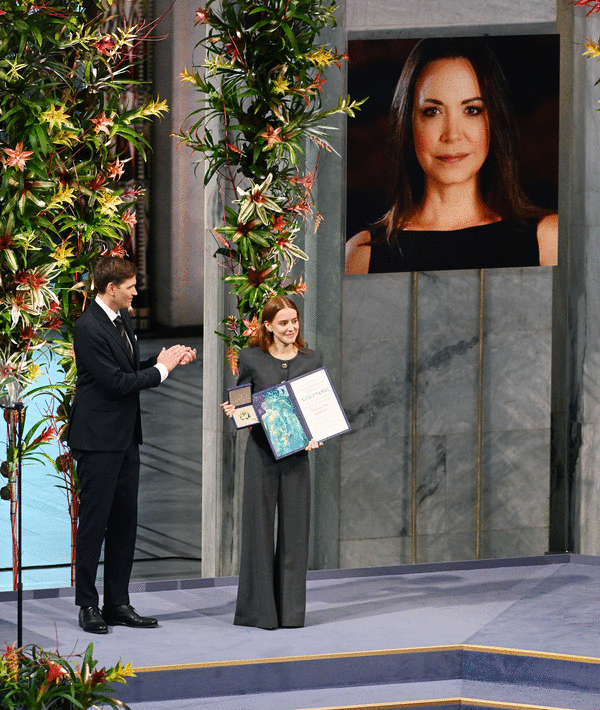
Venezuelan opposition leader María Corina Machado used her Nobel Peace Prize lecture on Wednesday to deliver a sweeping account of her country’s two-decade struggle against authoritarianism, portraying Venezuela’s crisis not only as a national tragedy but as a global warning about the fragility of democracy and the cost of freedom.
Machado was unable to leave Venezuela — where she is living in hiding — in time to attend the ceremony in Oslo. Her remarks were read on her behalf by her daughter, Ana Corina Sosa Machado, before members of Norway’s royal family and international diplomats. Even in her absence, Machado said, the message carried the voice of a nation — the echo of “millions of Venezuelans who rose, once again, to reclaim the destiny that was always theirs.”
Moments after receiving the prize on her mother’s behalf, Sosa announced that she expected to embrace Machado in Oslo within hours — and that the opposition leader intends to return to Venezuela “very soon.”
“I must say that my mother never breaks a promise. And that’s why, with all the joy in my heart, I can tell you that in just a few hours we will be able to hug her here in Oslo after 16 months,” she told attendees at the ceremony. She added that while she and her mother have waited two years for this moment, she was mindful of “the other daughters and sons who today will not be able to see their mothers.”
“This is what drives her, what drives all of us,” Sosa continued. “She wants to live in a free Venezuela and will never give up that goal. That is why we all know — I know — that she will soon be back in Venezuela.” Until then, Sosa said she carries “the difficult task of giving voice to her mother’s words, the speech she prepared for this occasion.”
She opened with “infinite gratitude” on behalf of her family and the country to the Norwegian Nobel Committee for recognizing that “the struggle of an entire people for truth, freedom, democracy, and peace is today recognized throughout the world.”
“I am here on behalf of my mother, María Corina Machado, who has united millions of Venezuelans in an extraordinary effort that you, our hosts, have honored with the Nobel Peace Prize,” she said.
Over the next 40 minutes, her daughter read Machado’s speech, which traced the arc of Venezuelan history, from independence to the oil-fueled prosperity of the 20th century and the subsequent dismantling of democratic institutions under Hugo Chávez and Nicolás Maduro. The lecture was both a tribute to ordinary citizens who resisted repression and a road map to what she described as Venezuela’s imminent democratic transition.
“Freedom is not something we wait for, but something we become,” she said, arguing that authoritarianism took root not only through the ambitions of rulers but through a society convinced its democracy was unshakable. “My generation was born in a vibrant democracy, and we took it for granted. We assumed freedom was as permanent as the air we breathed.”
She said the concentration of oil revenue in state hands created “perverse incentives,” turning public wealth into a tool of political control and eroding the civic culture needed to sustain a republic. When Chávez — a former coup leader — won the 1998 election, many believed charisma could replace institutions. “From 1999 onward, the regime dismantled our democracy,” she said. “They eroded institutions, politicized the military, censored the press and criminalized dissent.”
The collapse, Machado added, was moral as well as economic. Oil wealth “was not used to uplift, but to bind,” she said, recalling televised handouts of appliances that masked rising poverty. In two decades, the economy contracted by more than 80%. Poverty exceeded 86%. Nearly 9 million people fled — an exodus she described as “an open wound” that tore families across continents.
Yet exile, she said, ultimately forged unity. In 2023, when the opposition organized primary elections despite repression and scarce resources, Venezuela “rediscovered itself.” With no access to media and campaign events held amid blackouts and fuel shortages, supporters spread the message “by conviction alone.”
Machado recounted a teacher who convinced her local ruling-party captain to support the opposition after her son, living in Peru, urged her to vote for change. In a mountain town controlled by guerrillas, flags hidden for years out of fear reappeared on rooftops. “That day, love defeated fear,” she said. “That day, courage defeated oppression.”
The primaries on Oct. 22, 2023, became a civic uprising, she said, with Venezuelans at home and abroad lining up to vote even after ballots ran out. Machado won by a landslide, only to be barred from running for president. The opposition later rallied behind Edmundo González Urrutia, a former diplomat then little known to the public. “They underestimated the resolve of millions,” she said.
Ahead of the July 2024 presidential election, activists built a vast volunteer network to protect the vote — using QR-scanning apps, clandestine Starlink antennas hidden in fruit trucks and training sessions in church basements. On election day, turnout surged. Volunteers photographed tally sheets and carried them by hand, mule and canoe. “What began as a mechanism to legitimize leadership became the rebirth of a nation’s confidence in itself.”
González won with 67% of the vote, Machado said. The regime responded with “state terrorism,” she said — arrests, disappearances, torture and sexual abuse, even of minors. She accused authorities of hunting down citizens who shared tally sheets from the vote and forcing detained children to incriminate themselves under electric shocks. “These are crimes against humanity,” she said, noting United Nations documentation of abuses.
Still, Machado insisted the country has crossed a point of no return. “During these past 16 months in hiding we have built new networks of civic pressure and disciplined disobedience, preparing for Venezuela’s orderly transition to democracy,” she said. The prize, she added, was proof the world stands with Venezuelans at a decisive hour.
Machado framed the struggle not as partisan but existential — a fight for truth, for life and for the right to reunite families. She imagined the future in intimate scenes: political prisoners stepping into sunlight, children hearing stories of their parents’ bravery, students debating freely, streets filled again with music and laughter.
“The world will witness one of the most moving sights of our time,” she said. “Our loved ones coming home.”
Machado vowed to stand at the Simón Bolívar bridge — once a route of mass exodus — to welcome returning Venezuelans, “the greatest blood loss our country has ever suffered.”
Throughout the speech, Machado rejected the idea that peace can exist without democracy. Peace, she said, “is ultimately an act of love,” attained only when citizens defend freedom with “willingness and courage.” Venezuela’s struggle, she added, belongs to humanity — both a warning and an example.
She ended by naming those she said share the peace prize: political prisoners, persecuted families, journalists, human rights defenders, activists and the millions who sheltered and protected the resistance.
“To them belongs this honor. To them belongs this day. To them belongs the future,” her daughter read, voice breaking at the final words.
_____
©2025 Miami Herald. Visit miamiherald.com. Distributed by Tribune Content Agency, LLC.



Comments