Lawyers say new CDC policy may violate federal disability law
Published in News & Features
WASHINGTON — Employees at the Centers for Disease Control and Prevention say a Trump administration policy change is making it nearly impossible for agency staff with disabilities to access telework as a reasonable accommodation.
Political appointees at the agency are repealing previously approved reasonable accommodation requests as the agency implements a new Health and Human Services policy for those with disabilities, according to documents and internal communications obtained by CQ Roll Call.
Legal experts who reviewed the policy change say it may circumvent requirements that federal employers provide a reasonable accommodation to employees with a disability unless it causes an “undue hardship” on the agency.
Federal disability law offers a wide definition of reasonable accommodation but is more narrow when it comes to an undue burden, meaning the law more often sides with a disabled employee than an employer, explained Inimai Chettair, a civil rights attorney and president of A Better Balance, a legal advocacy organization.
The policy would strip CDC supervisors of the ability to approve telework reasonable accommodation requests, thereby creating a backlog.
Employees working under such approvals will likely have to wait months for their already-approved requests to be reapproved, according to internal communications from CDC senior officers. In the meantime, some supervisors have said the policy will require the employees to return to offices.
The department denied that any policy change will result in more hardships for disabled employees. HHS spokesperson Andrew Nixon said such concerns are “false and totally based on unsubstantiated rumors from anonymous sources.”
He said the department isn’t asking employees seeking telework to return to the office until their requests can be processed. “We are working as quickly as possible to get through all reasonable accommodation requests,” he said.
An internal memo shared with CQ Roll Call, however, stipulates that workers waiting for their requests to be approved must report to their duty stations.
While a CDC memo, dated Sept. 15, lays out the change, sources familiar with the situation who didn’t want to be named in fear of retaliation, said the agency has only recently moved to implement it. The CDC is the only agency in the department to implement the new policy, so far, they said.
The September memo says supervisors cannot grant telework as a reasonable accommodation to agency employees. Instead, all such requests must be reviewed and approved at the assistant secretary level or above.
Disabled employees will be required to report to the workplace, while being told it could take six to eight months for their previously approved disability accommodation to be reapproved by higher-ups.
If a disabled worker cannot return to the office, CDC senior officials have been instructed to tell the employee to take another form of leave, such as paid time off or sick leave. The new policy has not yet been widely circulated with CDC staff.
“I know this is frustrating. We are certainly frustrated too,” Cheryl Prigodich, CDC principal deputy director of the Office of Safety, Security and Asset Management, wrote in a Nov. 26 email to an agency employee requesting an extension of their previously approved telework accommodations. “(T)his represents a significant policy change for a great number of people who rely on this type of accommodation for their personal health and needs.”
In another email, an employee whose reasonable accommodation request was retracted was told on Dec. 3 that staff in such a situation “must return to office ASAP” if they live within 50 miles of their duty station.
The agency has the ability to approve temporary accommodations in short-term situations allowing for up to 80 hours, or two weeks of telework, Pamela Protzel Berman, deputy director for the Agency for Toxic Substances and Disease Registry, told her staff in a Dec. 1 email. This could apply to situations like an injury, surgery or pregnancy. But all other telework reasonable accomodations must go through HHS.
Governing law
Federal employees’ disability rights are governed by Section 504 of the 1973 Rehabilitation Act, which works very similarly to the Americans with Disabilities Act, employment lawyers say. Under the law, disabled employees have a right to a reasonable accommodation, like telework, unless it places undue burden on the employer.
Jennifer Mathis, deputy director of the Bazelon Center for Mental Health Law, said if the CDC takes months to respond to a disabled employee’s request for a reasonable accommodation, that is essentially breaking the law — especially if that employee previously was approved for accommodation in the workplace.
“Delays in providing needed reasonable accommodations can amount to denials,” Mathis said. “If they truly need that accommodation, then they’re not going to last that long at work. And so, you know, eight months is going to be too late in many cases.”
Jinny Kim, a managing attorney at the Disability Rights Education and Defense Fund, said, “To have a blanket rule to say that no one can have a remote accommodation anymore seems unlawful.”
The CDC’s action may also run counter to the Trump administration’s previous guidelines. In January, the Office of Personnel Management said federal employees had to return to office full time, except for those excused due to a disability, medical condition, or other excused condition.
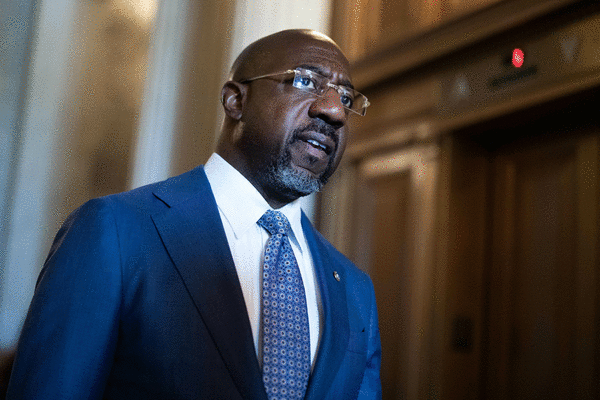
Sen. Raphael Warnock, D-Ga., hosted a roundtable with CDC workers in October in which he heard concerns about teleworking and pressed the administration for answers.
“I am deeply concerned by reports that the Trump Administration is finding new ways to drive out qualified scientists and public health experts at the CDC. If true, this is yet another attack on the dedicated public servants working to cure chronic disease and keep our country safe,” Warnock said at the time.
Next steps
The agency’s union, AFGE Local 2883, is alerting managers of possible violations of federal disability laws — but that’s not having much effect on changing managers’ behavior, according to the union’s president, Yolanda Jacobs.
“I would say that we are looking at our options,” Jacobs said when asked about possible litigation.
There are over 3,300 requests for reasonable accommodations in the CDC Accommodation Tracking System. Normally CDC staff would sort through these requests, but the agency is so understaffed that HHS has taken control of the process — which could further slow down the remote work determinations for disabled employees.
Employees who do not report to work could face disciplinary action, including removal from federal service.
“People have mechanisms to enforce their rights, and they can eventually go to federal court also,” Mathis said. “But all of that takes time and the problem with many of these employment situations is that in the interim, people may be left without a job.”
_____
©2025 CQ-Roll Call, Inc., All Rights Reserved. Visit cqrollcall.com. Distributed by Tribune Content Agency, LLC.






Comments