Ford's move to affordable trucks won't include Ranger PHEV, Super Duty
Published in Business News
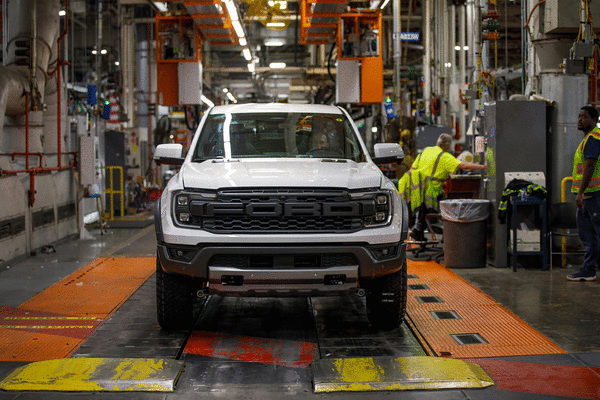
Ford Motor Co. is bringing more affordable trucks to the United States, but there are no plans to bring the plug-in hybrid and Super Duty variants of its midsize Ranger that it's betting on to expand market leadership in Europe, Australia and southeast Asia.
The Dearborn automaker this year introduced the models as it seeks to expand its share in markets where regulators are clamping down on carbon emissions and to meet ever-demanding customer needs. The full-size F-Series trucks that top sales charts in the United States often aren't as practical in international markets where streets are narrower and parking garages smaller.
As result, Ford already has vehicles that fill the space in the U.S. market that the Ranger PHEV and Super Duty are designed to fill outside of it, said Brian Bell, Ford Blue truck marketing manager. Given the cost and the demand in their home market, it doesn't make sense at this point to bring them here.
"We position the Ranger differently in the U.S. than we do the rest of the world," Bell said during a recent event with the trucks in town. "That truck is really pushing the position towards the adventure vehicle and for fuel economy ... Because we have vehicles that cover what the reason for that truck is in the rest of the world that are already here, it's not going to be enough to justify it."
In North America, Ford offers the gas-powered F-150 and a hybrid version. It also just ended production of the all-electric Lightning model, which will return in its next generation at an undisclosed time as an extended-range EV with an onboard engine as a generator to recharge its battery. The automaker also offers the Ranger midsize pickup and Maverick compact truck, which also has a hybrid version. There are no plug-in hybrid trucks.
In 2027, Ford will introduce an all-electric midsize truck starting at $30,000 that executives have described as similar in size to the Maverick. The automaker this week also scrapped plans for a new all-electric full-size truck and will instead launch new affordable gas trucks in 2029 at its new Tennessee Truck Plant.
That was all part of a $19.5 billion restructuring announcement by the automaker that includes the redeployment of plants assigned for EV products to gas, hybrid and energy storage applications.
"The industry has become more proactive than in the past," Michael Ward, analyst at Citi Research, wrote in an investor note. "Previous generations would have debated a decision like this for years, allowing the cloud to remain, and it would have looked for ways to pressure suppliers and dealers to pay for unplanned errors. Suppliers benefit from the new Detroit."
Gareth Chennells, Ranger global truck director, declined to comment on future plans internationally for the electric midsize truck coming in 2027. He noted there are companies that import Lightning and Maverick into places like Europe, but his focus is on the Ranger PHEV.
"If you come into the truck market, you have to be good at being a truck," Chennells said. "You've seen in Europe a number of manufacturers coming in with trucks that are not trucks, that are car-derived, or don't have the right payload for customer use, and they're not there anymore."
In Europe, more than 80% of pickup customers tow, outsizing the percentage of U.S. truck drivers who tow. But the market is smaller. A buyer who chooses a truck does so because the customer needs one. Cheaper, Chennells noted, isn't always the right tool for the job.
He added about North America: "You've got a plethora of EV products and trucks. You're spoiled versus us. Unfortunately, we've got one, which is Ranger."
Fortunately for Ford, the Ranger has made a name for itself. The pickup is poised to be the top-selling truck in Europe for an 11th year, and if it were broken out by its diesel, PHEV and Raptor variants, it would claim No. 1, No. 4 and No. 5.
In Australia, it's the top-selling car of any segment with a market share of almost 24% in its segment. In Vietnam, it holds closer to a 70% share with 12 years of leadership. Of the 180 countries in which Ranger sells, it is the No. 1 midsize truck in more than 20.
Still, there's more market to claim in Europe, Australia and other regions, Chennells said, with the truck's ability to haul family and provide comfort technologies appealing to lifestyle buyers as well.
Ford executives have communicated concerns about Chinese automakers increasingly bringing low-cost electrified products to global markets. In Australia, the BYD Shark plug-in hybrid ute starts at more than $38,000 ($57,900 AUD) with a 1.5-liter gas engine with roughly 5,500-pound maximum towing (2,500 kilograms) and 62 miles of all-electric range (100 kilometers). The Ranger equipped with a 2.3-liter EcoBoost gas engine begins at more than $47,700 ($71,990 AUD) with more than 7,700 pounds (3,500 kg) of maximum towing and more than 30 miles of all-electric range (49 kilometers), according to Ford's website.
"When the power from the battery runs out, you need to have the power from the engine to haul and tow anything that you are carrying or chugging along with," Chennells said. "We've seen others who've come into the marketplace ... Chinese manufacturers who put a smaller engine in the front and maybe a bigger battery, but once the battery is depleted, you're left with the 1.5-liter engine. Trying to tow a huge, great trailer ... just doesn't work."
Although the U.S. market might not benefit directly from these new variants, the learnings from them will benefit Ford's greater portfolio, Bell said.
In Europe, the PHEV between June and November has met the sales target. But the European Commission adopted increasing regulatory standards that would ban the sale of new carbon-emitting vehicles in 2035. Ford and other automakers have pushed for delays to allow the continued sale of PHEVs beyond that deadline, and the commission on Tuesday said it would back away from its pledge to allow only zero-emission new cars.
Although the Ranger PHEV seeks to address those changing market conditions, it's not just a compliance vehicle, Chennells said. It was designed to meet the demands of customers, matching the diesel model's towing and payload and surpassing its torque.
In the United States, PHEVs represent roughly 2% of the new vehicle market, and the expiration of the plug-in vehicle tax credit that some models qualified for didn't help.
"U.S. PHEV adoption is not that strong," said Stephanie Brinley, principal automotive analyst for S&P Global Mobility's Auto Intelligence service. "It's a more complex system. It’s confusing to customers. Ford's announcement was focused on hybrids and extended-range EVs. They're not pushing plug-in hybrids, which is likely in response to consumers' response to it so far. But they have a decent mix of models."
U.S. consumers also expect a smoother ride than customers of the international Ranger, which tends to be more of a work truck, she added.
Eddie Stivers, president of E.M. Stivers Inc., which has five Ford dealerships in states like Alabama, Georgia, Arizona and Iowa, agreed: "Those are products that suit the realities of international markets, but just will not resonate with the United States.
"Ford has the most diverse, most robust offering of trucks of any manufacturer in the United States," he continued. "It’s undeniable that Ford understands that sweet spot very well."
Additionally, the discontinuation of the Lightning communicates a bit of a "miscalculation," said Erin Keating, executive analyst at dealer services provider Cox Automotive Inc.
"It made sense to go in that direction because of their strengths in big medium-duty and light-duty trucks," she said. "But it was a misfire based on what those types of clients are actually looking for."
Plug-in hybrids also carry challenges with towing and other tasks that work trucks are expected to perform. But an EREV might make sense, especially with Volkswagen AG-backed Scout Motors and Stellantis NV's Ram introducing such models, Keating said. EREV popularity is also growing in the Chinese market.
The Ranger Super Duty is selling in Australia and arrives in Europe in 2026. It was tested in mining conditions in Australia and put on an autonomously driven loop. A few European defense companies are assessing the vehicle, Chennells said.
"It was designed around customers who were maxing out on payload," he said. "Because once you've got four people in the cab, and then you're trying to put some heavy equipment in the back, you start to max out the payload."
And even as customers may become more price sensitive, Chennells said market leadership offers pricing control opportunities and that Ranger ultimately offers value.
"We want to do a truck that customers can use every day," he said.
©2025 www.detroitnews.com. Visit at detroitnews.com. Distributed by Tribune Content Agency, LLC.










Comments