Americans facing a tough job market in 2025 won't get a break next year
Published in Business News
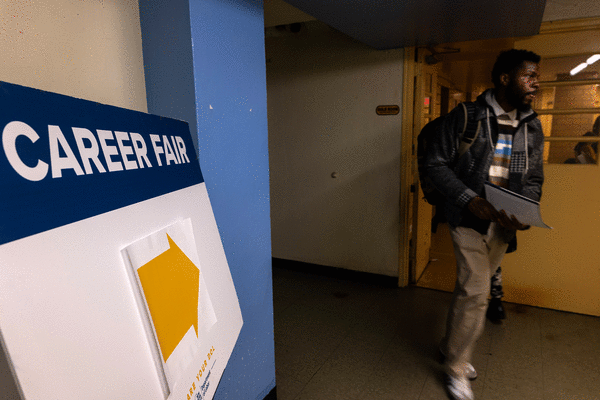
This year was a difficult one for Americans looking for work. Forecasters don’t see much improvement in their prospects coming in 2026.
The unemployment rate is set to remain elevated through almost all of next year despite solid economic growth, according to economists surveyed by Bloomberg. That unusual combination owes to the growing role of investments in artificial intelligence in powering the expansion without boosting hiring, some say.
A stagnant labor market likely means another year of limited job opportunities and cooling wage increases, exacerbating affordability concerns for American families heading into the midterm elections. It also spells an even greater reliance on the health-care sector, which accounted for nearly all job growth in 2025.
“A lot of the GDP growth we’re getting is from AI infrastructure investments, which don’t generate very many jobs, and there’s some displacement from AI,” said Diane Swonk, chief economist at KPMG. “We don’t know how much that is yet. It looks like it’s only the beginning phases of it.”
While economists say the U.S. isn’t in a recession, the second half of 2025 probably felt like it for many job-seekers. In the five months from June to November, the unemployment rate rose half a percentage point, to 4.6% — a rare development outside of business-cycle downturns.
Those with four-year college degrees were hit particularly hard, reflecting an ongoing hiring freeze across so-called white-collar occupations. While their unemployment rate remains somewhat below that for lesser-educated workers, young college graduates have seen their historical advantage in the job search disappear this year.
Hiring rates, meanwhile, looked even worse — low enough that, in decades past, they would have been consistent with even higher levels of unemployment. And layoff announcements have picked up in recent months, adding to Americans’ malaise about the job market.
Workers outside of health care, in particular, have had a difficult go of it: Excluding that sector, nonfarm payroll employment actually fell in the first 11 months of 2025.
There are some positives for the outlook. The Federal Reserve has cut interest rates this year and is expected to continue doing so in 2026, and tax cuts alongside some potential easing in the Trump administration’s trade policies — a major source of uncertainty for small businesses this year — should also help, said Michael Pugliese, a senior economist at Wells Fargo & Co.
But first, there is “probably still a little more labor-market weakening to go, whether that’s another tick or two higher in the unemployment rate,” Pugliese said.
All of that has already added up to slower wage growth as the balance of power in the labor market has continued to shift from workers to employers. It’s a sharp turnaround from 2022 and 2023, when workers had the upper hand and employers were forced to offer higher pay to attract talent.
A Harris Poll conducted for Bloomberg News in October showed 55% of employed Americans were concerned about losing their jobs, and nearly half said they thought it would take at least four months to find a new job of similar quality if they lost their current position.
Various measures of wage growth show pay is now rising at the slowest rate in four years, and low-earners are seeing pay rise by less than top earners — worsening the so-called “K-shaped economy” trend of widening inequality this year.
That’s a risk for Republicans, who were elected to majorities last year in part due to widespread anger over rising prices that exacerbated cost-of-living concerns, as they head into the 2026 campaign season.
“Overall wage growth will likely come close to the pace of inflation, and likely maybe even go a little above overall inflation,” KPMG’s Swonk said. “But the problem is the distribution of wages.”
Black unemployment
Inequality is also increasingly noticeable in who is being hired in the first place. Black Americans have seen their unemployment rate shoot higher over the last several months — to 8.3% in November, from 6% in May — and the ratio of Black to White unemployment now matches the highest level since 2019.
While some of that increase reflects more Black Americans joining the labor force, Black workers historically have been disproportionately impacted whenever the U.S. job market loses steam. The Trump administration’s efforts to shrink the federal workforce, where Black workers are overrepresented, has only added to the difficulties they’ve faced in an already-challenging employment landscape this year.
Michelle Holder, an economist who studies labor-market outcomes for Black Americans, said there is a risk Black unemployment continues to trend higher in 2026.
“Even if the overall unemployment rate continues to revolve around the same 4.6% level, trends are pointing that the fallout of a stagnant economy is increasingly falling more and more heavily on the shoulders of Black workers,” Holder said.
Economists surveyed by Bloomberg said they expect gross domestic product to grow 2% in 2026, powered by solid consumer spending and strong business investment. Yet hiring is set to remain muted as in 2025, and the unemployment rate will be higher on average next year than this year, according to the median estimate.
While respondents said they anticipate the unemployment rate could fall slightly by the end of 2026, Veronica Clark, an economist at Citigroup Inc., warned the risks are “skewed toward worse outcomes” if hiring fails to pick up.
“This has been a very prolonged period of such low hiring that until that changes, you would be worried that the next step would be larger layoffs,” Clark said.
(With assistance from Dana Morgan.)
©2025 Bloomberg L.P. Visit bloomberg.com. Distributed by Tribune Content Agency, LLC.









Comments