Plans for huge new oceanfront battery storage plant are withdrawn following disastrous Moss Landing fire
Published in Business News
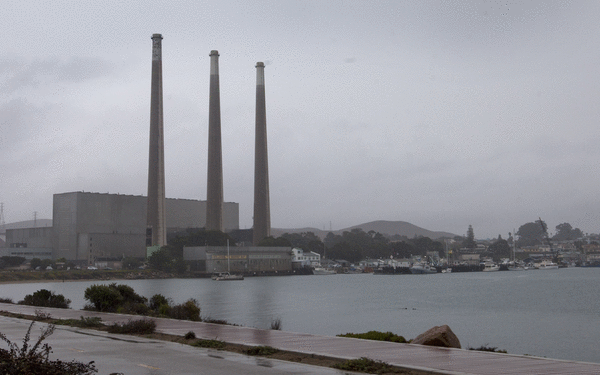
The Texas company that owns the battery storage plant at Moss Landing, California, that burned in a spectacular fire in January, raising questions nationwide about the safety of the fast-growing renewable energy technology, has withdrawn plans to build a similarly-sized battery storage plant in the adjacent county.
Vistra, based in Dallas, has notified the California Energy Commission that it is dropping efforts to secure state permits to construct a 600-megawatt battery storage plant in Morro Bay, a coastal town in San Luis Obispo County.
The proposed plant would have been one of the largest in the United States with thousands of lithium-ion batteries capable of storing enough electricity for 450,000 homes. Vistra did not announce the decision to halt the project publicly or notify city leaders, despite having advocated for it over the past four years.
The information became public in recent days when local media outlets in San Luis Obispo County confirmed with the energy commission that the company had withdrawn the project.
“The comprehensive review and investigation of the incident at our Moss Landing facility is ongoing,” said Meranda Cohn, a Vistra spokeswoman, “which will inform current and future energy storage operations across our fleet.”
The company has not given a reason for halting the Morro Bay project, which was being watched across the state by renewable energy interests.
Residents of Morro Bay opposed it. Last year they approved a ballot measure by a 60-40% margin to prohibit its construction with future voter approval.
After the Moss Landing fire on Jan. 16, which spread 55,000 pounds of toxic heavy metals on the surrounding area, according to a San Jose State study released this week, and forced the evacuation of 1,200 people and closed Highway 1 for three days, Morro Bay’s opposition stiffened.
Two weeks after the fire, the Morro Bay City Council voted 5-0 to impose a two-year moratorium on the construction of battery plants in the town, a scenic fishing and tourism community of 10,000 residents known for Morro Rock, a giant natural landmark at the edge of its harbor.
“The Moss Landing fire had a huge impact,” said Morro Bay Mayor Carla Wixom. “People were afraid. They were angry. It was like ‘oh my gosh — if that could happen to them, it could happen to us.'”
Like the Moss Landing facility, Vistra also proposed building the Morro Bay plant on the site of a former 1950s-era PG&E power plant on the oceanfront. The Morro Bay site is well-known for three towering 450-foot concrete smokestacks, which, similar to the two 500-foot tall former PG&E smoke stacks at Moss Landing in Monterey County, are among the tallest structures on the California coast between Los Angeles and San Francisco.
Vistra attempted to go around Morro Bay’s opposition by using a state law, AB 205. Signed by Gov. Gavin Newsom in 2022, the law allows corporations to secure approval from the California Energy Commission for renewable energy projects, even when the projects are slowed or denied by local cities and counties. The energy commission’s five members are appointed by the governor.
Vistra announced in April that it would pursue that route.
But in an email Oct. 10 to Eric Knight, siting branch manager for the California Energy Commission, Cathleen Colbert, Vistra’s senior director for Western markets, said that “the project is no longer being advanced.”
The 107-acre oceanfront site in Morro Bay “remains in our ownership and perhaps we will revisit plans for redevelopment sometime in the future,” Colbert added.
She did not cite a reason for the shift, citing only “some challenges with the project.”
The cause of the Moss Landing fire, which Vistra reported was a $400 million loss, remains under investigation.
California has seen a massive increase in the growth of battery storage plants in recent years, going from 17 in 2019 to 248 today. Many more are planned across the Bay Area, in the Central Valley and Southern California.
The plants store electricity generated by large solar and wind farms to release back on the power grid at night when the sun isn’t shining, or the wind isn’t blowing.
California lawmakers have set a goal of generating 100% of the state’s electricity from renewable and carbon-free sources by 2045.
Earlier this year, Assemblywoman Dawn Addis, D-San Luis Obispo, introduced a bill in Sacramento to prohibit construction of new battery storage plants near homes, schools, parks and hospitals. It died amid opposition from labor unions and the renewable energy industry. Addis opposed the Morro Bay plant.
“There is understandable concern around safety,” Addis said. “Vistra has told me they are focused on Moss Landing — getting the results of the investigation and finishing with the cleanup. I am pleased they are maintaining their focus on Moss Landing. The investigation and cleanup could take years.”
Vistra acquired the Moss Landing and Morro Bay sites in 2018 after merging with Dynegy, another Texas energy company that had purchased them. Both properties are valuable because they are connected to high voltage power lines that move electricity across California. Years ago, they burned oil and natural gas, and PG&E used ocean water to cool them.
Morro Bay’s mayor, Wixom, said she would like the Morro Bay site redeveloped into businesses or other facilities that serve tourism, fishing and education.
“I’m not against battery storage,” she said. “But there are a million places you can build it away from populated areas. The risk isn’t worth the reward.”
Wixom noted that a high school and hundreds of homes are located near the site, which closed in 2014 amid tougher state rules about pumping seawater.
“I want us to be a beach town where people can paddle board and surf without the fear of a plant burning,” she said.
Wixom said she worries that Vistra will eventually bring the battery plant idea back.
“You feel like David and Goliath,” she said. “But we know how that ended.”
©#YR@ MediaNews Group, Inc. Visit at mercurynews.com. Distributed by Tribune Content Agency, LLC.










Comments