How AI is quietly reshaping your shopping trip
Published in Business News




From the recommendations on a store’s app to the prices flashing on digital shelf labels, artificial intelligence now shapes what shoppers see, what they buy and how products reach the shelves.
Until recently, most of it has happened behind the scenes. But retailers, including Target, are rolling out features that interact more directly with customers— a shift that could accelerate AI use and make the technology more visible.
“Every step of the way, from discovery to trial to purchase, whether it’s online or in-store, AI is embedded into all of that,” said Toopan Bagchi, managing director of Starship Advisors.
Gen AI and the supply chain
Before products reach shelves, retailers are already using machine learning to predict demand, plan shipments and reroute inventory.
But generative AI — today’s technology buzzword — could take that a step further, said Dayton Steele, assistant professor of supply chain and operations at the University of Minnesota’s Carlson School of Management.
Unlike machine learning, generative AI can pull from unstructured data such as videos, customer reviews and social media chatter. It also can track which items shoppers pick up and put back via sensors, potentially improving on-shelf availability at individual stores.
For now, Steele said, generative AI isn’t capable of operating independently, likening it to a “B+ student that can do a lot of tasks at a B+ level.”
He added that AI performs best with historical data, such as last year’s weather or inventory trends, while humans can draw on context to respond to unexpected events, like the COVID-19 pandemic.
“In the next few years, we’re going to see companies rapidly adopt AI to replace human workflows,” Steele said. “And then you’ll have shocks or disruptions where humans can respond in much more agile ways.”
A personalized shopping experience
AI powers the product descriptions, review summaries and recommendations that appear on retailers’ apps — and it’s poised to change how people purchase items.
Several retailers have announced partnerships with OpenAI that enable shoppers to purchase items directly through ChatGPT.
Target said it will be one of the first major retailers to allow multiple items to be purchased in a single AI-assisted transaction. Walmart made a similar announcement in October.
It’s a move retailers say is focused on adapting to consumer’s changing habits, though some are wary of the purported benefits. Deloitte’s holiday survey found 33% of people plan to use generative AI in their shopping journey this year — more than double last year’s share.
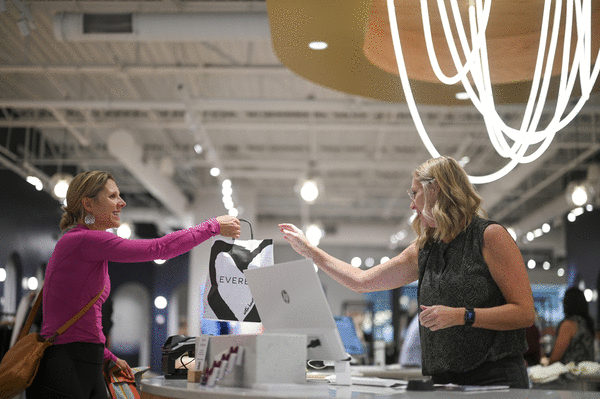
Edina-based Evereve uses Shopify for both its online and brick-and-mortar operations. The e-commerce platform is partnering with OpenAI to bring the retailer’s women’s clothing to ChatGPT, where shoppers will be able to make purchases directly through the chatbot.
“Someone can type, ‘I’m looking for a dress to wear to a summer wedding in a tropical place in February. I’m this tall. I have an athletic build,’” said Tamer Selim, chief technology officer at Evereve. “The AI uses that information, as well as the data it has available, to try to find a match.”
The chatbot can also draw from earlier conversations, such as a shopper’s usual size or location, to refine results.
Most retailers already pull from vast troves of consumer data, including credit card transactions and social media activity, to improve recommendations on their apps. Those streams of information will now be combined with the habits of similar shoppers to predict what a consumer might want next — even if it’s never crossed his or her mind.
That kind of targeting can help people find items that match their preferences. But it can also blur the line between helpful personalization and subtle manipulation, said Ali Makhdoumi, an associate professor at Duke University who studies data markets and privacy.
“Once you realize, ‘Oh, this is not a good quality product, I don’t want to use this,’ they’ve already offered you something else,” Makhdoumi said. “And they keep dragging you into this behavioral manipulation.”
Smarter shelves and shifting prices
There are growing concerns about how AI will affect the white-collar workforce. Major companies, including Amazon, Target and Verizon, have cut thousands of corporate jobs while pointing to new AI investments.
Now analysts and consumers are asking similar questions about stores.
Inside stores, retailers are looking for ways to use AI for time-consuming tasks like changing price stickers. Walmart began installing electronic shelf labels last year, allowing prices to update within seconds.
That speed could also open the door to potential price gouging or dynamic pricing that shifts based on demand, supply and competitor moves, retail experts warn.
AI’s rise has also sparked questions about its effect on in-store hiring. Some argue the technology frees employees to focus on customer service, while others worry it gives retailers an incentive to hire fewer workers.
“It’s a labor-intensive thing when you’re trying to update the prices across an entire store physically. That’s an activity that would have taken multiple people, multiple days,” Bagchi said. “And now, once it goes all electronic, it’s just a matter of one person doing it in a matter of minutes or hours.”
Job placement firm Challenger, Gray & Christmas projected the smallest seasonal hiring increase for retailers since the 2009 recession.
Both Walmart and Target have rolled out AI-infused apps for workers, which includes features like a chatbot that can answer common customer service questions, such as how to process a return without a receipt. Walmart’s platform can also translate more than 40 languages in real time.
AI can also help store employees spot shelves that need restocking by flashing a light where an item is running low.
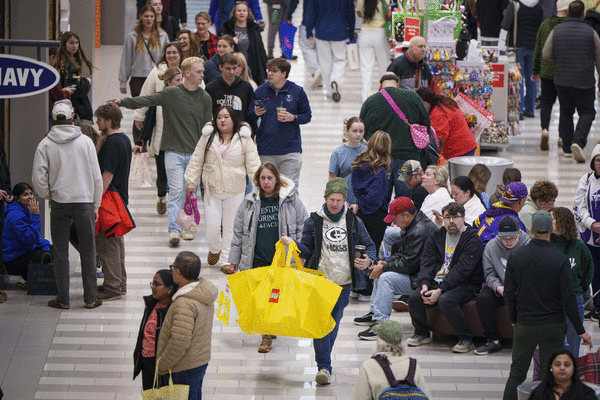
Despite the advancements, AI’s impact on holiday shopping will be “relatively limited” this year because not every retailer offers useful tools and not every customer wants to use them, said Brad Jashinsky, a senior retail analyst at research firm Gartner.
But the technology is expected to continue reshaping retail operations.
“The more retailers that launch these tools, the better they get, and the more that consumers get comfortable and start to seek them out,” Jashinsky said. “But customer behavior takes a long time to change.”
Walmart’s outgoing CEO Doug McMillon told the Associated Press in September that employees are enthusiastic when the tools eliminate extra steps. He said he expects most workers will be affected in some way by AI.
“I think no one knows how this is going to play out exactly,” he told the AP. “The way it feels to me is that basically every job gets changed. And I think the best way to think about it is getting ‘plussed up.’ So how can I lean in the role that I have, regardless what that role is, to adopt new tools, leverage them and make things better than they would’ve otherwise been?”
©2025 The Minnesota Star Tribune. Visit at startribune.com. Distributed by Tribune Content Agency, LLC.











Comments