A St. Louis suburb has a deer problem. Are bowhunters the answer?
Published in Outdoors
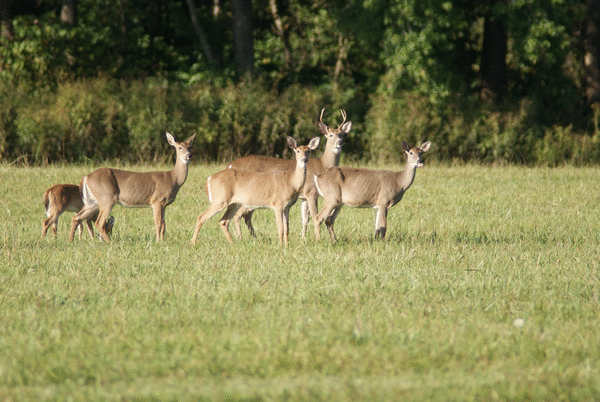
WILDWOOD, Mo. — St. Louis County's largest suburb, known for leafy subdivisions and wooded hills, has a deer problem.
There are far too many, by official counts. And that carries risks: car crashes, property damage and the spread of ticks that carry disease. The city is in the middle of a five-year plan to trim the population by paying specialists to bait and shoot hundreds of deer each winter.
But local hunters, backed by some city council members, want the city to stop. The city is killing too many deer to be sustainable, they say. It's spending hundreds of thousands of dollars to do it. And it's ignoring hunters who are offering to help, at no cost.
"Not only did they overkill, they overspent," said Tom Mitchell, a longtime bowhunter and leader of the Wildwood Conservation Alliance. "They went to the most extreme measure to kill deer rather than come to the hunting community."
Most officials say relying on bow hunting to cull deer comes with a range of complications. It's harder to kill high numbers of deer quickly with bows. Individual hunters accessing private properties poses more headaches for regulators. And the city's need is too great right now.
"This isn’t about pushing hunters away at all," Councilman Joe Farmer said. "It's about taking a very serious problem in the city and trying to solve it in the most effective way for the vast majority of our residents."
The debate in Wildwood is the latest turn in an issue that has troubled suburbs across much of the region in recent years. As development moved west, cul-de-sacs paved over deer habitat, SUVs replaced natural predators and cities began to take measures to thin deer herds to sustainable numbers. Nearly all ban people from feeding deer.
Many municipalities, from Eureka to Creve Coeur, allow archery hunts in parks and conservation areas or on large private properties — if their owners give permission.
Three cities — Wildwood, Town and Country, and Des Peres — also pay a wildlife nonprofit, Connecticut-based White Buffalo Inc., to bait deer to specific locations and shoot dozens to hundreds each year at close range. The culling takes place over a few weeks in January and February, scheduled in advance, on properties whose owners agree to take part. The deer meat is donated to food pantries, the St. Louis Zoo or wolf reservations.
White Buffalo did not respond to requests for comment for this story.
But municipal officials say the nonprofit has proven to be the best method for safely trimming deer numbers.
Cities hire White Buffalo
Town and Country, which does not allow archery hunts, was the first to hire White Buffalo in 2011. The city has paid the firm more than $900,000 to date; it has brought down the deer population to near 30 per square mile from 60, City Administrator Bob Shelton said. Deer and car collisions dropped from 80 a year to 40 a year.
Aldermen there voted 5-2 to renew White Buffalo's contract in December; Shelton said the city expects not to hire White Buffalo again in 2027 because it will have met its population goal of fewer than 30 per square mile.
Des Peres allowed hunting starting in 2020, then hired White Buffalo in 2023 after hunting alone didn't prove enough, said City Administrator Scott Schaefer. Deer are down to 25 per square mile, from 60 per square mile four years ago.
"It’s been extremely effective and very well received," Schaefer said.
But deer are particularly a problem in Wildwood, which spans 68 acres and includes subdivisions of homes on 1-acre lots and 3-acre estates amid farmland and wilderness.
The city hired White Buffalo in 2023 after recording an average of 240 deer-related crashes a year and counting 72 deer per square mile. Its plan called for killing 1,000 deer across 30 acres over five years, with a goal of having about 40 deer per square mile.
The firm culled 661 deer in northeast Wildwood, north of State Route 100 and east of State Route 109, over the past two years. That reduced the population to roughly 40 to 50 per square mile in those areas, officials say.
But hunting groups packed city council meetings for weeks claiming the city was vastly undercounting the number of deer killed.
"I noticed, I'm not seeing deer — not on my property, not in the crop fields nearby," said Mitchell, who lives in the area where deer were culled. "When I say I saw no deer, I mean no deer."
He estimated White Buffalo left six to 12 deer per square mile.
Wildwood City Administrator Thomas Lee stood by the city's count, which he said used the statistical methods recommended by the state conservation department.
Still, hunters urged the council to not renew its contract with White Buffalo.
Bowhunters push for change
The bowhunters argue they can kill enough deer to bring the population down to safer numbers while keeping the herds viable.
"This is a polished, professional group that is energized and wants to do this service for the city at no charge," Mitchell said in an interview. "We’re not a bunch of rednecks."
The bowhunters are pushing Wildwood for access to more properties, including 1-acre lots, as is allowed in neighboring cities. The city now requires at least 3 acres of land for any hunt.
"It would be a huge change," said Michael Sherman, a resident who leads Certified Bowhunters of St. Louis County, which works with property owners in other west St. Louis County cities.
The group carries a $2 million insurance policy, trains and vets its hunters, agrees to most conditions homeowners set and removes deer without a trace, he said. They killed 126 so far this winter.
"All these other areas have it figured out and have been doing it all these years with no complaints," Sherman said. "I don’t know why Wildwood hasn't followed suit."
In December, the bowhunters won a temporary victory when only eight Wildwood City Council members voted to renew White Buffalo's contract — with two absent members, the tally was one shy of the nine votes necessary to pass.
The city had paid more than $470,000 for the culling so far, and in December, was set to approve a third-year of culling another 239 deer for $224,783.
Councilman Scott Ottenberg, who voted against renewing the contract, said he wanted to see if the city could save the cost. He got the council to approve a council committee to study if bowhunters could do the work.
"They deserve a chance to at least show how effective they can be," Ottenberg said. "They have come forward to do this at no charge."
Then, last month, a full city council voted to revisit White Buffalo's contract.
But Lee, the city administrator, said last week that it was too late to bring White Buffalo back this winter.
And that means Wildwood will have more deer to contend with this spring, he said.
"It's going to sting," he said.
© 2026 the St. Louis Post-Dispatch. Visit www.stltoday.com. Distributed by Tribune Content Agency, LLC.






Comments