Omar Kelly: Drafting a QB every year isn't the answer, having legitimate competition is
Published in Football
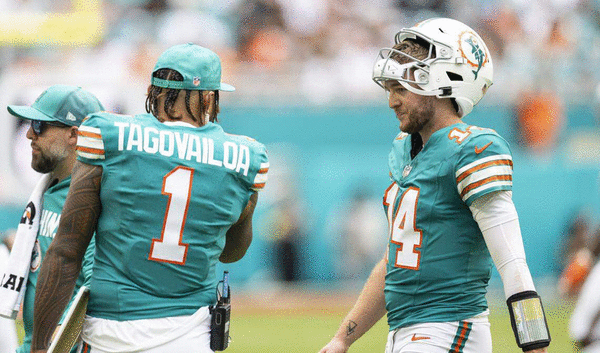
MIAMI — This is what being down bad looks like in the early stages of an NFL franchise’s rebuild.
It’s adding an aged veteran (Trent Green, Chad Pennington or Ryan Fitzpatrick) who has had success in spurts, and having him compete with a young quarterback (John Beck, Chad Henne or Josh Rosen) who is supposed to have upside.
The Miami Dolphins have done this dance so many times during its walk through the wilderness in life after Dan Marino, this is basically the NFL equivalent of the Cha-Cha Slide.
Everybody chap their hands ...
New general manager Jon-Eric Sullivan and head coach Jeff Hafley are supposed to stop South Florida’s NFL franchise from continuing this loser two-step.
They each come from the most storied franchise when it comes to drafting and developing quarterbacks, and have consistently vowed to implement the Ron Wolf way in Miami.
“I grew up in Green Bay. You know the history there. I was not with Ron Wolf, but Ron Wolf’s fingerprints were all over what we did,” Sullivan said at last week’s NFL Combine.
“I think back when Aaron [Rodgers] was our starter in 2008, but he was a young quarterback, [and] was not Aaron Rodgers yet. We drafted Brian Brohm in the second round and Matt Flynn in the seventh,” Sullivan continued. “If you just look at the history of what Ron did and who Brett Favre’s backups were with [Matt] Hasselbeck, Aaron Brooks and Ty Detmer, and you can go on and on [to quarterbacks like] Kurt Warner, I don’t think you can ever have too many quarterbacks.
“The value of the position cannot be overstated,” Sullivan said. “I think that you have to infuse as much competition into that room every year that you possibly can.”
Upon his hiring, Sullivan, who described the Dolphins as a “quarterback-needy team,” pledged that he will draft a quarterback at least every other year because that’s what the Packers did.
Problem is, history shows that’s an exaggeration of the truth.
A fib told with good intentions, but the reality is that during Sullivan’s 22 seasons with the Packers, the organization the Dolphins’ newest circle of trust came from used fewer resources to address the quarterback position than the Dolphins did in the same time span.
The Packers, who went from Favre, a first-ballot Hall of Famer, to Aaron Rodgers, who will eventually become a first-ballot Hall of Famer, to Jordan Love, drafted eight quarterbacks since 2004.
And only three of those eight were selected before the fourth round, with two of them — Rodgers and Love — being first-round picks.
If we’re going to factor in trades, the Packers used nine draft picks to acquire quarterbacks because Green Bay sent a 2025 seventh-round pick to acquire Malik Willis, who is supposedly the hottest free agent quarterback on the market this offseason, from the Tennessee Titans two years ago.
Let’s compare that to the Dolphins, which drafted eight quarterbacks — John Beck (second round), Chad Henne (second round), Pat White (second round), Ryan Tannehill (first round), Brandon Doughty (seventh round), Tua Tagovailoa (first round), Skylar Thompson (seventh round) and Quinn Ewers (seventh round) — during that same 22-year time span.
And if we factor draft picks the Dolphins shipped to other teams to acquire quarterbacks via a trade, that number grows to 14 because Miami acquired A.J. Feeley for a second-round pick in 2004, Daunte Culpepper for a 2006 second-round pick, Trent Green for a 2008 fifth-round pick, Tyler Thigpen for a fifth-round pick in 2009 and Josh Rosen for a 2019 second- and 2020 fifth-round draft picks.
And that doesn’t even factor in the $13 million Miami rented Jay Cutler for in the 2017 season.
My point is that it is not about the resources used to address the most important position in sports. It’s about getting the pick, the selection, the talent evaluation, right.
The Packers have been one of the more stable franchises in the NFL because they’ve slow cooked quarterbacks, pivoted when the time was right, and most importantly, weren’t afraid to have quarterbacks compete.
They weren’t concerned with everyone’s ego, and feelings, which has always been an issue in Miami in life after Marino.
The last time Miami had a legitimate quarterback competition for the starting role was the summer of 2012, and it only occurred because David Garrard sustained a season-ending knee injury playing with his children in their home’s pool on a training camp off day, and the two quarterbacks he had smoked all training camp — Tannehill, a first-round pick that year, and Matt Moore, the team’s MVP the previous season, competed for all of one week before Miami called the competition when Moore struggled replacing Tannehill during a hail storm in a preseason game against the Carolina Panthers.
Tannehill never won the starting job. He was given it, and most of his teammates never believed in him, seven years later.
That was 14 seasons, and plenty of bad decisions ago, and if we’re being honest, very little has changed.
While there isn’t a singular person to blame Miami’s quarterback crisis on, the franchise’s soft culture, which fuels the entitlement many of these quarterbacks have had, deserve ownership for the quarterback crisis this franchise finds itself in as they prepare for life after Tagovailoa.
Sullivan and Hafley vow to change that.
Let’s hope their words are backed up by action.
____
©2026 Miami Herald. Visit miamiherald.com. Distributed by Tribune Content Agency, LLC.




Comments