'Everything's cyclical': Examining the upshot of a wild NFL hiring cycle that featured the Steelers
Published in Football
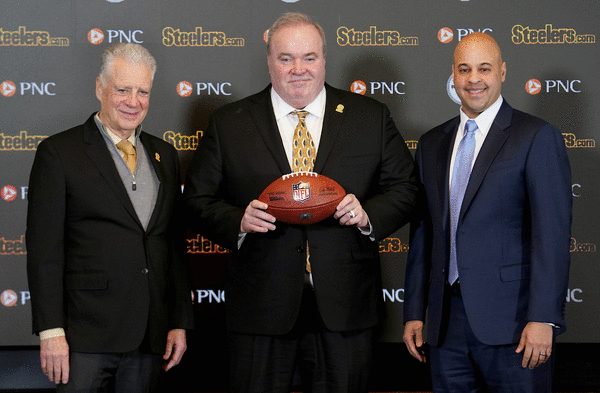
PITTSBURGH — The defensive success the Minnesota Vikings had in 2006 led to their young coordinator Mike Tomlin becoming a first-time head coach. But if not for even more success enjoyed by another NFC North team that postseason, "Steelers coach Ron Rivera" could've been a real possibility.
"Riverboat Ron" would've been an even better nickname at the confluence of the Allegheny, Monongahela and Ohio, but it wasn't to be. The Chicago Bears kept advancing in the playoffs, all the way to the Super Bowl, and in the meantime the Steelers were so impressed with Tomlin's second interview that they didn't bother waiting around for Rivera's run to finish.
"That's pretty much it," Rivera recalled by phone recently. "But the truth of the matter is they got the right guy because they're very thorough in the way they do things."
Rivera's involvement last time the Steelers had to replace a head coach has been relegated to a footnote, but the 2026 NFL coaching carousel won't soon be forgotten. Not with 10 openings, a few huge names leaving perennial playoff teams and — here in Pittsburgh — the Steelers finding themselves on the merry-go-round, too, for the first time in nearly two decades.
All 10 seats have been filled now in the annual game of musical chairs around the league, although the Las Vegas Raiders can't officially come to terms with Seattle Seahawks offensive coordinator Klint Kubiak until after the Super Bowl. The Raiders decided to play the long game and wait out the architect of Seattle's upstart offense, while the Arizona Cardinals weren't far ahead of them, waiting for Los Angeles Rams offensive coordinator Mike LaFleur.
"We're in a competitive league," said commissioner Roger Goodell at his annual news conference ahead of the Super Bowl. "We had 10 openings this year. Teams are trying to get the coaches they think can win. I think taking the time pressure off of that is one of the things we focused on as a league, and the policy to give them that time, so they can make a really good decision."
Goodell also called the turnover within the coaching ranks "pretty extraordinary for our industry." And two of those jobs, in Pittsburgh and Buffalo, didn't open until after the first round of the playoffs.
That made the timing element of it particularly difficult for the Steelers and Bills. The eight other teams had a head start on preliminary interviews, coaching candidates in the postseason and how wide to cast their net.
"It was a sprint to the finish," is how Baltimore general manager Eric DeCosta described the Ravens' process. "We talked to at least 20 candidates in different formats — [via] Zoom, in person, on the phone."
The search process
In the end, the Ravens were near the top of the league in completed interviews, along with Las Vegas and Tennessee — which fired Brian Callahan way back on Oct. 13. According to the interview tracker from NFL.com, the Ravens had 16 known interviews, while the Titans had 19 and the Raiders 15.
Comparatively, the Steelers had nine, with three of those advancing to the in-person stage. That was the fewest of any team, when accounting for interviews either requested or scheduled. But if their approach this time around was similar at all to the previous search, perhaps they went for quality over quantity in terms of vetting candidates.
"I really appreciated it, and probably one of the best things that really helped me was afterward, I did a debriefing with the Rooneys and Kevin," Rivera said, referring to former general manager Kevin Colbert. "And they were very good because they gave me some great information.
"The thing everybody has to understand is some [teams] know exactly what they're looking for, and others want a chance to go through the entire process and be very thoughtful and deliberate in the decision."
Rivera, 64 and now a college general manager at California in the ACC, actually was involved in this cycle, as well. He was one of 13 to have at least one interview with the Cardinals, but he did not wind up as a three-time NFL head coach.
Only McCarthy can say that this year. In the end, though, this offseason saw four teams choose former coaches and the other six go with rookies (at the NFL level at least). The Steelers picked McCarthy, the New York Giants picked John Harbaugh, the Titans picked Robert Saleh, and the Falcons picked Kevin Stefanski.
Buffalo spoke with 10 candidates just to land on Joe Brady as an internal promotion from offensive coordinator. Two of the other new NFL head coaches beyond Kubiak and LaFleur were both on the Steelers' initial list: Jeff Hafley in Miami and Jesse Minter in Baltimore. And Cleveland settled on Ravens offensive coordinator Todd Monken.
"Everything's cyclical," Rivera said, "When you go through certain cycles, some people sit there and go, 'You know what, maybe what we need more than anything else is a veteran point of view or veteran perspective.' I think the really cool thing about what [the Steelers] did with Mike is they went with a guy who understands Pittsburgh. I know this is a homecoming for him, but he understands Pittsburgh, and he's also a very good football coach. He's had a lot of success wherever he's gone, and I think that's what they're banking on, is for him to pick up where they left off and change a few things."
Eye on Rooney Rule
What this round of coaching hires didn't have much of was racial diversity, an NFL topic the Steelers are uniquely tied to given the Rooney Rule. Only one minority head coach was hired in Saleh, who is of Lebanese descent. The league now has just five non-white head coaches: Saleh, Dave Canales in Carolina, Aaron Glenn with the New York Jets, DeMeco Ryans in Houston and Todd Bowles of Tampa Bay.
Every team, including the Steelers, complied with the expanded Rooney Rule to complete at least two in-person interviews with a minority candidate. The result is a "colossal disappointment" to N. Jeremi Duru, a sports law professor at American University who often appears alongside Jim Rooney, son of Dan and brother of current team president Art II, to discuss the impact of the initiative that bears their family name.
"It's upsetting. I don't know what's driving it," said Duru, who's in the San Francisco area where much of the league is gathered for the big game. "I know that not every club has the same commitment to casting a wide net and thinking very openly about their opening. But this is not an outcome that can inspire anybody."
Specifically, Duru wonders why Seahawks assistant head coach Leslie Frazier didn't get any interviews. Frazier, 66, was 18-29-1 as the Vikings head coach from 2011-13 and later had defensive coordinator stints with the Buccaneers and Bills. Duru also noted that Anthony Weaver, who met with the Steelers virtually and in person, had several opportunities but struck out entirely.
The Rooney Rule now awards two compensatory draft picks to any team that has a minority assistant or executive hired to be a head coach or general manager. But Duru doesn't think the competitive nature of the NFL is causing that to be a deterrent. He's more concerned that teams aren't going into their searches with an open mind and are instead just doing the bare minimum to satisfy league policy from a diversity standpoint.
"There's certainly some suggestions in that direction," Duru said. "There's certainly reason to believe there's some box-checking going on. The whole idea behind the Rooney Rule is it's got to be a meaningful interview. ... A club who doesn't take it seriously, isn't meaningful about it, checks the box, that damages the club because now the club has not done as exhaustive a search as they should have done for them. And, of course, it damages the rule, and in my view it damages the league because it just pays lip service to a really important concept and one that was core to Dan Rooney's philosophy."
Inevitably, some of these hires will hit and some won't, regardless of age, race or anything else. Next year, some young, ascending coordinators could rise to the forefront of wishlists for franchises that find themselves back in the market.
Tomlin could even re-enter the fray, which would be fascinating all around. In the AFC North division alone, the Ravens hired a new coach who's two decades younger than McCarthy. For the Browns, Monken just turned 60 but has never been in these shoes before. Elsewhere in the AFC, the Titans' new hire has a career winning percentage 250 points below McCarthy's.
But the bets have been placed, staffs are taking shape and the Steelers' commitment to McCarthy will be judged against this class of new coaches forever. At least one guy they considered long ago has a feeling it can work.
"They always used to say the hardest job to take in the NFL is to follow someone who's had tremendous success because it's always tough," Rivera said. "I think the big thing, though, is with time — and hopefully everyone kind of takes a deep breath and lets it unfold — it's really about getting the veteran guys to know him and buy in. Just look at Mike's track record. The success he's had, there's a good indicator guys have bought into him."
© 2026 the Pittsburgh Post-Gazette. Visit www.post-gazette.com. Distributed by Tribune Content Agency, LLC.





Comments