Sam McDowell: Andy Reid will return in 2026. But the Chiefs still require some change.
Published in Football
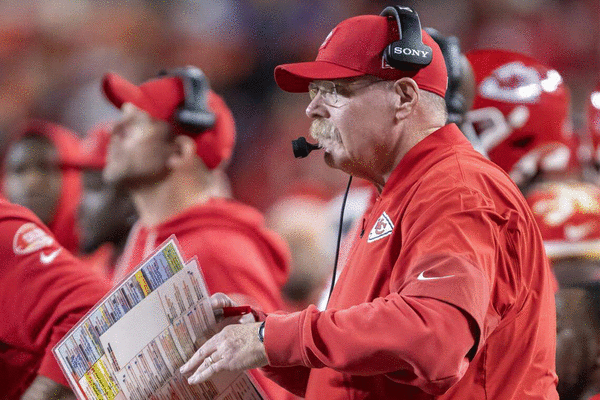
KANSAS CITY, Mo. — The first losing Chiefs season in more than a decade will prompt some change this offseason, the extent of the change to be determined, and all of it will unfold while the star quarterback endures a months-long rehab from knee surgery.
It’s a distinctive time in Kansas City.
But it will come with a constant.
Andy Reid said Monday he unsurprisingly plans to return as the team’s head coach for 2026 — well, “as long as they’ll have me,” he quipped — marking his 14th year with the Chiefs after he spent 14 seasons in Philadelphia.
Reid has most certainly earned the right to bounce back from a season gone so awry, and that’s not because he deserves a trophy for his past success. It’s because the past success — you know, the three Super Bowls and seven straight trips to the AFC championship game or better — didn’t just fall from the sky.
But this season has illustrated that the return of those results, even with the return of the coach at the center of them, will require some change.
A year without the playoffs ought to leave some hard lessons — most critically that having the most talented quarterback in the league isn’t enough. There has to be more.
The offense, designed and called by Reid, reminded the world just how difficult it is to play quarterback in the NFL, while the rest of the league has intentionally made the point of making things as easy as possible for their quarterbacks.
Patrick Mahomes can mask a lot of deficiencies, but when an opposing defense has only one dimension with which to concern itself — well, it looks a lot like it did this year.
It is not uncommon for highly successful offensive schemes and game plans to get decoded over time, especially when that offense produces the most decorated NFL run of the last two decades. The Chiefs were ahead of the curve, so of course the league would spend considerable time trying to figure out how to catch up. It’s hard to stay ahead of the curve, but the first step is a recognition that you no longer are ahead of it.
In the last two seasons combined, the Chiefs have scored 30-plus points just five times. Only six teams have done it fewer times, and their combined record over that span is 44-154.
The Chiefs have scored 31-plus points only twice in the last two seasons. Only the Raiders have done it fewer.
That’s not the type of company the team that employs Mahomes should be keeping.
There are far worse quarterbacks running offenses that are putting up better numbers. The Daniel Jones and Gardner Minshew-led Colts topped 31 points 10 times in the last two years — five times the amount of the Chiefs.
The Chiefs will finish 15th or worse in scoring for the third straight season.
They have to ask themselves why and, most importantly, how. What are other teams doing? How are they doing it?
What they should find: The Chiefs have made playing quarterback in Kansas City a tougher assignment than playing quarterback in cities elsewhere.
In response to teams like the Chiefs — really, players like Mahomes — the league has stacked the field with smaller but faster players who can cover. Several of the top teams in football, even those who employ elite quarterbacks, have responded by running the ball more frequently and, thanks to the defensive schemes designed to stop the pass, running the ball more effectively.
The Chiefs have somehow run the ball worse.
So guess what defenses opt to defend?
The Chiefs face the most light boxes in the league — those designed to play the pass and concede the run — and yet they are 24th in yards per contact, 26th in yards after contact, dead last in avoided tackles and dead last in yards generated from explosive rushes on non-quarterback scramble plays. (All of that data is sorted through on FTN Fantasy.)
The Bills, by an example of contrast, rank top-10 in the NFL in all of those rushing metrics, and they run the ball more frequently than any team in the league. They’re committed to it.
Guess what defenses opt to defend? The Bills face far more congestion at the line of scrimmage, and far less of it in the secondary. It sure makes life easier for Josh Allen.
It turns out that the best passing games are those that have the privilege of passing against defenses who actually have to worry about stopping the run. The Chiefs don’t afford themselves that opportunities.
That has to change, and that change must derive from better personnel and scheme alike. The Chiefs do not have enough talent in the backfield, but they also haven’t been diverse enough with how they attempt to run the ball.
I’m not advocating for less of Patrick Mahomes. I’m arguing for finding a path that takes him to his most effective — for find the path that makes life easier for him.
The run game is a significant piece of it, both in frequency and effectiveness. Something new — different — in the passing game is another piece of it. It looked late in the season as though the Chargers, a team that has faced Mahomes and Reid’s offense often, knew what was coming.
There’s enough talent and certainly enough investment on the offensive line. Their wide receivers might not be the best the NFL has to offer, but the package is good enough to create options. There’s enough to work with, but the jobs need some modifications.
Reid will be 68 in March. Can he change? He’s done it before, bringing a tweaked offense to Kansas City, one suited for Alex Smith, than the one that drove his prosperity in Philadelphia. There were more tweaks when Mahomes took over in 2018.
It drove the best years of Reid’s career into his early 60s. The rest of the league built their schemes around slowing the Chiefs. At one point, Bills coach Sean McDermott even admitted it.
The league has adjusted to what turned the Chiefs into a dynasty.
Reid is at the forefront of what created that dynasty.
But now he has to be at the forefront of adjusting back.
©2025 The Kansas City Star. Visit kansascity.com. Distributed by Tribune Content Agency, LLC.






Comments