Sam McDowell: The Big 12 Tournament is done with its LED court. It was foolish to begin with.
Published in Basketball
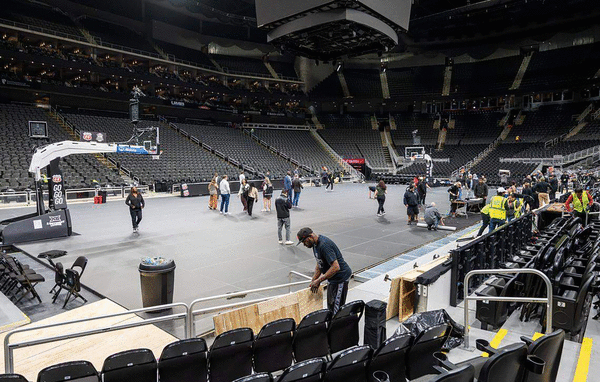
KANSAS CITY, Mo. — After 12 games, a few dozen slips and one injury over three days, the Big 12 Conference Tournament employees were scrambling late Thursday — err, early Friday — for their busiest hours yet.
Overnight.
The conference removed the glitz and glamour of its all-LED glass floor in favor of the traditional hardwood court ahead of the tournament’s semifinals set for Friday night — Iowa State vs. Arizona and Kansas vs. Houston.
And, guess what, people just might still watch anyway.
That’s the lesson to be learned from all this.
It’s not that players are slipping. It’s not that perhaps the experiment should’ve had a longer test run before implementation. And it’s not whether it ever affected the outcome of a game.
This tournament doesn’t need a gimmick.
The fans aren’t flocking to Kansas City to see a court. They aren’t attending for the chance to see Fat Joe or Shaq sitting courtside.
They’re flocking to T-Mobile Center in downtown Kansas City for the same reason they once flocked to Kemper Arena for years before that in a historic West Bottoms neighborhood that still flaunts a sign welcoming these fans to town.
They’re here for what’s happening on the court — not the lights underneath it.
This might not be New York or Los Angeles. But for three decades, that’s always been enough here.
And this year? Come on.
A single ticket Thursday offered admission to watch the projected top-two picks in the NBA draft on the same night — AJ Dybantsa and Darryn Peterson. There are nearly two-dozen NBA draft prospects in this tournament. It’s a historic year, even for a tournament that has featured Kevin Durant, Paul Pierce and hundreds of others.
All eight quarterfinalists — all freaking eight — will be playing in the NCAA Tournament next week.
Big 12 commissioner Brett Yormark could have left the neon signs at home.
The convergence of Iowa State fans to Power & Light or the sea of blue that overtakes downtown this week or the plethora of NBA general managers in the front rows offered enough of a reminder that Kansas City didn’t need.
OK, but it’s for the rest of the world to tune in, right? Any publicity is good publicity, right? There’s some truth to that. Heck, maybe these words fall into the trap.
But for three days in Kansas City, the focus has been on the wrong thing.
The court got this tournament some pub. You know what got a little less?
The games that comprise it.
All four semifinalists Friday were ranked inside the top 10 at some point this season.
BYU star AJ Dybantsa scored 93 points over three games. He finished three points shy of setting the tournament record on Wednesday.
Afterward? He was asked about the floor.
Over the course of three days, the word “floor” appeared in press conferences 31 times, and the word “court” appeared 19 more in this very context. It probably appeared dozens more in locker room conversations.
“I’m excited,” KU coach Bill Self said when asked about the decision to spend overnight installing a traditional hardwood floor, “that the talk tomorrow will be about the semifinals as opposed to the court.”
The talk was foreseeable. Part of the design, even.
It’s not exactly the first innovation the Big 12 has implemented in the past few years. What’s the difference? Why the criticism now? The past ideas were additive. This quickly became the story.
The conference got more than it bargained for.
Texas Tech point guard Christian Anderson slipped and tweaked his groin, though he later said he thought he’d be fine. Kansas wing Tre White nearly lost his footing with under four minutes to play in a five-point game, collecting himself at the last moment to prevent a turnover.
It was more than part of the ambience. It was part of the game.
The conference deserves some credit for correcting its self-inflicted mistake. If you’re going to fail, it’s better to bail quickly. But it should remember why it made a mistake in the first place.
Some of the league’s recent entertainment ideas — those that have become annual look-at-us moments — have found a place in a decades-old tournament. This isn’t advocating against all change.
But when they analyze those ideas ahead of time, the question shouldn’t only be what they might add to the tournament, but also something they seemed to omit from this conversation.
What might they subtract?
©2026 The Kansas City Star. Visit kansascity.com. Distributed by Tribune Content Agency, LLC.





Comments