Dave Hyde: How Jai Lucas resurrected Miami basketball, brought it to edge of March Madness
Published in Basketball
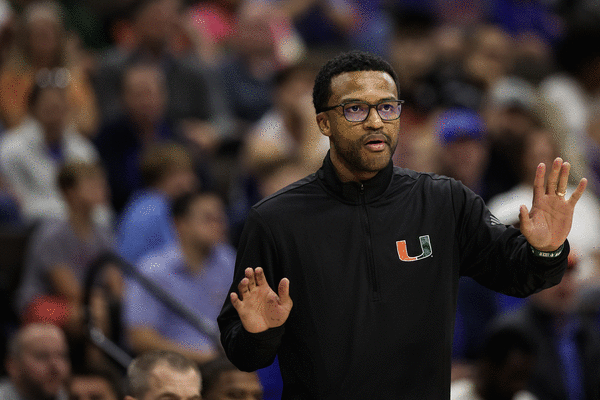
He mentioned the noise on the morning after. He mentioned the sound the University of Miami basketball arena made, as if it still echoed in his heart and mind, as if it was a soundtrack he’d like to replay over and over on basketball nights over the coming weeks — and years.
“That crowd — they helped us,’’ Miami’s Jai Lucas said just before noon on Wednesday, meaning the 67-66 win against Virginia Tech already was receding into the past tense.
The noise is notable because there was none of it when he began this season. No crowds, either. He had to rebuild all that in the only manner a team can in South Florida — by winning.
For that matter, when Lucas arrived in Coral Gables last spring there was nothing awaiting him at all. No assistant came with him — he hired a staff he’d never worked with. No players came with him, either — and not one was inherited on the roster.
He had to hire an entire staff, recruit an entire team, rebuild a once-proud program.
“You just start and do it,’’ he said.
To best understand how Lucas made something from nothing, how he took over an empty program and has it pointing toward an NCAA Tournament bid, the easiest answer is this: The Formula.
That came after he hired his staff and after he recruited a roster with an emphasis on, “great, positional size,’’ he said. “If you have size, it gets rebounding, defends without fouling. It keeps you in the game.”
So, he first signed Malik Reneau, the 6-foot-9 senior who came home to Miami from Indiana University.
“Malik will lead us in scoring,’’ Lucas told his new team.
That was another idea. He assigned roles to each player. Tre Donaldson, the former Michigan guard, was the top ballhandler. Ernest Udeh was the best defender. Freshman Sheldon Henderson was the secondary ballhandler.
“In this day and age, you need to give as much clarity and as much role definition as possible,’’ Lucas said. “We also had all these guys playing together for first time. So we went into games with everyone having expectation of what roles were.”
This leads to The Formula. Lucas looked over his roster before the season for its physical strengths and talent liabilities. He then looked at winning teams that were similarly built like Arizona, Florida, Gonzaga and Tennessee and culled their statistics to see how they won.
That led to the recipe he aims for each game. For instance, from the offense:
1. Points in the paint. With their size and interior talent, he wants at least 45 points in the paint.
2. Get at least 40% of missed shots back with offensive rebounds. “That’ll end up being around 15 rebounds a game,’’ he said.
3. Have your second-chance points match your offensive rebounds. “If we get 15 rebounds, 15 second-chance points,’’ he said.
4. Make as many foul shots as they shoot.
The last one is difficult, considering Miami isn’t a great-shooting team. But that’s baked into The Formula. Take No. 4 Arizona, one of those similarly built rosters.
“They’re making six threes a game,’’ Lucas said . “We’re at 7.2. No one talks about them like they need more threes.”
It was only three Marches ago that Jim Larrañaga took Miami on its run to the Final Four. The NIL era hit after that. Larrañaga saw players ready to step into starting roles the next season go to smaller schools for money. By last season, he’d had enough of the NIL mindset.
Enter Lucas. The first-year coach finds himself coaching three distinct areas every day on how he wants the program run — the new staff, the new players and the new program administrators. He’s got Miami winning enough to be 21-5, fourth in the Atlantic Coast Conference and bringing back some noise around this program.
“We’re not playing our best basketball,’’ he said. “We’re getting close to it.”
March is coming, too.
©2026 South Florida Sun-Sentinel. Visit sun-sentinel.com. Distributed by Tribune Content Agency, LLC.






Comments