Vahe Gregorian: Royals' urge to move began with dreams of downtown. It's time to revive that focus.
Published in Baseball
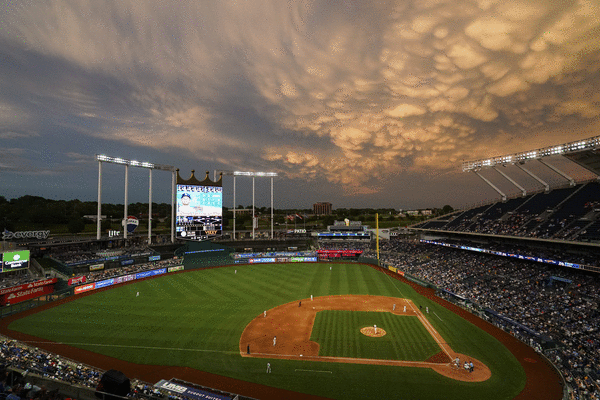
KANSAS CITY, Mo. — Nearly five years ago now, Kansas City Royals owner John Sherman began speaking publicly about moving the franchise downtown and developing around the prospective new stadium. And that was some three years after it was well understood he’d seek to do so even as he was in the process of buying the club.
At the heart of the idea was revitalizing Kansas City’s downtown, he said then, and supporting underserved communities — a notion reflecting Sherman’s extraordinary philanthropy and civic endeavors.
By the time Sherman and the Royals in December 2022 launched what they touted as a “listening tour” — events at which they’d gather feedback from fans about the team’s next stadium — part of the presentation at the Plexpod Westport Commons was dubbed “Why Downtown?”
So that certainly was the original intent, for a while seemingly even the point in itself, when the Royals declared they would vacate Kauffman Stadium before their lease expires after the 2030 season.
Then came the never-ending story, which may or may not be coming to a close even amid what seemed a significant development Thursday.
Like the puzzling drift in the apparent mission in 2023, when the Royals announced two finalist sites that included one in North Kansas City. That faded into a bewildering turn of events months later, when they pivoted to an entirely different site in the East Crossroads.
All of which led to a humbling vote in 2024 that rejected a proposal to extend a 3/8th-cent sales tax to help fund the team’s would-be new stadium and renovate Arrowhead.
Downtown becomes ‘near downtown’
Next thing you know, the Royals’ public emphasis increasingly shifted to “on or near downtown” … which came to include negotiating anew with North Kansas City and in Kansas, where the Chiefs in December announced they will move in 2031.
So it sure was a curious and circuitous route back to where this all started — and where it should end — as of the fresh turn on Thursday.
As reported in advance by The Kansas City Star, Kansas City Mayor Quinton Lucas introduced an ordinance to the city council with the most substantial plan to lure the Royals downtown since the 2024 election.
Albeit with fine details either unclear or pending, if the concept goes forward the city would contribute approximately $600 million toward a $1.9 billion stadium at Washington Square Park.
Around that site adjacent to Crown Center and Union Station, Lucas said, the Royals are expected to separately fund the bulk of a surrounding entertainment district.
“I think that this in many ways was the beginning of the end of what’s been a long conversation in Kansas City,” Lucas said after the meeting at City Hall.
Moments later, he paralleled the initiative with having the bases loaded in the bottom of the ninth on the verge of a victory.
Just the same …
“Does that mean it can’t get screwed up?” Lucas said, smiling. “Absolutely it can. … But we are in a very strong position.”
New stadium no done deal, yet
As ever, the viability of this scale of enterprise will hinge on a vast number of details — including the pesky matter of whether it comes to fruition to begin with.
That starts with the city’s legislative process, which will entail a follow-up committee hearing Tuesday before a vote of city council members that is not assured of passing.
To say nothing of securing what city officials anticipate will be funding from the state, county and other sources and mechanisms as they engage a process that works around a public vote.
Oh, and it also remains unclear how the Royals view this week’s developments.
Sure, it might be surmised that the city announcing this initiative reflects months, even years, of conversations and coordination. Lucas made it a point to note that the timeline to get the Royals downtown by the 2030 season — a year before the lease expires — reflected efforts to make sure the city is “in alignment” with the team.
But Kansas City’s Major League Baseball franchise met the news with a generic statement to The Star.
“The Kansas City Royals appreciate the work of our City’s leadership — the Mayor, City Manager, and City Council — as they take important steps toward continued economic development for our city,” the statement said. “We are grateful for their engagement in this process, as well as for the critical work of the State of Missouri, and look forward to more detailed conversations as we consider solutions that are best for our team, our fans, and our community.”
So there remain many more questions than answers, especially about specifics of how this would, in fact, tangibly benefit the area’s underserved population. Also unclear is how to calculate the true economic impact — and consequences — of such a prolific investment.
But here’s what we can hope: that this at least reflects the start of renewed urgency to get this concept back to what it seemed intended for — and where it should land.
Not urgency in the sense that the city and other entities should necessarily yield more to the Royals. It’s reasonable to question if this package already is too pricey, especially without knowing how all these financial levers will work and what entities would be accountable for inevitable cost overruns.
But given that the Royals have been unwavering about leaving a beloved stadium that nonetheless will be nearly 60 years old when the lease expires, the greatest good — or at least the greater good — is to be found in investing downtown.
Most of all because the regional ripples reverberate most from the nucleus, the epicenter that makes the rest relevant and even possible.
In 2004, when ground was broken for the Power & Light District (soon to include T-Mobile Center), Kansas City’s population was 444,134, according to census statistics. Now it’s approximately 520,000, in no small part because downtown has gone from a void to vibrancy and is appealing to young people.
In basically the same time frame, the region has grown by several hundred thousand to nearly 2.3 million.
It’s true that the P&L never has generated enough revenue to meet its debt obligations. But it’s also true that the area changed Kansas City, including as it was perceived globally to be a soccer mecca because of scenes from there while the city was in the process of bidding to be a 2026 FIFA World Cup host
Just as there are many more reasons Kansas City earned that bid, of course, there are plenty more reasons for its growth.
But, as is the case in the game of baseball, it’s foundational to be strong up the middle.
‘You have to fight for your city’
In an interview with The Star in New Orleans during Super Bowl week in 2025, Lucas made the point deftly.
“The future of American cities, and this is why big cities should still be in the game and not give up their teams to suburbs, is that we’re places where people come,” he said. “We’re places that host big events.
“If we didn’t have an arena, if we didn’t have stadiums, if we didn’t have a convention center, (if) we didn’t have hotels, our whole economic model starts to shift tremendously.”
He later added, “You have to continue to fight for your city being better. And that’s why I think the Royals being downtown is a generational issue for Kansas City and our entire region.”
In his office Thursday morning, Lucas spoke to a question about why he believes this stadium project would connect and catalyze downtown, rather than cannibalize from, say, Power & Light and the Crossroads. To the contrary, he said, citing the way the T-Mobile Center with P&L has stimulated the Crossroads and vice versa.
In this case, he even pictured further synergy through such possibilities as a pedestrian bridge from the stadium to the Freight House District. Also standing to benefit is ... the Crossroads, where a vocal group felt it was in the crosshairs in 2024.
From Lucas’ perspective, anyway, this is akin to another transformative project: the Kansas City Current building CPKC Stadium on the Berkley Riverfront … and the $1 billion in development plans that have followed. While the model and methods have significant differences, he touted them as similar in terms of potential economic development ramifications.
As for this particular site, tight as it might be on five acres as of now, Lucas touted it for its proximity to “pretty robust residential neighborhoods” and real infrastructure cost savings. Adjoining or close are several major hotels, established entertainment venues, the KC Streetcar and bus routes and some 19,000 parking spaces within a 10-minute walk.
Multiply that and ancillary projects by 81 dates a year for games alone, and with proper logistical planning it’s hard not to see how a new stadium at the Washington Square Park site would make the city — and thus the region — all the more desirable.
As Lucas put it, the footprint is “a space that fits surprisingly well, as if we were trying to fill in the pieces of a puzzle.”
Plenty more pieces still need to be put in place to frame this one properly, of course.
Most of all, a clearer picture of the funding and just how the Royals would create more tangible benefits to the community.
Those would be essentials for both the city and Royals to prioritize and communicate, especially because a significant construction project there will mean years of inconvenience to nearby institutions before it comes to fruition. And just because the city and the Royals have sought to avoid a public vote doesn’t mean they don’t have a duty to be transparent and accountable. In fact, that seems all the more critical in this context if they want buy-in.
But at least the downtown-site part of the original premise is back in focus, and that’s where it should stay.
No matter how much posturing or leveraging the Royals may have felt they needed along the way, no matter what impediments they’ve felt stymied by in the past, it’s well past time they put all their time and energy back into getting right the very notion they broached in the first place.
____
©2026 The Kansas City Star. Visit kansascity.com. Distributed by Tribune Content Agency, LLC.



Comments