Rep. Mike Levin says 'not so fast' on a key energy bill on Capitol Hill
Published in Political News
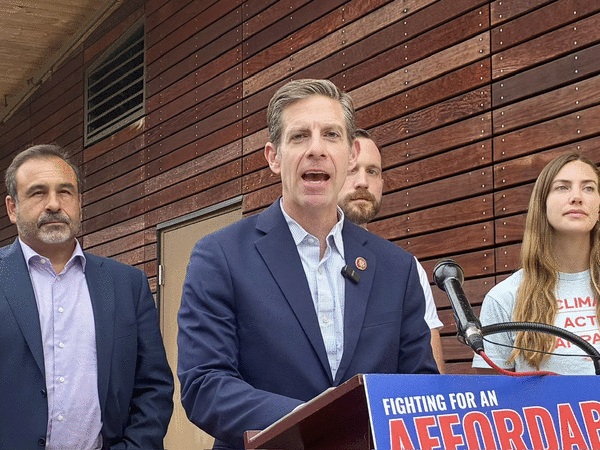
The major federal energy permitting and transmission bill looks like it’s in for a real fight to get through the U.S. House of Representatives.
Rep. Mike Levin, D-Calif., came out against the version of the Bipartisan American Affordability and Jobs Act of 2026, nicknamed BAAJA, that the Senate passed last week on a 62-33 vote. Levin said the bill, as written, needs changes before he can support it.
“Since the Senate released the bill, I’ve worked with my colleagues in the House Sustainable Energy and Environment Coalition on targeted fixes to permitting certainty, clean water, endangered species, judicial review, and historic and tribal protections,” Levin said in a statement Monday. “None of our major concerns have been addressed. I’ve also heard from hundreds of people across our district, and they oppose this bill by roughly two to one.”
Levin represents the 49th District in Southern California, which covers coastal areas in portions of Orange and San Diego counties that include Oceanside, Vista, Encinitas and parts of Del Mar.
Serving in the House since 2019 and re-elected to a fifth term earlier this month, Levin said he’s not dead set against the bill.
“There’s still time to get this right,” Levin said. “If House and Senate leaders from both parties sit down together and negotiate sufficient changes, I’ll be ready to vote yes.”
BAAJA is considered one of the most consequential energy bills that lawmakers on Capitol Hill have tackled in recent years.
It aims to streamline the federal permitting process and boost the number of energy transmission projects that cross multiple states.
It’s backed by members of Congress who often don’t see eye-to-eye.
Senate Republicans such as John Barrasso of Wyoming and Shelley Moore Capito of West Virginia say passing BAAJA will cut red tape and provide certainty for developers to move forward on energy projects, while Democrats like Sheldon Whitehouse of Rhode Island and Martin Heinrich of New Mexico say the bill, among other things, will accelerate the deployment of renewables that are often delayed or never get built.
But while some environmental groups, such as the Citizens’ Climate Lobby, have come out in favor of the legislation, others, including the Natural Resources Defense Council, oppose it, predicting the bill will weaken the Endangered Species Act and other statutes.
Others worry that BAAJA undermines the sovereignty of Native American tribes.
Levin cited those issues Monday, as well as others that included concerns that the bill’s language would make it harder for future presidents to undo the Trump administration’s approvals of fossil-fuel projects.
“For those of us who have spent years fighting to keep new oil rigs off the California coast, that’s a serious threat,” Levin said.
Levin’s announcement comes in sharp contrast to another San Diego-area member of the House and fellow Democrat, Rep. Scott Peters, who strongly supports BAAJA.
“It’s a major reform to how we approve (energy) infrastructure in the United States,” Peters told the Union-Tribune after the Senate vote. “At the same time, San Diegans utility rates have tripled in the last few decades, and this would bring relief to electricity bills — $50 to $78 per year by 2040.”
Peters also touts provisions in BAAJA regarding data centers, including compelling operators of facilities of 20 megawatts or more to bear the full costs of the electric service and grid infrastructure required to power them.
Should the House follow the Senate’s lead and pass BAAJA during the current lame-duck session of Congress, President Donald Trump has indicated he will sign it into law. Republicans hold a tenuous 218-214 edge over Democrats in the current House.
In the aftermath of the “blue wave” from the November midterm elections that will see Democrats take majorities in both the House and Senate, some Democrats such as Rep. Jared Huffman, D-San Rafael, have argued the party should negotiate a new bill when the new members take office in January.
But BAAJA’s backers say changes to the bill that drift too far left would almost certainly get vetoed by Trump, and there are not enough Democrats to override a veto.
Peters favors passing the bill and then improving upon it in subsequent legislation.
“This is a great deal, we should go for it, and then we should start the day after to make it better,” he said.
Levin sounded more circumspect.
“I’ve thought hard about the old saying that a bird in the hand is worth two in the bush,” Levin said in his statement. “These grid reforms are real, and there’s no guarantee a better bill comes along that can actually become law soon. That risk is significant. But in the end, taking the current deal would mean giving up protections we may never win back in exchange for gains that aren’t guaranteed either.”
The House is expected to take up debate on BAAJA after the Thanksgiving recess.
©2026 The San Diego Union-Tribune. Visit sandiegouniontribune.com. Distributed by Tribune Content Agency, LLC.












































Comments