US Steel CEO recounts talk that won Trump's support for Nippon deal
Published in Political News
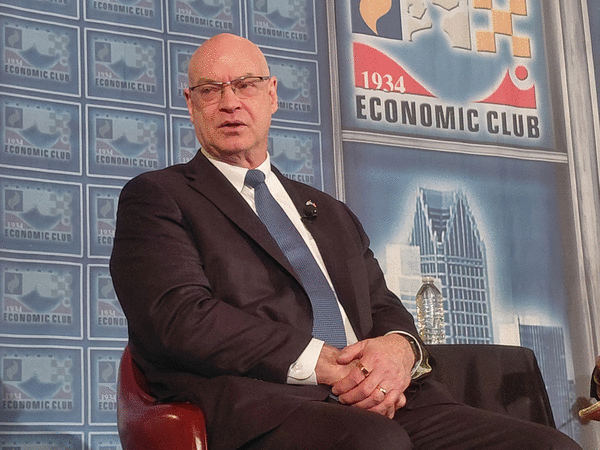
DETROIT — When U.S. Steel's CEO entered the Oval Office in February 2025, one of the first things President Donald Trump told him was that his predecessor, Joe Biden, had copied him, as he was against Japan-based Nippon Steel Corp.'s acquisition to buy the Pittsburgh metal manufacturer first.
"So that's how the meeting started," David Burritt said, "and it went downhill from there."
Burritt gave members of the Detroit Economic Club on Thursday a fly-on-the-wall perspective of his meeting with the president that eventually was followed by Trump's approval of the transpacific, $14.9 billion all-cash deal that closed in June of last year. The transaction, Burritt said, has paved the way for investment into U.S. steel manufacturing, including plans for a roughly $4 billion mini-mill — potentially more than one — that he says will include consideration of every state that wants it, including Michigan.
"We would not do it (the expansion) without Nippon Steel," Burritt said at the event moderated by Daniel Howes, The Detroit News' senior business editor and a columnist, "because we would not have this much money to spend. ... The reality is without the investment, we were going to take the (older) integrated mills down and spend more on the mini-mills. Now, because of Nippon, their technology, their advancement with the integrated mills, we can do both."
A location for the mill is expected to be selected by the end of 2028 when the company must have $10.8 billion spent or committed to investment in the United States. Priorities for its placement include workforce and talent, proximity to consumers and supply chain access.
The mill would support demand for domestically produced steel in various industries, including the automotive, appliances, construction and converters sectors. Automotive, however, is the company's most important, Burritt said, and while once it was interest rates that were the biggest factor for vehicle sales, it now is the Iran war and gas prices.
"We're going to make sure we're as adaptable as possible," Burritt said.
Along with Trump, Burritt met with now-U.S. Commerce Secretary Howard Lutnick and Peter Navarro, a top trade adviser who Burritt previously worked with amid new steel tariffs in 2018 under the first Trump administration. They hugged, though, Burritt said he knew Navarro was against the deal. And although Lutnick had history with Japan, the conversation revealed some information wasn't up-to-date, Burritt said.
"I knew that wasn't a good sign," he said.
Nippon Vice Chairman and Executive Vice President Takahiro Mori was in Japan awaiting news of the discussion, as Burritt was unable to have his phone with him in the Oval.
Conversation zig and zagged, Burritt said, sharing that he and Trump discussed President Ronald Reagan's picture on the wall, the chalices in the back, oceans and pollution, and U.S. steelworkers.
"He is not always on the subject you're talking about," Burritt said. "I think it's actually his way of negotiating, because he bounces around and then leans in."
Burritt said he originally had planned to explain the rule of law with respect to the deal, but at the recommendation of his wife of 45 years, Lynn, Burritt researched via a book and a Netflix documentary how Trump negotiates.
"You're not going to criticize him," he said he learned. "You can criticize the issues. And then if you appear weak, he will squish you."
He said he went in, pretending to be Tom Homer: "Part of the time when you would say some of the comments, I'd think, 'I'm going to wet myself,' because I was not comfortable, and I'm losing, and I can only image waking up Mori-san in the middle of the night."
For Trump, U.S. Steel was an iconic company that under the deal would be directed by Japan, Burritt said. He pushed that the acquisition would be best for the country's future and he could negotiate for 10 times more than what the Japanese at that point were promising because the United Steelworkers had refused to come to the table. Under terms of the deal, Nippon must invest $14 billion in U.S. growth capital and facility upgrades through 2028, up from the original $1.4 billion.
"I said ... 'If you study this, you'll get the truth,' and to his credit, he took the time," Burritt said.
The agreement also included a "golden share," power for the U.S. government to veto decisions like changing the company's name, moving its headquarters or idling plants — things, Burritt said, that the company doesn't want to do anyway. The agreement also requires a U.S. citizen to lead the company and that its board be majority-American.
Burritt felt the shift when Trump asked him if he would like a medallion on his desk with the presidential seal that he said was made of steel from the company. Burritt accepted and took a photo with the president, who suggested he post it saying they were working together.
"I said, 'We're working together?'" Burritt said. "He said, 'You work with Howard.' ... All of a sudden it's gone to I think this is going to be dead, but now he's going to study the issue."
Attendees of the discussion left impressed by Burritt's down-to-earth demeanor and how he approached the negotiation.
Mark Ostach, 44, of Clarkston, a keynote speaker and author, said he often emphasizes truth, tone and timing in meetings, which Burritt's approach captured: "You have to control what you need to control.
Rafael Neitzel, 50, of Chicago, who is a managing director for a professional service company's metal practice, said he appreciated hearing from the CEO: "I like how he explained to bet on a vision and execute it."
For Burritt, the best part of his meeting with Trump was when he was leaving, and Meta Platforms Inc. CEO Mark Zuckerberg was arriving. Burritt said Trump introduced the CEOs to each other, referring to Burritt as "that good-looking guy."
©2026 www.detroitnews.com. Visit at detroitnews.com. Distributed by Tribune Content Agency, LLC.






















Comments