Retirement of US Rep Danny Davis of Illinois sparks scramble -- and flood of PAC dollars -- for seat
Published in Political News
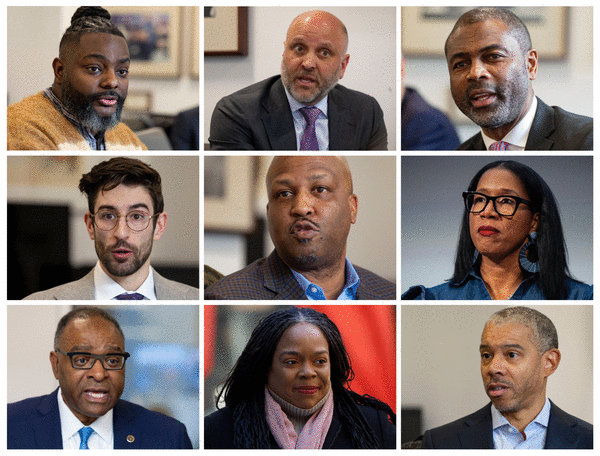
CHICAGO — A crowded race in one of America’s bluest congressional districts has grown increasingly hostile, as candidates to succeed longtime U.S. Rep. Danny Davis battle to prove their anti-President Donald Trump bona fides while navigating national divisions within the Democratic Party that are driving the Chicago primary contest.
Davis’ retirement announcement comes after three decades of representing the 7th Congressional District, triggering over a dozen candidates to vie for the Democratic nomination. The question of who should replace him in the racially and economically diverse district — spanning downtown, swaths of the West and South sides and the west suburbs — has drawn national interest, with super PAC dollars upending the fundraising ground game.
Some hopefuls, among them Davis-endorsed state Rep. La Shawn Ford and city Treasurer Melissa Conyears-Ervin, are longtime Illinois politicians. Others, including real estate mogul Jason Friedman, labor leader Anthony Driver and progressive activist Kina Collins, are outsiders to elected office.
Conyears-Ervin, Chicago’s treasurer since 2019, is mounting her second bid for the seat after falling short of unseating Davis two years ago, when she placed second with 21.3% of the vote to his 52.5%. Her candidacy, endorsed by the Chicago Teachers Union, has focused on her working-class roots and role as a caretaker for a disabled sister.
Playing odd bedfellow to the progressive labor juggernaut in Conyears-Ervin’s coalition is the American Israel Public Affairs Committee, or AIPAC, whose super PAC is supporting her bid to the tune of $3.2 million, according to the Federal Election Commission.
That’s drawn sharp attacks from Conyears-Ervin’s opponents, given the special interest group’s eminence as a leading target of the political left following the 2023 Gaza war. Those contenders have also pounced on a smattering of ethics scandals throughout her tenure as city treasurer.
During last month’s candidate debate hosted by the College Democrats of the University of Illinois Chicago, progressive Anabel Mendoza said Conyears-Ervin should resign over her ethics controversies, and that she was “bought and sold” by AIPAC.
“I am a Black woman born in Englewood, raised on the West Side,” Conyears-Ervin responded. “I don’t have to prove anything to anyone.”
That response drew condemnation from Collins: “You do not get to hide behind a Black face and our community when you are selling us out.”
Last week Friedman, the highest fundraiser in the race at $2.5 million, added to calls for Conyears-Ervin to resign before releasing an ad knocking her for “being funded by Trump’s MAGA allies.”
Trump’s policies and his repeated targeting of Chicago have made him wildly unpopular among local Democratic voters, prompting primary candidates to try to tie their opponents to the president. In the 7th District, that playbook is being tested by the fact candidates are tacking left in their politics while also receiving dark money from special interest groups that align with conservatives.
In addition to $3.2 million in independent expenditures from AIPAC-affiliated United Democracy Project for Conyears-Ervin, her war chest includes new, growing support from AIPAC supporters.
Only 7.5% of the money Conyears-Ervin raised came from people who donated to AIPAC or UDP before this year, but since the latter’s first ad buy for her, such donors have accounted for over 58% of the $284,000 the campaign has raised in the last two months, according to the FEC.
However, Friedman’s campaign also took in $288,600 from UDP or AIPAC donors last year, leading to early assumptions from some contenders that the pro-Israeli lobby would back him.
Ford, the state representative, said he sent a paper to AIPAC in December that evidently didn’t agree with their positions so the group, “knowing the demographics of the district,” likely made a strategic choice with Conyears-Ervin.
“They know that the issue is not relevant,” Ford said, noting the UDP ad for Conyears-Ervin doesn’t mention Israel. “I think that they strategically made their wager. … and that’s what I think is the most egregious, that our laws allow for dark money like this to come in and spend.”
It’s a delicate dance for Friedman, a Jewish candidate, who has been fielding criticism that he’s beholden to AIPAC while its super PAC buoys his opponent.
During one candidate meet-and-greet in Ukrainian Village, Friedman responded to a woman confronting him over AIPAC by stressing the Jewish community is a “big tent.”
“AIPAC is supporting one of my competitors, not me,” he told her.
Friedman, former head of government affairs at the nonprofit Jewish United Fund, did contribute $1,250 to a separate political group that supports the Israeli government, City PAC, in 2008. He also pulled a Republican ballot in the 2012 primary election, according to Chicago voter registration records, and the next year gave $250 to ex-U.S. Rep. Peter Roskam, a Republican who lost the seat to Democrat Sean Casten.
Friedman’s campaign did not directly respond to questions on why he cast a Republican ballot or whether he voted for Republican Mitt Romney in his race against President Barack Obama that year.
“Jason Friedman is a lifelong Democrat,” his campaign wrote, noting he worked in former President Bill Clinton’s White House, and also created “union jobs and advocated for safety-net health care systems like Mt. Sinai Hospital on the West Side.”
Besides the AIPAC affiliate, the pro-cryptocurrency PAC Fairshake has dumped about $1.7 million in attack ads against Ford, who voted for Springfield regulations of the digital asset.
Friedman has received $277,400 from the Stronger Illinois PAC, a new organization whose purposes were not clear.
A PAC that says its mission is to “elect more scientists” to public office, the 314 Action Fund has raised $120,000 for Dr. Thomas Fisher. And Driver, executive director of the Service Employees International Union’s state council, has netted $371,600 from a PAC affiliated with the labor organization.
As far as total funds raised by candidates so far, after Friedman’s $2.5 million comes Fisher at $799,700, Conyears-Ervin at $620,800 and Ford at $494,800. Former Cook County Commissioner Richard Boykin netted $383,300, ex-U.S. Justice Department lawyer Reed Showalter $331,530 and Mendoza $228,200.
The rest of the Democratic hopefuls include Collins, Forest Park Mayor Rory Hoskins, engineer Felix Tello and UIC adjunct lecturer David Ehrlich. The nominee will face either GOP candidate Patricia “P Rae” Easley or Chad Koppie in November.
Davis’ decision to forgo a 16th term in Congress set off a frenzy among hopefuls eager to run without worrying about beating an incumbent, one known as the dean of the Illinois House delegation.
He leaves behind a legacy as a forceful progressive voice in Congress, and his district has seen bustling development in some areas such as the Near West Side and South Loop, while other neighborhoods have been bleeding their Black populations.
Ford, Davis’ pick to succeed him, has touted securing funds for financial aid, behavioral health and test prep programs at colleges and universities. His profile has also netted attacks from Fairshake, whose ads on his past felony bank fraud charges were decried by Ford as slanderous.
“Running for office is very challenging, and when you stand up for the people, you actually get punished,” Ford said during the UIC debate, regarding the pro-crypto group.
In 2014, Ford agreed to plead guilty to a single misdemeanor tax count in exchange for federal prosecutors dropping all 17 felony charges.
Ford has also taken $12,000 in contributions from former Loretto Hospital executive Anosh Ahmed, who was arrested in Serbia this January after being indicted on fraud charges. An ex-Loretto board member, Ford has not been implicated in any wrongdoing tied to the West Side safety net hospital and said he called for Ahmed to be fired in 2021.
He responded to a question on whether he should refund Ahmed’s money by noting the checks were made to his 2019 mayoral campaign and cashed before the embezzlement scandal.
Multiple ethics investigations into Conyears-Ervin during her time as city treasurer have dogged her on the campaign trail as well.
In 2024, the Chicago Board of Ethics determined she misused taxpayer resources for a series of church events and found probable cause she improperly fired two whistleblowers, slapping her with the maximum $70,000 fine.
She agreed to pay $30,000 to settle both cases while denying all wrongdoing. Chicago taxpayers had to front a $100,000 settlement with the two ex-staffers who filed wrongful termination complaints.
Another whistleblower filed a wide-ranging ethics complaint last fall, alleging her political campaign staff pushed a questionable plan to boycott U.S. Treasury bonds in protest of Trump, despite internal objections over its financial prudence.
When Mendoza called for her to step down over these scandals, Conyears-Ervin shot back, “To think that I would resign from city treasurer because I stood up to Donald Trump is insane.”
Conyears-Ervin herself has held investment funds that contained U.S. Treasury bonds during Trump’s second term, records show. Her public disclosure reports from last year show a combined total that could range from about $17,000 to $80,000 from three exchange-traded funds, according to a copy of the forms required for U.S. House candidates.
Her campaign said last week she divested from those funds at some point in 2025.
Fisher, an emergency room physician at the University of Chicago Medical Center, said the wave of local political giants retiring this election — Davis, along with U.S. Sen. Dick Durbin and Reps. Jan Schakowsky and Jesus “Chuy” Garcia — opens up a road to “a new vision” of Democratic leadership. That’s why he has run as an outsider and sworn off corporate PAC dollars.
“This is the opportunity for voters to choose,” Fisher told the Tribune. “Do they want more of the same, or do they want a difference?”
Collins, now on her fourth run for this seat, said she was fighting the Democratic establishment long before the rest. She noted nearly all candidates are now vowing to abolish U.S. Immigration and Customs Enforcement — a recent litmus test among the left — when she has supported that position since 2020, along with the “defund the police” movement that also caught fire that year but grew too politically risky for most Democrats: “This goes much deeper than just a slogan.”
Collins was 16 days late in filing her end-of-year campaign finance reports last December, in violation of federal law. She said the delay has since been rectified and was because the usual consultant who prepares her paperwork died.
Court records also show Collins is being sued for $2,882 in credit card debt, which she said is “even more of a reason for someone like me to go and represent working-class people.”
Driver, the SEIU leader, is angling to be the progressive movement’s candidate, too. Fisher, immigrant rights advocate Mendoza, ex-U.S. Justice Department lawyer Reed Showalter and comedian Jazmin Robinson are also running with leftist credentials.
The first president of the city’s Community Commission for Public Safety and Accountability, Driver hopes his experience on labor picket lines and his lived experience prove to voters his “progressivism doesn’t come from reading a book.” He’s backed by Garcia and Schakowsky as well as the Congressional Progressive Caucus.
But the 7th District has also exposed a fissure among the city’s left-leaning unions, as the CTU has backed Conyears-Ervin and contributed $72,500 to her state central committee fund.
“Anybody in labor who has endorsed her or who stands with the working class should reconsider their endorsement of Melissa Conyears-Ervin,” Driver told the Tribune.
Asked if that means the CTU should rescind their support, he said “yes.”
As the vanguard of Chicago’s progressive coalition, CTU leadership has long been outspoken against the Gaza war, hosting a 2024 panel on why Palestine is a “labor issue” and promoting figures across the left who “fight back against AIPAC.”
Conyears-Ervin’s campaign told the Tribune the CTU “never raised this issue” when she sought their endorsement. The CTU declined to comment, but internal sources said the union plans to reevaluate its endorsement process in light of such outside spending concerns.
During one campaign stop last Friday evening, Conyears-Ervin stopped by a string of modest neighborhood bars on the West and South sides to dance with senior citizens, hold hands with voters — and pointedly avoid the political talk.
“Now this is what the seven looks like,” Conyears-Ervin declared.
____
©2026 Chicago Tribune. Visit at chicagotribune.com. Distributed by Tribune Content Agency, LLC.







Comments