Blue states push to ban ICE at the polls amid federal voter intimidation fears
Published in Political News
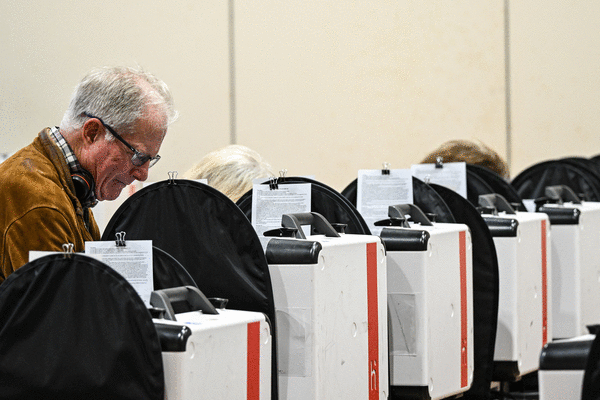
Several Democratic states are moving to bar federal immigration agents from being near polling places and other election sites, amid persistent worries that President Donald Trump will use federal law enforcement or the military to disrupt the midterm elections.
Measures to restrict federal agents from operating at or near election-related locations have been offered in more than half a dozen states, according to a Stateline count. While the proposals vary, they broadly seek to combat the prospect of chaotic confrontations between federal agents and voters this November.
A federal law dating to the end of the Civil War already bans sending the military or other “armed men” to polling places, except to repel armed enemies of the United States. The U.S. Constitution also gives states — not the president or federal government — the responsibility for running elections.
But Trump’s calls to nationalize elections, his promise to impose voting restrictions with or without Congress, and his history of working to overturn the 2020 presidential election is prompting some Democratic state lawmakers to act. Adding to lawmakers’ fears is the FBI’s January seizure of ballots from the 2020 election in Fulton County, Georgia, and U.S. Department of Justice lawsuits against dozens of states for copies of their voter rolls that include sensitive personal information.
The president’s party typically loses ground in Congress in midterm elections. Given that, Democrats fear Trump is laying the groundwork to block or cast doubt on a losing outcome.
“When the president says he’s going to break the law, I actually believe him,” said California state Sen. Tom Umberg, a Democrat who has introduced legislation that would prohibit federal immigration enforcement within 200 feet of polling places. He said Trump’s call to “nationalize” elections was the “triggering event” that prompted him to offer the bill.
Legislation to restrict immigration enforcement or the presence of federal forces near polling places and other election sites has been offered or announced in California, Connecticut, New Mexico, Pennsylvania, Rhode Island, Virginia and Washington. A bill has also been introduced in Kansas, which has a Democratic governor, but the measure is unlikely to pass in the Republican-controlled legislature.
The bills focus on immigration enforcement, but the New Mexico legislation would go further, prohibiting the military or any armed federal personnel from polling locations.
The Trump administration and its supporters have suggested that the president might order U.S. Immigration and Customs Enforcement, or ICE, to the polls. After former Trump adviser Steve Bannon in early February said ICE will surround polling places, White House press secretary Karolina Leavitt said she couldn’t guarantee an ICE agent wouldn’t be near a polling place
Trump allies have also circulated a draft executive order that Trump could sign declaring a national emergency and attempting to assert broad powers over elections, The Washington Post reported last week. Trump told reporters on Friday that he had never heard of the draft order.
But during a conference call last week for election officials from across the country, the Department of Homeland Security committed to not placing ICE agents at any polling places in 2026, according to both Republican and Democratic secretaries of state who were on the call.
Homeland Security told Stateline in a statement that ICE isn’t planning operations “targeting” polling places, but could arrest individuals if an active public safety threat endangered a polling location.
“There’s no reason for us to deploy to a polling facility,” ICE’s current leader, Todd Lyons, told Congress in February.
Democratic state lawmakers calling for election-related restrictions on ICE in state law say they don’t want to take any chances.
“I think this is just prudent, wise policy to do what we all know is right, which is to protect polling places,” said Virginia Democratic state Del. Katrina Callsen, the chief sponsor of a bill that would prohibit federal civil immigration enforcement within 40 feet of polling places and voting counting sites.
The New Mexico legislature in February passed a measure that largely mirrors restrictions in federal law against armed federal personnel at polling places. The bill is now before Democratic Gov. Michelle Lujan Grisham.
The bill says officials generally cannot order or bring troops or other armed federal agents to polling places or parking areas for polling places beginning 28 days before Election Day, when early in-person voting begins. It also would prohibit officials from changing who is qualified to vote contrary to New Mexico law or from imposing election rules that conflict with state law. Violators would be guilty of a felony.
New Mexico lawmakers offered the legislation the day after Trump’s initial remarks about wanting to nationalize elections. New Mexico Democratic state Sen. Katy Duhigg, the bill’s lead sponsor, said she wanted a measure that wouldn’t run into issues with the U.S. Constitution’s supremacy clause, which says federal law supersedes state law.
“I think a lot of states, frankly, are trying to figure out what to do right now,” Duhigg said, adding that courts will likely be asked to sort through new state-level limits on federal forces. “This seems like a reasonable approach to try.”
Republican lawmakers opposed
Some Republican state lawmakers are dismissive of the Democratic measures, casting them as unnecessary.
“I just cannot imagine the president, as much as you might dislike him, ordering federal troops to seize New Mexico elections by armed force,” New Mexico Republican state Sen. William Sharer, the minority leader, said during debate. Sharer didn’t respond to an interview request from Stateline.
In Washington state, one bill would require local election officials to block anyone from accessing areas where ballots are processed or counted for the purposes of immigration enforcement. Law enforcement could be allowed access with a judicial warrant or court order, however.
Washington state Rep. Jim Walsh, a Republican who also chairs the state party, characterized the proposal as “fearmongering” and a solution in search of a problem — unless its supporters acknowledge that people in the country illegally are voting. And he claims Washington doesn’t have the authority to legally bar ICE from areas of an election office.
Washington Democratic state Sen. Drew Hansen, the bill’s lead sponsor, said election workers counting ballots deserve to be able to perform their task without interference from federal immigration authorities. Hansen noted that ICE “does not have a perfect track record, to say the least, of only detaining extremely dangerous, violent noncitizens.”
More than 170 U.S. citizens have been held by immigration agents during Trump’s second term, ProPublica reported in October. A December report by Democrats on the U.S. Senate Permanent Subcommittee on Investigations identified at least seven U.S. citizens who were held for more than 24 hours.
In Arizona, some Republicans want to encourage an ICE presence at the polls. In February, Republican state Sen. Jake Hoffman offered a bill that would require counties to sign an agreement with ICE to provide a federal law enforcement presence at polling places.
Hoffman didn’t respond to an interview request from Stateline. A scheduled committee hearing on the measure was canceled in February, likely killing the bill. Still, the underlying proposal could be resurrected, Arizona Mirror reported.
“Arizonans deserve to know that election laws are not just written in statute but actually enforced in practice,” Hoffman said in a news release.
Existing federal laws against federal election interference are specific and straightforward, said Sean Morales-Doyle, director of the Voting Rights and Elections program at the left-leaning Brennan Center for Justice at New York University. States such as Arizona don’t get a “free pass” to violate federal law, either, he said.
Options exist to hold people accountable under federal law, Morales-Doyle said. If ICE agents deployed to polling places, federal prosecutors would have five years to bring charges against ICE personnel under the statute of limitations. While the Justice Department under the Trump administration would be unlikely to bring charges, he noted, the time limit extends into the next presidential administration.
Still, Morales-Doyle said he understands why people are skeptical, given how ICE and other elements of the Trump administration have behaved.
“So it is, I think, important to think about what state legal mechanisms there are for holding people accountable,” he said.
Local enforcement
Some of the state legislative proposals would place local election workers on the front lines of resisting federal interference.
The Washington state measure would instruct multiple election workers, when possible, to document incidents in which they deny permission to enter areas that are off limits to immigration enforcement. The New Mexico bill would allow county clerks and voters who experienced intimidation to sue over alleged violations, in addition to state officials.
The California legislation goes perhaps the furthest in empowering local election officials. It would allow county election officials to keep polls open if they determine that voting was disrupted because of violations of a ban on federal immigration enforcement nearby.
Some local election officials appear hesitant to discuss the proposals and whether they are preparing for the possibility of federal interference. The president of the California Association of County Clerks and Elected Officials and the clerks chair of New Mexico Counties, a statewide advocacy group for county officials, didn’t respond to requests for interviews. The Washington State Association of County Auditors declined to comment.
More broadly, other election officials have said the possibility of federal interference is informing their preparations for the midterm elections. Scott McDonell, the Democratic clerk of Dane County, Wisconsin, which includes Madison, told Stateline in February that while Trump’s desire to “nationalize” elections isn’t possible under the Constitution, he is paying attention to agencies that answer to Trump.
“What does the president actually control? The FBI, National Guard, ICE, DOJ in general. That’s far more concerning,” McDonell said. (State national guards can be federalized by the president.)
Barbara Richardson Crouch, the Republican registrar of voters in the Town of Sprague, Connecticut, said she prefers no law enforcement at polling places — whether local, state or federal.
In Connecticut, legislators plan to offer a measure to restrict federal immigration enforcement within 250 feet of a polling place or other election site. Crouch, who has been involved in election administration for nearly two decades, said she has long dealt with concerns surrounding law enforcement at voting sites, but that those fears in the past centered on state and local police.
Crouch said a state trooper typically comes through her polling place in the early morning as election workers are setting up, and then again when polls close. Law enforcement is on call, but Crouch said she believes that if someone sees law enforcement, it sends a message that the area isn’t safe.
“I personally have never liked police at election places, even local police,” Crouch said.
____
Stateline reporter Jonathan Shorman can be reached at jshorman@stateline.org.
____
©2026 States Newsroom. Visit at stateline.org. Distributed by Tribune Content Agency, LLC.

















Comments