Secret talks: Rubio team meets with Castro grandson on sidelines of Caribbean conference
Published in Political News
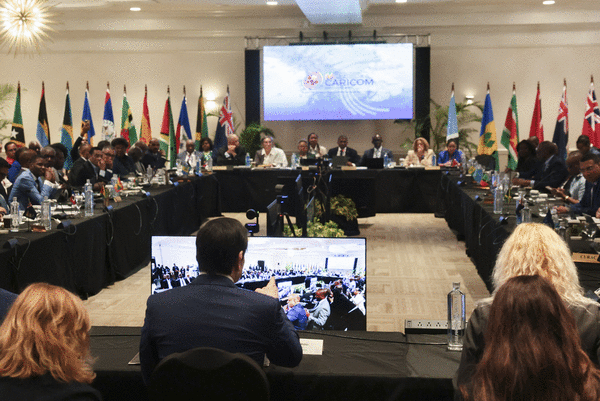
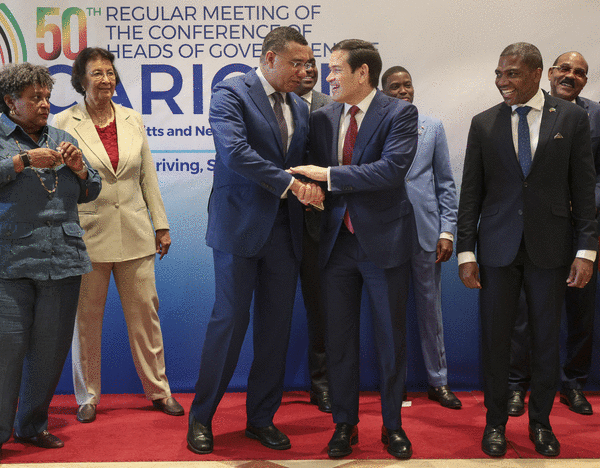
BASSETERRE, Saint Kitts and Nevis — U.S. officials close to Secretary of State Marco Rubio met with Raul Castro’s grandson on the sidelines of the annual meeting of Caribbean leaders Wednesday in Saint Kitts’ capital as efforts to negotiate economic and political changes in Cuba continue.
Multiple sources with knowledge of the meeting, who asked for anonymity to speak about the delicate negotiations, said Raúl Guillermo Rodriguez Castro met with one of Rubio’s close advisers in a hotel near where the 50th regular meeting of the Conference of Heads of Government of the Caribbean Community, known as CARICOM, has been taking place.
It is not clear if Rubio himself, who attended the CARICOM meeting and spoke to Caribbean leaders Wednesday, met with Rodriguez Castro. But the fact that his team is engaging Castro’s grandson confirms the Trump administration sees him as a powerful key player in Cuba amid U.S. efforts to push for reforms on the island.
Though Rodriguez Castro does not have any official government or Communist Party position, he is Raúl Castro’s closest aide and bodyguard. Known in Cuba by his nickname "El Cangrejo," the Crab, Rodriguez Castro is also believed to oversee the Cuban armed forces’ conglomerate known as GAESA, which controls much of the island’s economy.
Rodríguez Castro traveled to Saint Kitts on Wednesday with a Cuban protocol officer and left the Caribbean nation the same day. Rubio arrived in the island-nation early Wednesday after attending President Donald Trump’s State of the Union address Tuesday night, and had his first meeting with Caribbean leaders shortly before 12:30 p.m.
A more formal meeting between Cuban government and State Department officials was expected Thursday, the sources said. Josefina Vidal, Cuba’s deputy foreign minister and a key player in negotiations with the U.S. during President Barack Obama’s effort to thaw relations with the island, was also in Saint Kitts Wednesday and held a meeting with Grenada’s foreign minister on Thursday.
Rodriguez Castro also met with other leaders while staying at the Coral Building next to the Marriott hotel where the main CARICOM meeting is taking place.
The crux of the discussions Wednesday between U.S. officials and Castro’s grandson, some of the sources told the Herald, was the potential of slowly easing U.S. sanctions in exchange for Cuban leaders enacting changes on the island “on a month-to-month basis.”
A deal in the works?
A Caribbean diplomat privy to the discussions between Rubio and Caribbean leaders told the Miami Herald that in the private conversations, Rubio made it clear that “the discussions with the Cuban government were well advanced, and they did not want to do anything to prolong the regime. They were encouraging countries to not give Cuba any kind of false hope and the U.S. was pretty close to getting the Cubans to change their system.”
“He seemed to be pretty confident they were near a deal,” the diplomat said.
Another source said there was no done deal between the U.S. and Cuba yet.
After meeting Rubio, Guyana President Irfaan Ali said they had “deliberate and focused discussions” on a number of topics including Venezuela and Cuba.
“We spoke about Cuba and of course, dealing with Cuba, it’s not a simple issue, but speaking about a framework of which CARICOM could be a part of, that would deal with Cuba and deal with transitions that are necessary for the people of Cuba,” Ali said. He is one of the Caribbean prime ministers that will meet with Trump during his “Shield of the Americas” summit in Doral, Florida, on March 7.
Ahead of Rubio’s arrival, Jamaica Prime Minister Andrew Holness told leaders of the 15-member regional bloc they need to approach the issue of Cuba with “clarity and courage.”
“Jamaica supports constructive dialogue between Cuba and the United States aimed at de-escalation, reform and stability,” Holness said. “We believe there is space - perhaps more space now than in years past – for pragmatic engagement that protects the Cuban people from any further deterioration in their circumstances and instead promotes national and regional prosperity.”
The Trump administration has stopped oil shipments from Venezuela and Mexico to Cuba, aggravating a humanitarian crisis already unfolding on the island, but the situation in Cuba was not mentioned by Rubio in his opening comments to the CARICOM leaders. But some of the leaders of the Caribbean nations in attendance said they were left with the impression that there had been a dialogue between U.S officials and Cuba, and were asked not to bring up the subject of Cuba at the conference. CARICOM members have traditionally been supportive of Cuba, which, although not a member, has observer status in the regional organization.
In a press conference after meeting with prime ministers and other leaders in the Caribbean, Rubio did not deny earlier reports by the Miami Herald and Axios that over the past weeks he has had conversations with Rodriguez Castro.
“I won’t comment on any conversations we’ve had,” he said after a reporter asked about the reports. “Suffice it to say that the United States is always prepared for — prepared to talk to officials from any government that have information to share with us or viewpoints they want to share with the United States, and that’s my job to do that.”
“Cuba is a country located 90 miles off the coast of the United States,” he added. “It has a very severe and catastrophic economic crisis on its hands. And if someone in their system has information to share with us about changes they’re open to making or moves they’re prepared to accept, we would certainly listen to that.”
‘Dramatic reforms’
Rubio also suggested that the United States is not seeking immediate regime change in its talks with Cuba and is pushing for economic changes first, similar to what the administration is doing in Venezuela after the capture of the strongman Nicolas Maduro.
“Cuba needs to change,” he said. “And it doesn’t have to change all at once. It doesn’t have to change from one day to the next. Everyone is mature and realistic here. We’re seeing that process play out, for example, in Venezuela.”
He blamed Cuba’s current humanitarian crisis, and the mass migration of Cubans, on an economic model that “that does not work” and “doesn’t exist anywhere in the world” and offered U.S. support if Cuba were to embark on “dramatic reforms.”
“That is not a system that’s working,” he said. “That’s a system that’s in collapse, and they need to make dramatic reforms. And if they want to make those dramatic reforms that open the space for both economic and eventually political freedom for the people of Cuba, obviously the United States would love to see that. We’d be helpful.”
“If they decide they’re going to dig in and just continue forward, then I think they’re going to continue to experience failure and the people of the country are going to continue to suffer,” he added. “It’ll be the regime’s fault.”
Rubio also suggested Cuba’s private sector is key in his vision for the transformations in Cuba.
“The private sector in Cuba is quite small,” he said. “It exists, but it’s small. And it certainly in and of itself does not have the capacity to deal with the scale and scope of the challenges they’re facing. But if the Cuban economy were a functioning economy, it would have a much larger private sector.”
“If you go back to President Trump’s 2017 or 2018 executive orders on a new policy in Cuba,” a policy that Rubio was involved in drafting, “that policy was entirely designed in many ways to put the private sector and individual private Cubans — not affiliated with the government, not affiliated with the military — in a privileged position,” he added. “The reason why those industries have not flourished in Cuba is because the regime has not allowed them to flourish.”
Even under tight government restrictions, Cuba’s private sector imported over $2 billion in food and supplies in 2025, according to Cuban economists. In December, exports of food and agriculture products to Cuba from the United States amounted to $46.2 million, according to figures compiled by the U.S. Cuba Trade and Economic Council. Most of those products were imported by private enterprises in Cuba.
Ahead of Rubio’s trip to the Caribbean, the U.S. Treasury and Commerce departments issued formal clarifications that American companies could export fuel to the private sector in Cuba and said the Trump administration would approve requests for authorizations to resale Venezuelan oil to private companies on the island.
“Now that they’re in a crisis, there is an opportunity for them to import fuel — in small quantities, granted — through a private sector,” Rubio said. “If we catch the private sector there playing games and diverting it to the regime or to the military company, if we find that they’re moving that stuff around in ways that violate the spirit and the scope of these permissions, those licenses will be canceled.”
Florida boat shootout
News of an exchange of gunfire Wednesday between a Cuban coast guard vessel and a boat from Florida that left four people dead and five injured broke as Rubio was meeting with Caribbean leaders. Rubio said the incident was “unusual” and that the United States would pursue its own investigation.
Later Wednesday evening, Cuban authorities said the men on the boat were known to Cuba’s law enforcement agencies and were attempting a “terrorist infiltration.”
The shootout happened just hours after the 30th anniversary Tuesday of the shooting of two planes with Cuban exiles by Cuban fighter jets in 1996, prompting speculation about the timing of Wednesday’s incident and its diplomatic consequences. In 1996, the Clinton administration was engaged in back-channel talks to Cuba to improve relations, but after the shoot-down of the planes, which many saw as a calculated move by Fidel Castro, President Bill Clinton ended up instead strengthening the U.S. embargo, which Congress codified into law.
The concern, Cuba experts noted, is that the killing of four people Wednesday could be used in Havana and Miami to try to derail the ongoing conversations.
©2026 Miami Herald. Visit at miamiherald.com. Distributed by Tribune Content Agency, LLC.



Comments