Man convicted of trying to kill Trump at his South Florida club sentenced to life
Published in Political News
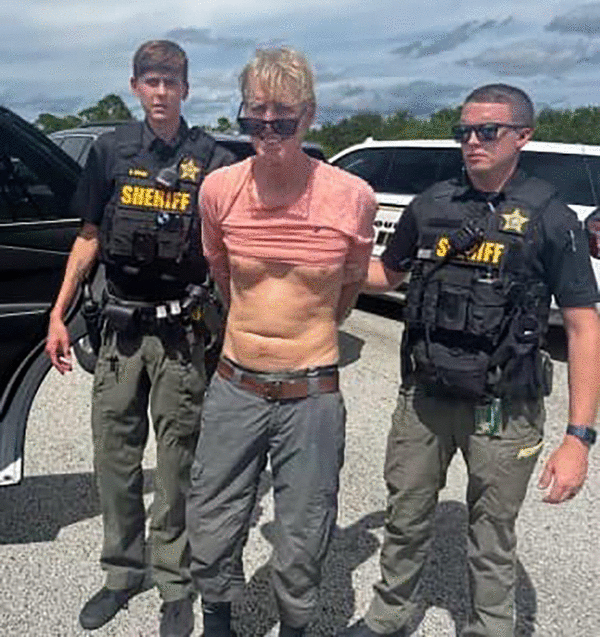
MIAMI — Ryan Wesley Routh, the man convicted of trying to kill Donald Trump as the Republican nominee for president was playing golf at his club in West Palm Beach, was sentenced to life in prison on Wednesday.
During his sentencing in Fort Pierce federal court, Routh generally listened and then read part of a 20-page statement that U.S. District Judge Aileen Cannon cut short before giving him the maximum life sentence for attempting to assassinate Trump in 2024. Cannon also sentenced him to a mandatory-minimum term of seven years for his conviction on possessing a firearm in furtherance of a crime of violence.
As he was escorted by deputy U.S. marshals out of the courtroom, Routh turned around and blew a kiss to the gallery of observers, which included his brother and sister. After the hearing, Routh’s defense attorney, Martin Roth, said he would be appealing the judge’s sentence.
Before she ruled on his punishment, Routh, 59, had asked the judge to give him less than life — despite being found guilty of attempting to assassinate Trump and four related charges at his trial last September. But federal prosecutors urged the judge to give him a maximum life sentence.
”Routh’s crimes undeniably warrant a life sentence — he took steps over the course of months to assassinate a major Presidential candidate, demonstrated the will to kill anybody in the way, and has since expressed neither regret nor remorse to his victims,” federal prosecutor John Shipley said in a court filing.
“The Constitution affords citizens many peaceful avenues to oppose or express strong dissent about a Presidential candidate — murder is not one of them.”
Routh, who represented himself at his trial in Fort Pierce federal court last September, got a court-appointed defense attorney for his sentencing before Cannon, whom Trump appointed during his first term as president. The new lawyer used Routh’s self-representation as an excuse for him to avoid a maximum life sentence and asked Cannon to impose a 27-year prison term. He described it as a “just punishment.”
Routh “recognizes that he was found guilty by the jury but asserts that the jury was misled by his inability to effectively confront witnesses, use exhibits or affirmatively introduce impeachment evidence designed to prove his lack of intent to cause injury to anyone,” Roth wrote in a court filing.
Routh “denies he acted with the intent to kill a presidential candidate,” his lawyer argued, disputing a finding by the federal probation office, which advises the judge on his sentencing.
During his two-week trial, Routh put on a meandering defense on charges of attempting to assassinate Trump at his West Palm Beach club in September 2024. The 12-person Fort Pierce federal jury took about two hours to convict him not only of the main charge but also four others: possessing a firearm in furtherance of a crime of violence; assaulting a federal officer; being a felon in possession of a firearm and ammunition; and possessing a firearm with an obliterated serial number.
At Wednesday’s hearing, Cannon imposed concurrent sentences of 20 years for assaulting a federal officer, 15 years for being a felon in possession of a firearm and ammunition, and five years for possessing a firearm with an obliterated serial number.
Routh, a North Carolina native, didn’t testify in his own defense at trial. After the jury announced its verdict, he tried to stab himself in the neck with a pen. Since his arrest, he has been held at a federal lock-up in Miami.
Routh, who had fired his federal public defender before trial, was perhaps doomed from the moment that prosecutors called the first of a few dozen witnesses: At the outset, a Secret Service agent testified that he came within 5 feet of the defendant as he aimed an assault rifle through a cyclone fence directly at him on the West Palm Beach golf course.
Agent Robert Fercano testified that he was doing a security sweep of the sixth hole at the Trump International Golf Club as the presidential candidate played there on Sept. 15, 2024, when he spotted Routh and the barrel of a rifle protruding through a bush-obscured fence.
Fercano said he was able to see Routh’s face through the foliage and identified him in court as the defendant. Fercano said he fired shots at Routh, causing him to flee and leave his assault rifle, bullet-proof plates and other evidence by the fence.
“The barrel of the rifle was pointed directly at my face,” Fercano testified.
But Routh, while cross-examining the agent, asked if he ever injured him in any way, trying to make the point in his questioning that he didn’t return fire with his SKS semiautomatic rifle. Later in the trial, after prosecutors rested their case and Routh put on a brief defense, he tried to portray himself as a peaceful, gentle person in his questioning of witnesses, including an old friend.
Routh, who rambled incoherently about subjects unrelated to his case during the trial, planned to call about two dozen witnesses, including Trump, according to court records. In a court filing, he described the president as an “insecure ego idiot — mad fool.” Trump did not appear as one of his witnesses, nor did many others.
Early on, Shipley, the prosecutor, told jurors Routh “obsessively followed the movements” of Trump in the months leading up to the attempt to end his life.
Shipley said Routh used the internet to monitor him on the campaign trail, in his private plane and at his Mar-a-Lago estate in Palm Beach — right up to the moment Routh set up a “sniper’s nest” at the Trump International Golf Course.
Security sweep on course
As the Republican candidate stood on the fifth-hole putting green, Fercano, the Secret Service agent, was riding a golf cart and noticed someone hiding behind a chain-link fence in the southeast corner of the course. He spotted the scope of a rifle sticking through the tree-lined enclosure.
Federal authorities said the man lurking behind the cyclone fence was Routh. He had traveled from North Carolina to South Florida with a semi-automatic rifle in mid-August of 2024 to carry out the attempted execution of the former president at Trump International Golf Club, according to the FBI.
Authorities said Routh set up his sniper’s nest along the fence on the southern end of the sixth hole as he waited to take a shot at Trump just a few hundred yards away. When the Secret Service agent fired four shots at him, Routh fled but left the weapon behind with his fingerprints on the electrical tape attached to the scope, according to the FBI.
A witness driving by the club saw Routh running across the road from the golf course and getting into a black Nissan Xterra. The witness, Tommy McGee, reported the information, along with a partial license plate number, to law enforcement. McGee testified for the government at Routh’s trial.
Routh was later stopped that same day while heading north on I-95 by Martin County sheriff’s deputies, in coordination with the Palm Beach County Sheriff’s Office.
Soon after Routh’s arrest amid widespread news coverage, a man in North Carolina contacted law enforcement stating that Routh had dropped off a box at his residence several months before the attempted assassination attempt, according to trial evidence. The box contained a smattering of items, including ammunition, building materials, four cellphones and handwritten letters.
The witness, Lazaro Plata, who had once worked with Routh, testified at his trial, verifying for jurors that the defendant had left the incriminating box with him before heading to West Palm Beach to target Trump.
One of the letters found in the box, which was addressed as “Dear World,” outlined Routh’s plans: “This was an assassination attempt on Donald Trump but I am so sorry I failed you. I tried my best and gave it all the gumption I could muster. It is up to you now to finish the job,” according to part of the letter filed in court.
In the letter, Routh offered a $150,000 reward “to whomever can complete the job.” Among the grievances outlined in the letter is that Trump, during his first term as president, “ended relations with Iran” and that, consequently, “the Middle East has unraveled.”
Routh has a criminal history dating back more than two decades. He was convicted in Greensboro, North Carolina, in 2002 for possessing an explosive device. He was convicted again in North Carolina in 2010 on multiple counts of possessing stolen goods, according to authorities.
Routh had most recently lived in Hawaii before his arrest in the attempted assassination case.
_____
©2026 Miami Herald. Visit miamiherald.com. Distributed by Tribune Content Agency, LLC.





Comments