Commentary: Why Bondi chose a Missouri prosecutor for a Georgia election case
Published in Political News
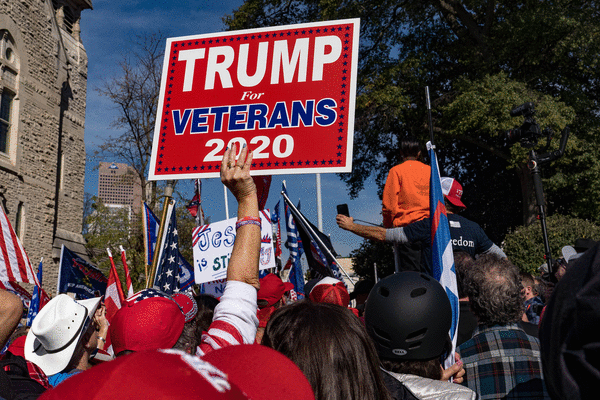
“I just want to find 11,780 votes, which is one more than we have. Because we won the state.”
That was President Donald Trump’s demand in a phone call to Georgia Secretary of State Brad Raffensperger after Joe Biden was declared the winner of the state in the 2020 election. Raffensperger, citing the results of numerous lawsuits and three rounds of vote counting, refused, making him one of the few Republican officials to publicly stand up to Trump’s false claims of election fraud.
Now, six years later, the Trump administration is sending one of its own to Georgia — where the president was once charged with election interference — in an apparent effort to find those phantom votes and retroactively validate Trump’s debunked claims. Even more troubling, the prosecutor — who has ties to Trump allies — received a special appointment from Attorney General Pam Bondi to investigate election fraud cases nationwide, according to Bloomberg Law.
When the FBI raided Fulton County’s main election office last week, St. Louis U.S. Attorney Thomas Albus was listed as the prosecutor who’d sought the warrant, not the U.S. attorney in Atlanta, who would ordinarily have jurisdiction. The appointment of Albus raises concerns not only about the potential for manufactured crimes but also about the risk of undermining the integrity of elections in 2026 and 2028.
The warrant suggests that federal prosecutors are now pursuing a theory that Trump was not the perpetrator of election fraud, but its victim. “People will soon be prosecuted for what they did,” Trump said recently.
Albus’ appointment bears resemblance to that of Lindsey Halligan, who was appointed U.S. attorney for the Eastern District of Virginia after the Trump-appointed interim U.S. attorney there was removed for refusing to indict James Comey and Letitia James. Halligan, a former insurance attorney who had been working in the White House, promptly filed indictments against the two, but both were ultimately dismissed after a court found Halligan’s appointment was invalid.
Unlike Halligan, Albus’ appointment appears to be lawful under a federal statute that permits the attorney general to direct “any other officer of the Department of Justice” to “conduct any kind of legal proceeding, civil or criminal ... whether or not he is a resident of the district in which the proceeding is brought.” But sidelining Atlanta U.S. Attorney Theodore Hertzberg in favor of Albus is concerning nonetheless — especially given his ties to Trump allies.
First, Albus previously served as the top deputy to former Missouri Attorney General Eric Schmitt and appears to have been working in that role when Schmitt joined a 2020 lawsuit brought by Texas Attorney General Ken Paxton to challenge the election results in Georgia, Michigan, Pennsylvania and Wisconsin.
The lawsuit, filed without evidence of fraud, was an audacious last-gasp attempt to overturn the results. Even Georgia’s Republican Attorney General Christopher Carr urged the Supreme Court to reject Texas’ request, joining other states in warning that the suit amounted to what Pennsylvania called an attempt to “overthrow the votes of the American people and choose the next president of the United States. That Faustian invitation must be firmly rejected.”
The Supreme Court dismissed the case, saying that Texas lacked standing to challenge elections in another state.
Albus’ career also moved in lockstep with that of fellow Missourian Ed Martin, the former interim U.S. attorney in Washington whose name was withdrawn when it became clear he lacked sufficient votes to win Senate confirmation. Martin, an election denier who represented some of the Jan. 6 defendants, now works as Trump’s pardon attorney and leads the DOJ’s “Weaponization” Working Group.
Martin and Albus both worked at the Bryan Cave law firm early in their careers, and Martin served as chair of the Missouri Republican Party, making it likely that the two are well acquainted.
While no one is guilty of impropriety by association, it is difficult to believe that Bondi would have appointed Albus without Martin’s input. Martin’s track record at the Justice Department has shown that he views his work through a political lens, as demonstrated by his social media post upon becoming pardon attorney: “No MAGA left behind.” It seems likely that Trump and Bondi would want another loyalist overseeing the election fraud investigation, and that Albus would be their choice.
Additional warning signs about the investigation include FBI Director Kash Patel’s recent firing of the head of the bureau’s Atlanta field office. While the reason for the termination has not been publicly disclosed, Patel has previously fired agents for participating in investigations involving Trump and individuals who participated in the Jan. 6 attack on the U.S. Capitol.
The special agent in charge of a field office would oversee any search conducted within their jurisdiction and would be positioned to push back against a search they perceived as improper. With the firing, Patel effectively cleared the way for the Fulton County search to proceed unopposed.
The Fulton County investigation also coincides with the DOJ’s lawsuit against several states, including Georgia, to obtain their voter rolls. Two courts have already ruled against the government, with an Oregon judge calling the Justice Department’s suit “a backdoor to grab” the personal information of Oregon voters. Is the Fulton County search warrant simply a way to obtain records to which the DOJ is not otherwise legally entitled?
Finally, an especially unusual twist to the raid of the election office was the appearance of Director of National Intelligence Tulsi Gabbard at the scene. It is difficult to conceive of any role for the DNI in the execution of a domestic criminal search warrant.
The role of the director of national intelligence is to coordinate intelligence collection across federal agencies and keep the president apprised of threats to national security. The only suggestion of any foreign role in the 2020 election was made by Trump lawyer Sidney Powell, who made wild and unsupported allegations that the Dominion and Smartmatic voting systems were created in Venezuela at the direction of the late Venezuelan President Hugo Chavez to ensure he never lost an election.
Are we about to hear a new conspiracy theory linked to Venezuela and Nicolás Maduro, whom the Trump administration accused, deposed and arrested on drug charges in January? With the prospect of a life sentence hanging over him, Maduro has every incentive to tell Trump what he wants to hear.
Elections in the U.S. are entrusted to each of the 50 states to administer. Officials like Raffensperger and Carr put their duty to the people of their state before their allegiance to their party. Can we trust Albus to do the same?
____
This column reflects the personal views of the author and does not necessarily reflect the opinion of the editorial board or Bloomberg LP and its owners.
Barbara McQuade is a professor at the University of Michigan Law school, a former U.S. attorney and author of "Attack from Within: How Disinformation Is Sabotaging America."
©2026 Bloomberg L.P. Visit bloomberg.com/opinion. Distributed by Tribune Content Agency, LLC.



















Comments