Venezuela has first chance for change in a decade, Rubio tells US Senate
Published in Political News
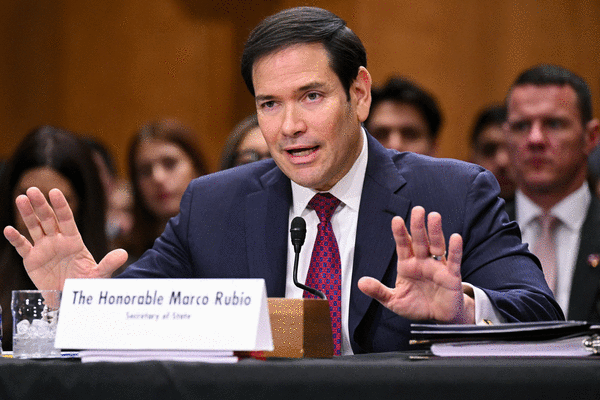
U.S. Secretary of State Marco Rubio said Tuesday that Venezuela has, for the first time in nearly a decade, a genuine opportunity for political change, marking a sharp shift from what he described as a long-frozen crisis under former strongman Nicolás Maduro.
“For the first time in literally a decade there is the opportunity that something could change,” Rubio said during a hearing before the Senate Foreign Relations Committee, cautioning that there is no guarantee of success but stressing that the underlying situation has shifted. “We have changed that dynamic.”
Rubio said that as recently as months ago — “eight months, a year ago at this time” — the Venezuelan challenge appeared locked in place, with the Maduro government firmly entrenched and the opposition dismantled through repression, exile and imprisonment.
“The opposition was either in hiding or had been forced overseas,” Rubio said, noting that opposition figure Edmundo González was in Spain and that Nobel Peace Prize laureate María Corina Machado, whom he described as “very brave,” ultimately had to leave the country after standing her ground as long as possible. Other opposition members, he said, remained jailed.
During that period, Rubio said, the Maduro government was deepening its ties with U.S. adversaries. “They were increasing their relationships and outreach with Iran, and of course we have the existing ones with Russia, Cuba and China,” he said.
Rubio contrasted Venezuela’s newly emerging opening with the situation in Cuba, which he described as economically broken and lacking any comparable prospect for change.
Rubio said Venezuela’s potential path forward will depend on “smart decisions” in Washington but, above all, on choices made by Venezuelans themselves, including current interim authorities and any future leadership.
A lasting transition, he said, would require broad political inclusion and internal reconciliation in a deeply divided society. The Venezuelan opposition, Rubio said, is not monolithic but includes former regime sympathizers who broke with the movement, as well as longtime opponents such as Machado.
He added that even Venezuelans who remain committed to Chavista ideology should be represented in a future democratic system.
“There’s a percentage of the Venezuelan population — whether it’s 15 or 20% — that may not have liked Maduro but are still committed to Chavista ideology,” Rubio said. “They’ll be represented in that platform as well. They may not win elections, but they’ll be involved. That’ll be up to the Venezuelan people.”
Rubio said Washington’s desired end state is a democratic Venezuela with legitimate elections and a pluralistic political system, even when electoral outcomes are not aligned with U.S. preferences.
“We want a Venezuela that has legitimate democratic elections,” he said, noting that democracies sometimes elect leaders critical of the United States, as in Colombia.
The broader goal, Rubio said, is a prosperous Venezuela aligned with the United States and no longer serving as a hub for hostile foreign powers.
“A year ago at this time, this was frozen,” he said. “Now we have a real opportunity not just to create change systemically within that country, through our help and their efforts, but also to ensure it is no longer a central base of operations for every geopolitical adversary we have — which is what Venezuela was under Maduro, and what we hope and intend to change.”
Rubio told lawmakers that the U.S. operation on Jan. 3 to arrest Nicolás Maduro constituted a law-enforcement action against an indicted drug trafficker, not a war or military occupation, and said Washington is prepared to oversee a closely monitored transition in Caracas.
Rubio said the operation, carried out with U.S. military support, resulted in the arrest of Maduro and his wife, Cilia Flores, both of whom face U.S. indictments. He credited President Donald Trump’s leadership and the professionalism of U.S. forces, emphasizing that no American troops remain on the ground in Venezuela and that no U.S. lives were lost.
“There is no war against Venezuela,” Rubio said, adding that the United States had “arrested two narcotraffickers who will now stand trial in the United States for the crimes they committed against our people.”
Rubio said Maduro was not a legitimate head of state, noting that more than 50 countries — including the United States, the European Union and most of Latin America — rejected the results of Venezuela’s disputed 2024 presidential election. He said Maduro refused to cede power after losing the vote and resorted to violence in defiance of Venezuelan law.
According to Rubio, Maduro and his allies transformed Venezuela into what he described as a “criminal state,” turning the country into a base for transnational narcotics trafficking linked to the Cartel de los Soles. He said drug proceeds were shared with Cuba, whose security forces helped shield Maduro from accountability.
Rubio accused the Maduro government of looting Venezuela’s energy sector and diverting oil revenues to support Havana while ordinary Venezuelans faced fuel shortages, hunger and economic collapse despite the country’s vast oil reserves.
He said the crisis displaced more than eight million Venezuelans — roughly a quarter of the population — creating what he described as the world’s largest mass migration crisis and destabilizing neighboring countries and the United States.
Rubio said Trump’s decision to authorize the operation has created conditions for Venezuelans to begin returning home and rebuilding their country, adding that Washington is prepared to assist Venezuela’s transition “from a criminal state to a responsible partner.”
Following Maduro’s removal, Vice President Delcy Rodríguez assumed leadership of Venezuela’s interim government. Rubio said Rodríguez has signaled a willingness to cooperate with Washington, including commitments to open Venezuela’s energy sector to U.S. companies, grant preferential access to production and use oil revenues to purchase American goods.
He said Rodríguez has also pledged to end Venezuela’s oil support to Cuba and pursue national reconciliation with Venezuelans inside the country and abroad. Rubio suggested her cooperation reflects an alignment of interests after witnessing Maduro’s fate.
“We will closely monitor the performance of the interim authorities as they cooperate with our stage-based plan to restore stability to Venezuela,” Rubio said.
He warned that the United States retains the option to use force if cooperation falters, echoing statements by Trump. “It is our hope that this will not prove necessary,” Rubio said, “but we will never shy away from our duty to the American people.”
Rubio framed the operation within a broader U.S. policy asserting primacy in the Western Hemisphere.
“The Western Hemisphere is our home,” he said. “Last month the president acted to uphold that principle in Venezuela, and we will continue to do so as required to keep the American people safe and secure.”
Rubio concluded his prepared remarks by inviting questions from senators, who pressed for details on the scope of U.S. oversight, the timeline for Venezuela’s political transition and safeguards surrounding renewed U.S. engagement with the country’s oil sector.
©2026 Miami Herald. Visit at miamiherald.com. Distributed by Tribune Content Agency, LLC.





Comments